
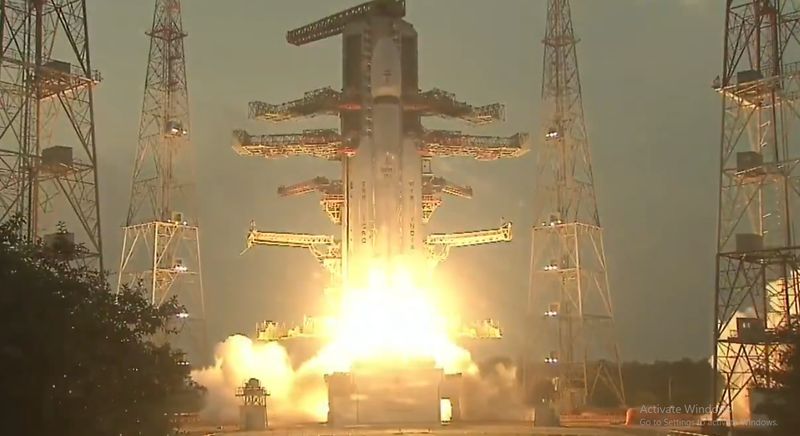
ISRO successfully launches 4,410 kg CMS-03 on LVM3-M5 rocket, marking a major milestone in India’s self-reliant space program.
Sriharikota: ISRO claimed on Sunday that the heaviest communication satellite ever launched from India was successfully deployed into the right orbit on board a new generation, homegrown “Bahubali” rocket.
The Indian space agency was able to do this remarkable thing thanks to the LVM3-M5 rocket, which carried the 4,410 kg communication satellite CMS-03. ISRO said that CMS-03 is a multi-band communication satellite that would cover a large area of ocean, including the Indian mainland.
The satellite was put in the right Geosynchronous Transfer Orbit (GTO).
It also takes the position of the GSAT 7 series, which was launched in 2013.
The launch vehicle successfully put the communication satellite into the right orbit, according to ISRO Chairman V Narayanan.
He said, “The 4410 kg satellite is precisely injected.” In his speech from the Mission Control Center after the launch, he called the LVM3 satellite “Bahubali,” which seems to be a reference to its ability to move big things.
He remembered that the last time the rocket was launched was for “the most prestigious Chandrayaan 3, which made the country proud.” It got “yet another pride” on Sunday after successfully launching the “heavier satellite.” There have been eight successful LVM 3 launches, including one for testing, which means that all of them have been successful.
Also read : Fake Notes Worth Rs 20 Lakh Seized in Khandwa Raid
Narayanan, who is also the Secretary of the Department of Space, said that the satellite was made to provide communication services for at least 15 years and is “yet another shining example of Atmanirbhar Bharat (self-reliant India).”
He claimed that the ISRO scientists had a hard time with the mission because the weather wasn’t good, but they worked hard and made sure it was a success.
Before the launch on Sunday, the Indian space agency had been using the Kourou launch pad in French Guiana to launch bigger satellites with Ariane rockets from Arianespace, which is based in France.
On December 5, 2018, ISRO sent the heaviest communication satellite, GSAT-11, into space. It weighed 5,854 kg and was sent into space on an Ariane-5 VA-246 rocket from French Guiana.
LVM3-M5 is a three-stage launch vehicle with two solid motor strap-ons (S200), a liquid propellant core stage (L110), and a cryogenic stage (C25). It lets ISRO launch bigger communication satellites that weigh up to 4,000 kg in GTO without needing help from anybody else.
Scientists at ISRO also call LVM3 the Geosynchronous Satellite Launch Vehicle (GSLV) MkIII.
Scientists at ISRO have put launch vehicles into groups based on things like the mission goals, the orbit they want to reach, the height, and more.
ISRO uses the Polar Satellite Launch Vehicle (PSLV), GSLV, and LVM3 (Launch Vehicle Mark-III) as launch vehicles or launchers. Since 1999, the space agency has been launching satellites for customers from Sriharikota.
Also read : IMD Forecasts Thunderstorms and Cooler Nights Till Nov 7
Scientists have relied on PSLV to get their work done because it is so reliable at completing missions. PSLV is a flexible launch vehicle that can carry cargoes of around 1,750 kg.
ISRO’s Small Satellite Launch Vehicle (SSLV) is used to put satellites weighing up to 500 kg into Low Earth Orbit at an altitude of roughly 500 km.
ISRO revealed that the GSLV with cryogenic upper stage can launch satellites that weigh about 2,200 kg. The LVM-3 rockets can deliver payloads that weigh more than 4,000 kg.
The LVM3 rocket is important for Sunday’s mission because it has successfully launched a heavier communication satellite from India. ISRO revealed that the LVM3-M5 is the fifth flight that is now in use.
The C25 cryogenic stage and the rest of the LVM3 vehicle were made using only Indian technology. ISRO added that it has a record of all successful launches, starting with the LVM-3 Crew module Atmospheric Re-entry Experiment (CARE) in December 2014.
ISRO announced that the human-rated LVM3 rocket, which is called HRLV, would be used to launch the ambitious Gaganyaan Mission.
The strong cryogenic stage of an LVM3 rocket can carry a payload of 4,000 kg to GTO and 8,000 kg to low Earth orbit. The two S200 solid rocket boosters on the flanks of the rocket provide it the thrust it needs to lift off. The Vikram Sarabhai Space Centre in Thiruvananthapuram makes the S200 boosters.
The third stage is the L110 Liquid Stage, which is powered by two Vikas engines that were designed and built by the Liquid Propulsion Systems Centre.
The LVM-3 rocket’s last mission was to launch the Chandrayaan-3 mission, which made India the first country to land successfully near the lunar South Pole in 2023. The satellite was 3841.4 kg heavy.