
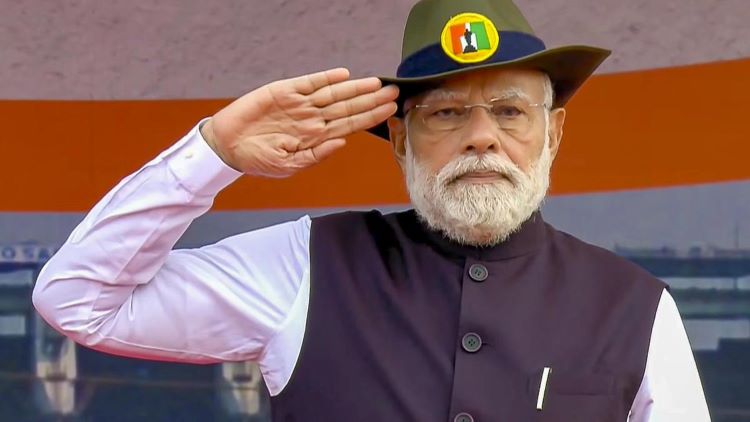
On Rashtriya Ekta Diwas, PM Modi said Sardar Patel aimed to integrate all of Kashmir into India but Nehru blocked it; parade showcases women-led contingents.
Prime Minister Narendra Modi stated that Sardar Patel had hoped to bring all of Kashmir into India, similar to his plans for other princely states, but that PM Nehru had prevented this from happening.
Speaking to the crowd during the Rashtriya Ekta Diwas procession in the vicinity of the Statue of Unity in Gujarat’s Ekta Nagar, Mr. Modi stated, “Sardar Patel advocated that we should work hard to create history rather than waste time writing it.”
Similar to his goals for other princely territories, Sardar Patel aimed to bring all of Kashmir together. However, his demand was not granted by Nehru ji. For decades, the country suffered as a result of the Congress’ error in dividing Kashmir, giving it its own Constitution and flag, Mr. Modi stated.
In the morning, PM Modi brought flower petals to the Iron Man of India at his 182-meter-tall statue, which is located close to Ekta Nagar in Gujarat’s Narmada area.
The prime minister claimed that Sardar Patel’s ideas and choices made history.
Sardar Patel made the unachievable goal of bringing together over 550 princely republics after independence attainable. He placed a high priority on the concept of “One India, Excellent India,” Mr. Modi stated.
Serving the country was Sardar Patel’s greatest source of happiness, he once said. I wish to communicate to our nation’s citizens that serving the country is the only way to truly be happy,” he stated.
Also read : Indian Oil to Partner with Vitol for Global Fuel Trading
Police and paramilitary contingents participated in the National Unity Day parade, which Mr. Modi reviewed prior to his speech.
All the contingents, including the police contingents from Jammu & Kashmir, Punjab, Assam, Tripura, Odisha, Chhattisgarh, Kerala, Andhra Pradesh, Maharashtra, and Madhya Pradesh, as well as paramilitary units like the BSF, CISF, ITBP, CRPF, and SSB, were commanded by female officers.
The National Cadet Corps (NCC) also has a contingent that takes part in the parade.
A prominent feature of this year’s festivities was the military’s “Republic Day-style” march, which included ornamental tableaux.
The parade’s theme, “Unity in Diversity,” was represented by ten floats from the National Security Guard (NSG), the National Disaster Response Force (NDRF), Gujarat, Jammu & Kashmir, the Andaman and Nicobar Islands, Manipur, Maharashtra, Chhattisgarh, Uttarakhand, and Puducherry.
900 artists performed in a cultural program along the parade route, showcasing India’s traditional dances, which illustrate the complexity and depth of Indian culture.
Also read : PM Modi Launches ₹2.2 Lakh Crore Projects for Indian Shipping
Contingents of police and paramilitary troops, all commanded by female officers, ceremoniously saluted PM Modi in a demonstration of women’s empowerment in the security services.
Assam Police’s motorbike daredevil display, Gujarat Police’s horse contingent, the BSF marching group made up entirely of Indian breed dogs like Rampur Hounds, and the BSF camel contingent and camel-mounted band were among the parade’s main attractions this year.
In addition, the parade honored 16 BSF gallantry medal winners and five CRPF Shaurya Chakra awardees for their valor in counterterrorism operations in Jammu and Kashmir and anti-Naxal operations in Jharkhand.
Operation Surya Kiran was the name of the fly-past that the Indian Air Force performed.