
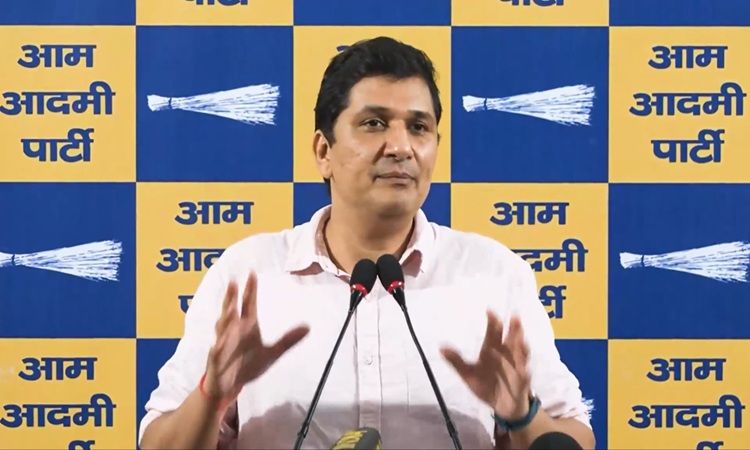
AAP’s Saurabh Bhardwaj Alleges Data Tampering on Diwali Night
The Aam Aadmi Party (AAP) has accused four government agencies of manipulating Delhi’s pollution data on Diwali night. AAP’s Delhi President Saurabh Bhardwaj claimed the agencies colluded to alter Air Quality Index (AQI) readings, calling it a “criminal act.”
Bhardwaj’s accusation came after reports emerged that the Nehru Nagar air quality monitoring station had recorded an unusually high AQI of 1763 before being abruptly shut down. “They are corrupt and criminals. What they have done is a criminal act,” Bhardwaj said in a statement on Wednesday.
CPCP Data – Rohini Station
Data चोर- गद्दी छोड़
दिवाली की रात 10 बजे प्रदूषण पहुँचा 1079, फिर Data ग़ायब pic.twitter.com/Jdvx6iysjw
— Saurabh Bharadwaj (@Saurabh_MLAgk) October 21, 2025
He further added, “Four different government agencies worked together to collect Delhi’s pollution data on the night of Diwali. They are playing with people’s health.”
The claim has triggered a new controversy in the ongoing debate over Delhi’s worsening air quality and the political blame game that surrounds it every winter.
भाजपा के मंत्री की प्रेस वार्ता में उनसे CPCB और DPCC द्वारा पोल्युशन के डाटा को छुपाने के बारे में पूछा तो जवाब गोल मोल था
पंजाब सिख किसानों के बारे में कह सकता हूँ कि वो दिवाली को बदनाम करने के लिए कभी षड्यंत्र नहीं करेंगे, उनपर आरोप लगाना शर्मनाक हैं
सिक्ख़ गुरुओं ने तो… pic.twitter.com/ABakvdmZYl
— Saurabh Bharadwaj (@Saurabh_MLAgk) October 21, 2025
Government Counters Allegations, Calls AAP’s Charge Political
Soon after Bhardwaj’s remarks, Delhi Environment Minister Manjinder Singh Sirsa dismissed the allegations, accusing the AAP of communalising the pollution issue. Sirsa said that the ruling party was unfairly blaming Diwali, Hindus, and Sanatanis for the capital’s pollution to serve its “vote bank politics.”
“It’s not the crackers. The Aam Aadmi Party is putting all its efforts into proving that the pollution in Delhi is due to Diwali,” Sirsa said in an interview with national media. “They have a particular vote bank to please and are trying to ban Diwali by saying that lighting lamps and bursting firecrackers creates smoke,” he added.
Sirsa backed his counterclaim with comparative air quality data from the Delhi Pollution Control Committee (DPCC) and the Central Pollution Control Board (CPCB).
According to official data, the AQI on Diwali eve stood at 345, significantly lower than the 414 recorded in 2020 and 382 in 2021. After the use of firecrackers, the AQI rose marginally to 356, an increase of only 11 points.
Sirsa: ‘Blaming Diwali Alone for Pollution Is Misleading’
To further support his argument, Sirsa highlighted AQI patterns from previous years when firecracker bans were imposed. “Last year, despite a ban, the AQI rose from 328 to 360, an increase of 32 points. In 2023, it jumped from 218 to 301, an 83-point rise,” he explained.
He argued that attributing the rise in pollution solely to Diwali firecrackers is misleading. “There may have been some impact, but what the Aam Aadmi Party is suggesting — that Diwali, Hindus, and Sanatanis are responsible for Delhi’s pollution — is a sin,” Sirsa said.
The minister accused AAP of using the pollution issue as a political weapon to appeal to a particular section of voters. “They want to ban our traditions by saying smoke from diyas and crackers causes pollution,” he added.
The political exchange reflects the deepening rift between Delhi’s governing and opposition leaders over the real causes of air pollution — a problem that worsens each year due to factors like stubble burning, industrial emissions, and vehicle exhaust.
Delhi’s AQI Remains in ‘Very Poor’ Category Post-Diwali
According to the Central Pollution Control Board (CPCB), Delhi’s overall AQI stood at 351 by 4 p.m. on Tuesday, a day after Diwali. Localized readings showed 343 at Lodhi Road, 274 at Sirifort, 282 in Greater Noida, and 324 in Ghaziabad.
For context, the CPCB classifies AQI levels as follows:
- 0–50: Good
- 51–100: Satisfactory
- 101–200: Moderate
- 201–300: Poor
- 301–400: Very Poor
- 401–500: Severe
These readings place Delhi in the ‘very poor’ category, typical for the city during the post-Diwali period.
Sirsa emphasized that the data from CPCB and DPCC is public and updated in real-time, dismissing AAP’s claim of manipulation. “Every minute’s data is available online. They thought AQI would shoot up, and they would create a ruckus. But when it didn’t, they said the data was fake,” he remarked.
Political Reactions and Ongoing Blame Game
The controversy has reignited Delhi’s annual debate on air quality and accountability. While AAP insists that data tampering is being used to downplay pollution levels, Sirsa maintains that systemic factors like stubble burning in Punjab and Haryana play a much larger role.
“It’s dishonest to solely blame firecrackers for pollution,” Sirsa said. “Yes, they may have some effect, but the opposition is focused on targeting Diwali and Sanatanis.”
In a sarcastic remark, Sirsa added, “In front of Kejriwal and his team’s lies, we fold our hands. We admit we cannot match their propaganda.”
As Delhi continues to battle hazardous air, experts urge political leaders to focus on coordinated policy measures instead of exchanging accusations. Until then, residents of the capital remain the ultimate victims of the toxic post-Diwali smog.