
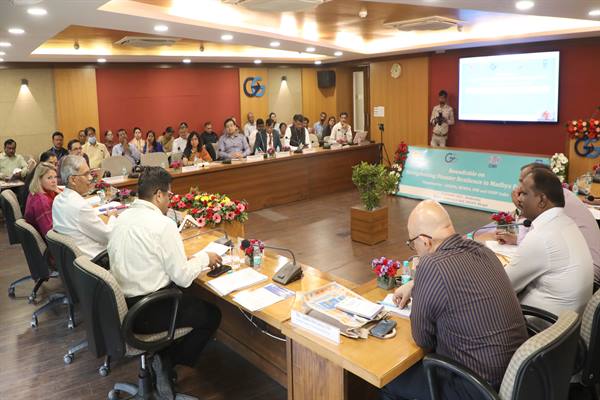
MP Chief Secretary Anurag Jain stresses proactive disaster management. Seminar pushes for Disaster-Resilient infrastructure and Mission Life lifestyle changes.
Chief Secretary Shri Anurag Jain said that it is very important to build development models strong and long-lasting because climate change is having more and more of an effect. He said that to reduce the number of deaths and property damage caused by disasters, it is important to take action before they happen. The state administration wants to build infrastructure that can withstand disasters so that life and work can carry on even when things are tough.
The Atal Bihari Vajpayee Institute of Good Governance and Policy Analysis, the Madhya Pradesh State Policy Commission, UNDP India, and the Disaster Management Institute in Bhopal all worked together to put on a seminar on “Strengthening Disaster Resilience” at the state level on Wednesday.
CS Shri Jain said that “Mission Life” isn’t just a campaign; it’s an effort to improve people’s lives for good. He stressed that everyone, from people to businesses, ought to be more ecologically friendly. He also stressed the need of urban planning that stops catastrophes from happening instead of producing new ones. He asked all departments and local governments to include climate and disaster risks in their policy and project planning.
Also read: CM Mohan Yadav Mourns the Passing of Sant Sain Chanduram
Sushri Isabel Chan, a representative from UNDP India, said that the 15th Finance Commission has given states money to help them deal with disasters, which will make local institutions stronger. She stressed the importance of using new ways to raise money, building up institutions, and involving the community in crisis management.
Smt. Pragya Richa Srivastava, Director General of Home Guard and Disaster Management, said that the Home Department is always working to make Madhya Pradesh more resilient. She said that the state is moving away from a reactive strategy and toward a proactive and preparedness-based structure. She said that the Home Guard’s job in crisis management is growing beyond only helping people to include training, raising public awareness, and building capacity.
Dr. K. Ravichandran (Director of the Indian Institute of Forest Management), Shri Mayank Agrawal (Department of Public Health & Medical Education), Shri Johnny Asin (Nagaland State Disaster Management Authority), Shri Manish Mohandas (UNDP India), Shri Ashish Bhargava (Disaster Management Institute, Bhopal), and Shri Mangesh Patankar (Regional Head, Munich RE) also gave talks at the seminar. Speakers stressed how important it is to use data to make decisions, identify risks, get the community involved, and come up with new ways to solve problems in disaster management.
Also read: Youth Informed About Investment and Export Prospects for Startups and MSME
Shri Rishi Garg, the director of AIGGPA, said that there is a plan to set up a Disaster Risk Management Center at the Atal Bihari Vajpayee Institute of Good Governance and Policy Analysis. Through policy analysis, training, and research, this institute will help the state build an integrated disaster management system. He stressed that the institute is taking real initiatives to make Madhya Pradesh a “Disaster-Resilient State” by 2047.
A lot of senior state officials, experts from the insurance industry, academic institutions, development partners, and policy specialists came to the seminar. Everyone who took part agreed that disaster management should be a crucial aspect of development policy to make sure Madhya Pradesh becomes a state that can last and be strong.