
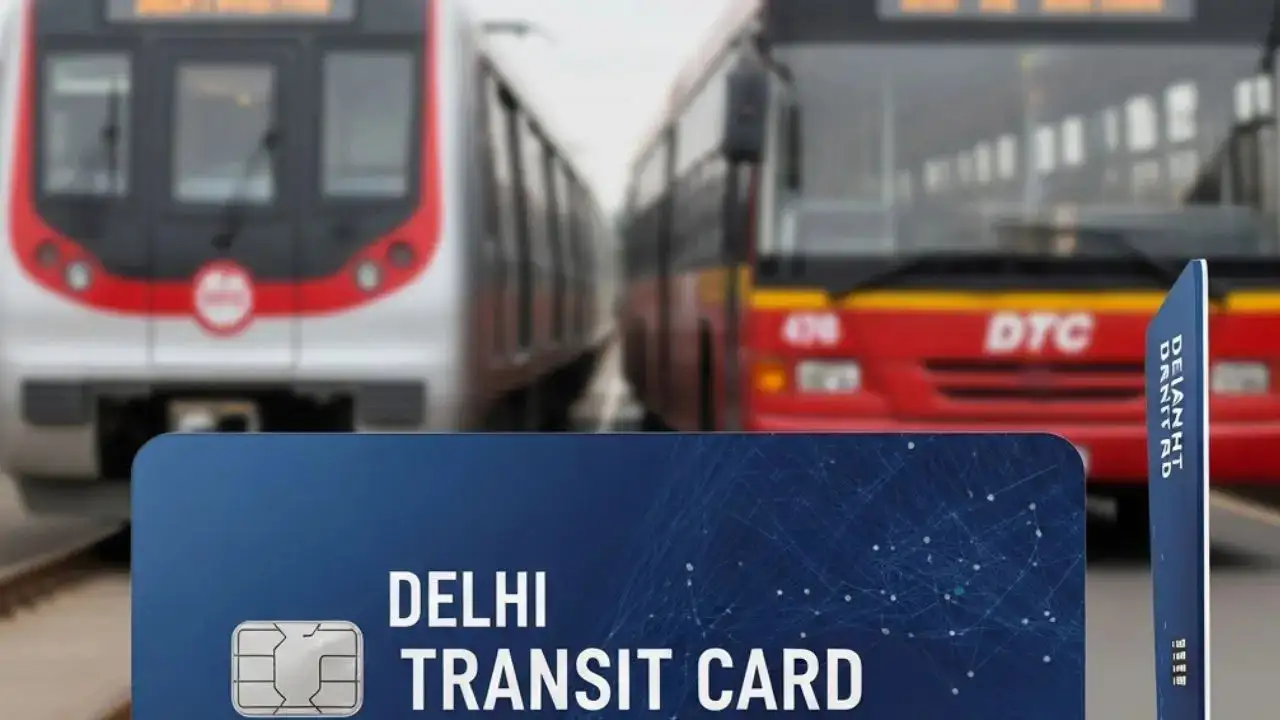
The program aims to ease travel in Delhi by letting commuters use a single card for buses, metro, and other public transport instead of multiple tickets.
New Delhi: The city government plans to implement a single smart card that can be used on various public transportation systems, making it easier to travel throughout Delhi. The National Common Mobility Card (NCMC), as it is called, will shortly be introduced in the capital.
The program’s goal is to give commuters a smooth journey. For buses, metro, and other public transportation services in Delhi, customers will only need to carry one card rather than several tickets or passes.
Contactless and prepaid, the NCMC functions as a card. Travelers are able to tap and go in Delhi as well as other places where the technology is already operational.
In order to provide nationalized banks with color-coded smart cards that can be used to travel in all of Delhi’s public transportation systems, the Delhi Transport Corporation (DTC) has requested proposals for empanelment.
An official stated that the card will be colored in three different ways: pink for women and transgender people, blue for everyone, and orange for commuters in the general and concessional categories.
Bus travel is free with the pink card, and other public transportation such as DMRC, RRTS, and others can be paid for with the same card. Only legitimate inhabitants of Delhi will receive the card.
In order to receive the digital card, candidates must be legitimate Delhi residents who are at least 12 years old and have a legitimate proof of address.
Commuters can obtain the NCMC via branches or other service channels from the banks of their choice. These cards will be issued immediately at specified service locations by the chosen bidders.
“During travel in a bus, the commuter shall specify the destination of travel to the conductor who will then use the Electronic Ticketing Machine (ETM) to punch in the necessary details (destination code, commuter category, no. of tickets, etc.) and generate the e-ticket through the ETM printer,” the official said.
The ETM machine will validate the contactless NCMC card when commuters tap it, and if necessary, it will subtract the fare amount for the route from the card, he continued.
The ETM gadget will write the final amount back onto the card. A secure communication channel will be used to send ticket and fare transactional data from the ETM to Automatic Fare Collection System (AFCS) back-end servers via GPRS at a predetermined frequency, according to the official.
He stated that the clearing house would settle the payment balances between the issuing and acquirer banks on a daily basis and that the ETM/AFC system would proceed to transmit the transaction data to the acquirer bank. The commuter can load or recharge the card via internet banking, pay at point-of-sale outlets, or use other payment methods that the issuing bank offers.
Smart Card Validation, E-Ticket Enforcement, and Revenue Reconciliation in Delhi Buses
Upon completion of the trip, the crew would deposit the cash and digital funds collected against the issued tickets at the appropriate depots, he added.
Using revenue reports, the depot manager will compare the amount collected from the crew with the information received at the back-end server and update the trip closure report’s status appropriately.
“An inspector might check the authenticity of the smart card and e-ticket using his ETM to stop any misconduct. The commuter may be penalized, fined appropriately, and given a system-generated receipt if the e-ticket or card is determined to be invalid, he said.
Based on the DTC and cluster bus ridership data for the last six months, from January to June of this year, the average daily ridership, excluding monthly pass commuters, has been estimated at 14.25 lakh for male passengers and 14.79 lakh for female passengers.
Monthly passes are currently being granted by the DTC in a number of categories; for the fiscal year 2024, roughly 3.5 lakh concessional category passes and 7.3 lakh general category passes were distributed.