
Highway Blockage Leaves Trucks Stranded
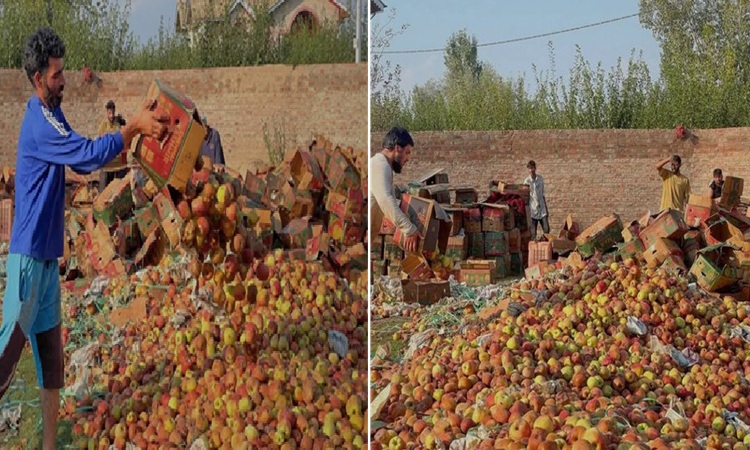
Srinagar — Thousands of tonnes of apples are rotting in stranded trucks along the Srinagar-Jammu National Highway as the key road link remains closed for 20 days. Farmers across Kashmir, already hit by erratic weather, are now facing devastating losses due to the prolonged disruption.
Visuals of rotting apples being dumped near the highway have gone viral on social media. These images reflect not only the wasted produce but also the despair of farmers who rely on horticulture as their primary livelihood.
About 80 percent of India’s apple production comes from Kashmir. The closure of the Srinagar-Jammu highway has crippled the supply chain, leaving growers unable to move their harvest to mandis across the country.
Farmers’ Protests and Mandis Shut
In response, apple growers have taken to the streets in protest. For the past two days, major mandis in Kashmir have remained closed. Farmers accuse the government of failing to anticipate and act on the crisis.
“We work all year in our orchards. Now our apples are rotting on the roads. This is our only source of income,” said one protesting farmer. Many growers demanded that the highway be handed over to the Army, expressing faith in its ability to restore the route quickly.
Another farmer remarked, “The government failed to restore the road. When floods struck, the Army built a bailey bridge within hours. We trust them.”
Omar Abdullah Slams Government Response
Former Chief Minister Omar Abdullah has strongly criticized the delay. He blamed both state and central authorities for failing to reopen the vital link despite repeated appeals.
“This highway has been closed for 20 days. The government has failed to act. If the Centre cannot restore it, hand it over to the J&K government,” Abdullah said.
He confirmed speaking with Union Transport Minister Nitin Gadkari, who assured that steps would be taken within 24 hours. However, many in the Valley remain skeptical, pointing to repeated unfulfilled promises in past crises.
Highway Damage Exposes Fragile Infrastructure
The Srinagar-Jammu National Highway, considered the lifeline of Kashmir, suffered extensive damage after heavy rains and cloudbursts last month. A 300-meter stretch near Thared was washed away, while avalanches and landslides struck areas between Udhampur and Chenani, and Nashri and Banihal.
Despite billions spent on upgrading the highway into a four-lane all-weather road, recent rains revealed its vulnerability. Experts argue that widening works were carried out without proper risk assessment in a geologically fragile region.
“Thousands of crores were spent, but basic disaster management planning was ignored. The result is visible today,” said a local analyst.
Army Steps In with Rail Supplies
The highway closure has also disrupted movement of Army convoys. To meet logistical needs, the Army requisitioned a freight train that delivered winter supplies to the Valley. On its return, the train carried apples from Kashmir to Delhi.
While this helped a fraction of farmers, it is far from a sustainable solution. With thousands of trucks stranded, the alternative is seen as “too little, too late” for growers watching their produce decay.
Livelihoods at Risk
Horticulture is the backbone of Kashmir’s rural economy. Farmers invest heavily throughout the year, from pruning to spraying to harvesting. A good apple crop sustains entire families.
This year, adverse weather had already reduced yields. The highway blockade has now pushed many farmers to the brink of financial collapse. “We have loans to repay. If apples don’t reach the market, how will we survive?” asked a grower from Shopian.
Prolonged closures could impact not only farmers but also traders, transporters, and workers dependent on the apple trade.
The Road Ahead
As pressure mounts, the government faces calls for urgent action. Farmers want immediate restoration of road connectivity and compensation for losses. Experts suggest diversifying transport routes, including better use of the railway network, to prevent such crises in the future.
For now, Kashmir’s apple growers continue to count their losses, with their produce decaying in stranded trucks. The crisis underscores the fragility of both infrastructure and livelihoods in a region where agriculture is the lifeline of millions.