
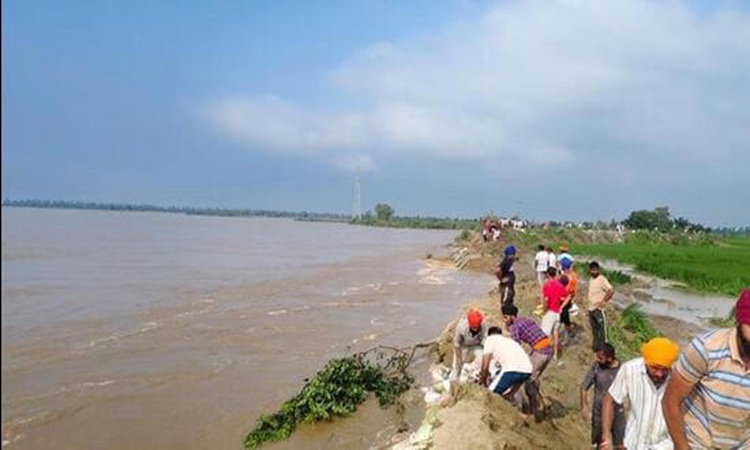
Beas River Breach Puts Kapurthala on Alert
Kapurthala, Punjab – The Beas River continued to cause widespread damage in Kapurthala district after an 8-kilometre-long advance embankment, built by farmers to protect farmland, developed cracks on Sunday.
The embankment was constructed by villagers of Kharijpur following the 2023 floods. It was intended to safeguard nearly 5,000 acres of fertile land. For the past 55 days, villagers had been monitoring the structure round-the-clock. However, the river, now flowing at 1.67 lakh cusecs, has shifted its course, putting extreme pressure on the dhussi bundh — the district’s main flood defence.
The breach has raised fears of devastation in several areas, with officials warning that both crops and residential zones could face serious flooding.
Punjab Faces Worst Floods in Four Decades
Punjab is experiencing its most severe flooding in nearly 40 years. Swollen rivers, including the Sutlej, Beas, and Ravi, have overflowed after heavy rainfall in their catchment areas across Himachal Pradesh and Jammu & Kashmir.
So far, at least 51 people have lost their lives in rain-related incidents during this monsoon season. Authorities fear that the toll could rise if embankments continue to weaken.
Large stretches of farmland in Mangupur, Nurowal, Sujokalia, Talwandi Chaudriyan, Baja, Amritpur, Safdarpur, Patti Safdarpur, Hussain Pur Dulowal, and Burewal are now under threat. Villagers report that cracks have already appeared at several points along the embankment.
Farmers Say Authorities Ignored Repeated Requests
Farmers allege that they have been left to fend for themselves despite repeated requests for government assistance.
Villagers claimed they raised nearly ₹20 lakh collectively to build the bundh, spending around ₹14 lakh on diesel alone. They added that stone-studding — critical reinforcement to prevent erosion — was never provided despite multiple appeals to the district administration.
Nurowal sarpanch Hukam Singh expressed concern over the shifting river course. “Not only crops but also homes in Baja, Safdarpur, and Amritpur will be hit if the bundh breaks. Two government schools in the area could also face flooding,” he warned.
Political Leaders Step In as Crisis Deepens
Sultanpur Lodhi MLA Rana Inder Partap Singh, who had earlier provided earthmoving machines to assist with the embankment’s construction, appealed to residents to gather for urgent reinforcement efforts.
“We managed to control the situation overnight. If given another 12 to 14 hours, villagers can strengthen the bundh to withstand the river’s force for a few more days,” the MLA said.
Rajya Sabha MP Balbir Singh Seechewal also visited the affected areas and reported severe damage in Baupur Mand. “The river has changed course, and houses are collapsing under strong currents. Large cracks have appeared in the walls, forcing families to evacuate,” he said.
Thousands of Acres Still at Risk
With heavy rainfall forecast to continue, villagers and local leaders fear the situation may worsen. The Beas River remains in spate, increasing the risk of breaches in vulnerable areas.
Residents say their primary concern is saving farmland, which supports thousands of families in the region. However, as cracks widen and bundhs weaken, attention is also turning to residential zones, where evacuations could become necessary.
Flood-hit families are demanding immediate intervention from the Punjab government and the central authorities to prevent large-scale destruction. Relief measures, including food supplies, temporary shelters, and medical assistance, are also being requested as the crisis unfolds.
Outlook
The coming days will be crucial for Kapurthala and surrounding districts. Villagers are working tirelessly to strengthen bundhs, but without urgent official reinforcement, thousands of acres of farmland and dozens of villages remain at the mercy of the Beas.
The disaster highlights the vulnerability of Punjab’s riverine districts to extreme weather events. As climate change intensifies rainfall patterns, experts warn that such breaches could become more frequent unless long-term flood management strategies are adopted.