
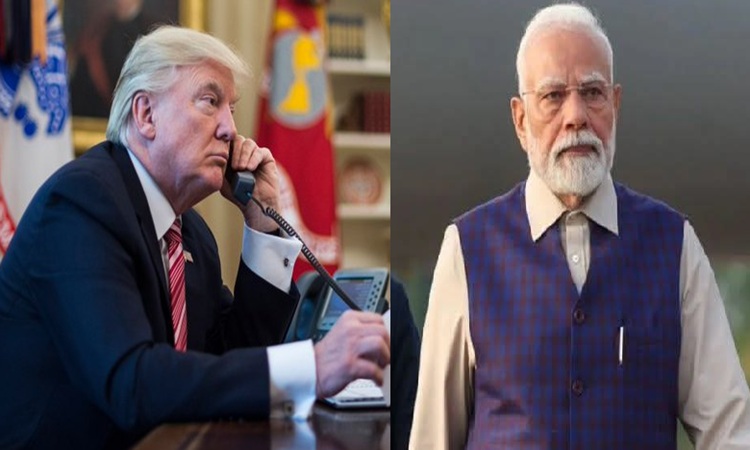
Modi’s Refusal Deepens Strain in India-US Ties
A recent report by The New York Times has revealed fresh insights into the strained relationship between Indian Prime Minister Narendra Modi and US President Donald Trump. According to the publication, a phone call between the two leaders on June 17 played a decisive role in worsening ties.
During the call, Trump reportedly sought Modi’s support for his Nobel Peace Prize nomination. He argued that his intervention had ended hostilities between India and Pakistan earlier this year. However, Modi dismissed the claim and reiterated that the ceasefire agreement had been a direct outcome of talks between New Delhi and Islamabad, without any US involvement.
The exchange, according to the report, left Trump upset and contributed to mounting friction between the two nations. Weeks later, the United States announced 25 percent reciprocal tariffs on Indian goods and added another 25 percent penalty linked to India’s purchase of discounted Russian oil, pushing the total tariff rate to 50 percent.
Trump’s Nobel Ambition and Modi’s Stand
The NYT report, written by journalists Mujib Mashal, Tyler Pager, and Anupreeta Das, cites more than a dozen officials in Washington and New Delhi who spoke on condition of anonymity. It states that Trump stressed how “proud” he was of what he saw as his role in de-escalating the military standoff between India and Pakistan.
He also told Modi that Pakistan was considering nominating him for the Nobel Peace Prize — an honour Trump had long pursued. Modi, however, refused to endorse this narrative. He maintained that India’s security decisions were sovereign and not influenced by outside intervention.
Indian officials quoted in the report said that Trump “cared very little” about the complexity of India-Pakistan relations. Modi’s refusal to align with Trump’s narrative, they added, led to frustration at the White House.
Trade Disputes and Diplomatic Fallout
The fallout from the June 17 call extended beyond political discomfort. By July, the US had imposed steep tariffs on Indian goods, with Washington linking the move to New Delhi’s energy ties with Moscow.
The tariff escalation was viewed in India as one of the harshest trade measures taken by Washington against a partner nation. Analysts suggest that Modi’s rejection of Trump’s Nobel pursuit may have aggravated existing tensions, making negotiations over tariffs even more contentious.
According to the report, Trump also extended an invitation for Modi to visit Washington after the G7 Summit in Canada. Modi declined, citing concerns that Trump might attempt to orchestrate a public handshake between him and Pakistan’s Army Chief, General Asim Munir. Indian officials feared such a spectacle would be politically damaging at home.
Silence Between Leaders
Since that pivotal phone call, Modi and Trump have not spoken directly. While there were discussions about arranging another call to finalise a partial trade deal, Indian officials were wary. They feared Trump might disclose or misrepresent sensitive details on Truth Social, his personal platform.
The NYT report mentions that Trump tried reaching out to Modi several times. However, Modi did not respond. A White House spokesperson, however, denied these claims.
The rift also has diplomatic consequences. Trump is now expected to skip the Quad Summit in India later this year, a gathering seen as crucial for regional security cooperation. The absence of the US President would likely raise questions about Washington’s commitment to the grouping.
A Fragile Chapter in Bilateral Relations
The revelations add to the perception that India-US relations are navigating a fragile phase. While trade, defense, and technology cooperation remain strong pillars, personal mistrust between leaders has complicated high-level diplomacy.
Experts note that while India values its strategic partnership with Washington, New Delhi is unlikely to compromise on its independent foreign policy. Modi’s firm stance on the Nobel episode highlights India’s resistance to being drawn into politically sensitive narratives, especially those involving Pakistan.
Going forward, much will depend on whether the two countries can rebuild trust through institutional engagement, even as the leadership gap continues.