
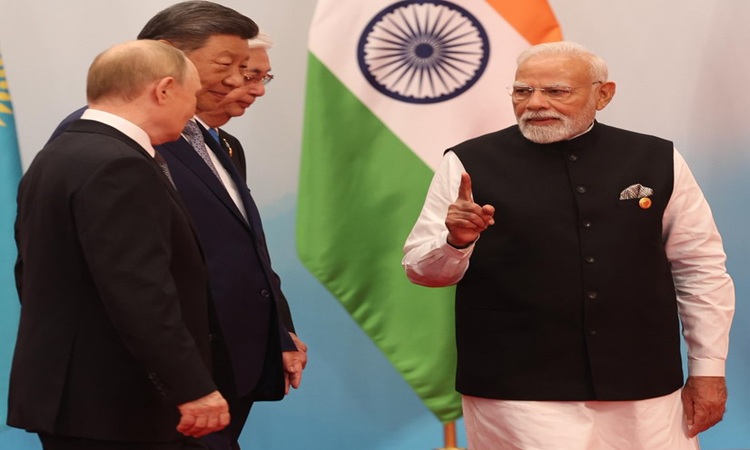
Modi’s Remarks at SCO Summit
At the Shanghai Cooperation Council (SCO) summit in Tianjin, Prime Minister Narendra Modi delivered a sharp message on regional connectivity and sovereignty. Without directly naming China, Modi took a veiled swipe at Beijing’s flagship Belt and Road Initiative (BRI).
“Connectivity initiatives must be based on trust, transparency, and respect for national sovereignty,” Modi said. His comments were widely interpreted as a reference to China’s global infrastructure project, which India has long opposed.
The BRI, launched in 2013, spans Asia, Africa, and Europe. It aims to enhance trade links through large-scale infrastructure, including railways, highways, and ports. However, one of its most contentious projects — the China-Pakistan Economic Corridor (CPEC) — runs through Pakistan-occupied Kashmir (PoK), which India claims as its own territory.
India’s Stand on the Belt and Road Initiative
India has consistently refused to endorse the BRI, citing sovereignty and security concerns. New Delhi argues that projects like CPEC undermine its territorial integrity by bypassing India’s consent.
Moreover, Indian policymakers view the BRI as a strategic tool for expanding China’s geopolitical influence. Analysts point out that many participating countries have been drawn into debt dependency due to Chinese financing.
Modi’s remarks at the SCO summit highlighted India’s alternative vision for regional development. According to him, connectivity projects should foster mutual trust, create opportunities, and avoid imposing political or financial burdens on partner countries.
This emphasis reflects New Delhi’s cautious approach. While India supports greater trade and cooperation within Asia, it has made clear that such initiatives must not compromise national sovereignty or regional stability.
Regional Implications of Modi’s Statement
Modi’s comments at the SCO summit come at a time of rising tensions in India-China relations. The two countries remain locked in a prolonged border standoff in Eastern Ladakh. Against this backdrop, India’s opposition to the BRI takes on broader strategic importance.
Several SCO members, including Russia and Central Asian states, are participants in BRI-linked projects. By raising sovereignty concerns, India positioned itself as a voice of caution within the grouping.
Additionally, India’s remarks align with growing global skepticism about BRI projects. Countries such as Sri Lanka, Kenya, and Montenegro have struggled with debt distress tied to Chinese loans. Modi’s speech signals India’s readiness to champion a more sustainable model of development that avoids these pitfalls.
Observers note that India’s stance also resonates with its partners in the Quad alliance — the US, Japan, and Australia. All four countries have voiced concerns about the strategic and economic risks of the BRI. Modi’s statement at the SCO summit reinforces India’s role in shaping alternative connectivity frameworks.
Sovereignty and Strategic Security
At the heart of India’s objection is the principle of sovereignty. By running the China-Pakistan Economic Corridor through Pakistan-occupied Kashmir, Beijing has challenged India’s territorial claims. For New Delhi, endorsing the BRI would amount to legitimising Pakistan’s control over disputed territory.
Beyond sovereignty, security considerations also shape India’s resistance. Analysts argue that BRI projects often involve dual-use infrastructure, such as ports that can be used for both commercial and military purposes. This raises concerns about China’s growing naval presence in the Indian Ocean Region.
By linking sovereignty to credibility and trust, Modi underscored India’s broader geopolitical concerns. His remarks sought to remind SCO members that sustainable development cannot be achieved by overlooking territorial disputes.
Looking Ahead
India’s message at the SCO summit reinforces its long-standing position on the BRI. While New Delhi remains committed to regional integration, it insists that connectivity cannot come at the cost of sovereignty.
As the debate over global infrastructure expands, Modi’s call for trust and transparency could shape future discussions. With multiple countries reconsidering their commitments to the BRI, India is likely to push for inclusive, rules-based frameworks that balance economic growth with national security.
The SCO summit highlighted the deepening divide between China’s grand vision and India’s strategic caution. Whether this difference will complicate cooperation within the grouping remains to be seen. For now, Modi’s remarks send a clear message: India will not compromise on sovereignty, even in the face of sweeping global initiatives.