
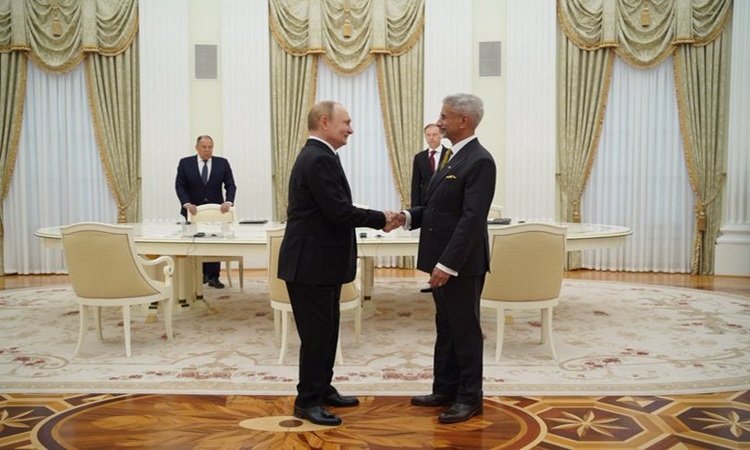
Jaishankar Meets Putin to Strengthen India-Russia Partnership
MOSCOW : External Affairs Minister S. Jaishankar met Russian President Vladimir Putin in Moscow on Thursday. The meeting underscored India’s push to expand trade with Russia despite growing Western pressure. The discussions came hours after Jaishankar held talks with Russian Foreign Minister Sergey Lavrov, focusing on economic cooperation, energy security, and geopolitical issues.
Honored to call on President Putin at the Kremlin today. Conveyed the warm greetings of President Droupadi Murmu & Prime Minister @narendramodi.
Apprised him of my discussions with First DPM Denis Manturov & FM Sergey Lavrov. The preparations for the Annual Leaders Summit are… pic.twitter.com/jJuqynYrlX
— Dr. S. Jaishankar (@DrSJaishankar) August 21, 2025
The visit comes at a sensitive time as former U.S. President Donald Trump’s renewed tariff threats and calls to curb Russian oil imports put India under scrutiny. Washington claims that India’s continued oil trade with Moscow indirectly fuels the Ukraine war. However, New Delhi has maintained that its decisions are guided by national interest and long-standing strategic partnerships.
India-Russia Ties Among the Steadiest in the World
At a joint media briefing with Lavrov, Jaishankar described India-Russia relations as “among the steadiest of the major relationships in the world after the Second World War.” He emphasized that geopolitical convergence, leadership-level engagement, and deep-rooted public sentiment continue to drive the partnership.
His remarks highlighted India’s balanced foreign policy approach. While strengthening ties with the United States and Europe, India has not distanced itself from Moscow. Instead, New Delhi has deepened its engagement with Russia, particularly in areas like defense, energy, and trade.
Expanding Trade and Energy Cooperation
During the three-day visit, Jaishankar co-chaired the 26th Session of the India-Russia Inter-Governmental Commission on Trade, Economic, Scientific, Technological, and Cultural Cooperation (IRIGC-TEC). He also addressed the India-Russia Business Forum in Moscow, where both sides reaffirmed their commitment to boosting trade volumes.
India has emerged as one of the largest buyers of discounted Russian oil, which has helped cushion its energy import costs. Additionally, Indian companies are exploring investments in Russian infrastructure, fertilizers, and pharmaceuticals. Russia, in turn, is looking to increase exports of defense technology, energy equipment, and agricultural goods to India.
Trade between the two nations has grown sharply since 2022. According to official data, bilateral trade crossed $65 billion in 2023–24, with energy imports dominating the basket. Both countries are now working toward diversifying trade to include manufacturing, high technology, and agricultural products.
Balancing Global Pressures
The Moscow visit highlights the fine balance India must strike in global diplomacy. The United States and European Union have repeatedly urged New Delhi to reduce oil purchases from Russia. However, India argues that its energy security cannot be compromised. Moreover, New Delhi has consistently stated that buying Russian oil does not violate international sanctions, as transactions follow permitted mechanisms.
Putin welcomed Jaishankar warmly, signaling the resilience of India-Russia ties. The Kremlin has also reiterated that India remains a priority partner in Asia. Observers note that Jaishankar’s meeting with Putin underlines the political weight New Delhi attaches to the relationship, especially at a time when global alignments are shifting.
Outlook for India-Russia Relations
Experts believe the latest round of meetings could accelerate trade diversification. Areas like digital technology, nuclear energy cooperation, and defense co-production are expected to gain momentum. Both nations are also working on a proposed trade corridor via the International North-South Transport Corridor (INSTC) to reduce dependence on Western-dominated shipping routes.
While global tensions around the Ukraine war remain unresolved, India’s position reflects its strategic autonomy. New Delhi has consistently called for dialogue and diplomacy to end hostilities, while avoiding direct criticism of Moscow.
As Jaishankar concluded his engagements, he reinforced India’s stance that strong relations with Russia are vital to its foreign policy. “India-Russia relations have remained steady through changing times, and this visit reaffirms that commitment,” he said.