
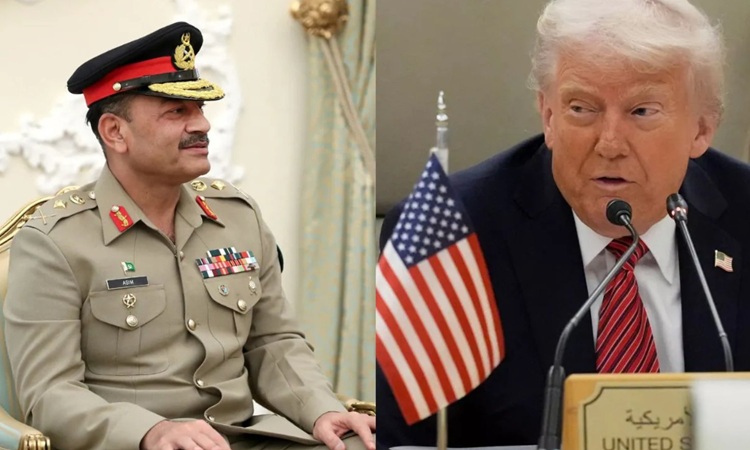
Trump’s Claims on Pakistan and Nuclear Testing
In a revealing interview with CBS News, U.S. President Donald Trump alleged that Pakistan is carrying out secret underground nuclear tests, along with Russia, China and North Korea. He used these claims to justify ending America’s 33-year moratorium on nuclear weapons testing.
However, international monitoring agencies and independent experts emphasise that no credible evidence supports secret nuclear detonations in Pakistan, and seismic activity attributed to the region is consistent with natural earthquakes.
Monitoring Agencies and Global Reactions
Global monitoring systems, including those of the Comprehensive Nuclear‑Test‑Ban Treaty Organization (CTBTO), report no confirmed nuclear test signals in Pakistan in the recent period. According to the Japan Times, Trump claimed “Russia’s testing, and China’s testing… they test way underground” but offered no public proof.
Meanwhile, China officially denied any such tests and appealed for the U.S. to uphold the testing moratorium. Beijing’s foreign ministry stated that China has “abided by its commitment to suspend nuclear testing”.
In South Asia, the accusation has generated heightened alarm. While Pakistan has not immediately commented directly on the new allegations, New Delhi remains cautious, given the region’s history of nuclear rivalry.
Implications for U.S. Nuclear and Arms-Control Policy
President Trump’s remarks mark a dramatic shift in U.S. nuclear policy. The last full-scale U.S. underground nuclear test occurred in 1992, underlining the longstanding 33-year moratorium. The Economic Times noted that although Trump ordered “fresh tests of the American nuclear weapons system”, U.S. officials say these may not involve actual explosions but system checks or “non-critical” blasts.
If the U.S. indeed resumes nuclear explosions, it could undermine the global norm against testing and strain the arms-control architecture, including the CTBT, which the U.S. has signed but not ratified. Experts warn that open testing could trigger a fresh arms race.
Regional Fallout: South Asia and Pakistan’s Deterrence
Within South Asia, Pakistan’s nuclear posture has been subject to scrutiny. Earlier this year, India accused Pakistan’s military leadership of “sabre-rattling” following reported comments about nuclear threats.
Trump reiterated a previously unverified claim that he helped avert a “2025 nuclear war” between India and Pakistan through U.S. intervention. Indian officials have rejected this narrative, viewing it as domestic U.S. posturing rather than factual.
For Pakistan, any formal admission of secret tests would carry severe diplomatic and economic consequences, including sanctions and international isolation. Thus far, the country has maintained it acts responsibly within its declared deterrence posture.
Science, Verification and the Challenge of Secrecy
Seismic monitoring and verification remain central to distinguishing natural earthquakes from nuclear tests. Analysts note that Pakistan lies within a complex seismic zone, making detection of clandestine tests highly challenging—but not impossible.
Trump’s allegation that underground tests could “feel like a vibration” reflects claims of hikers or miners inadvertently sensing blasts. Yet no monitoring station has reported any such suspicious signature in Pakistan recently. The Japan Times reports that the U.S. president noted “a global monitoring system… somehow failed to detect the tests.” ()
What Comes Next: Diplomacy and Nuclear Norms
As the U.S. moves toward reconsidering its testing ban, global arms-control watchers anticipate renewed diplomatic engagement. Key questions include: will the U.S. follow through with full-scale detonations? How will regional players like Pakistan respond? And can verification systems uphold the non-proliferation regime?
For Pakistan, the allegation alone increases pressure to demonstrate transparency and cooperate with international inspectors. For the U.S., the policy shift could reshape the entire architecture of deterrence and arms control. The emerging picture is one of renewed nuclear competition rather than disarmament.