
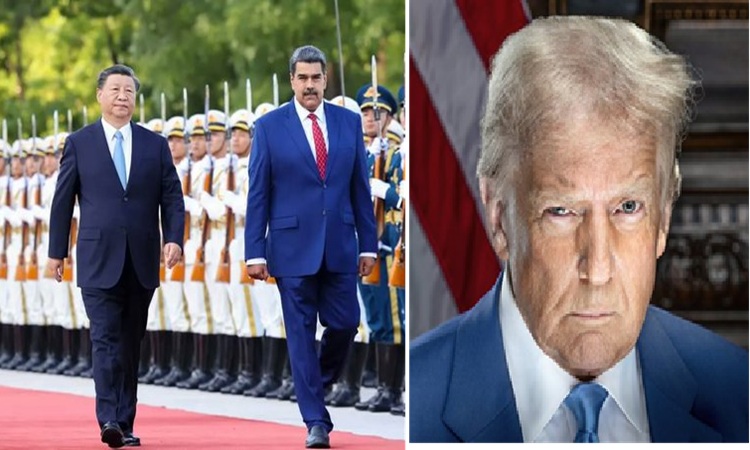
Trump deploys warships near Venezuela, Xi Jinping condemns action
The United States and China have entered a new phase of confrontation, this time over Venezuela. The Trump administration has deployed naval submarines and Aegis guided-missile destroyers near the South American nation, citing efforts to curb drug trafficking. In response, China has strongly condemned the move, accusing Washington of violating international law and interfering in Venezuela’s internal affairs.
This development has escalated tensions between Washington and Beijing, adding another flashpoint to an already strained global relationship.
US deploys warships to Venezuela
On August 21, the US announced the deployment of at least three Aegis guided-missile destroyers off Venezuela’s coast. The White House described Venezuelan President Nicolas Maduro as a “narco-terrorist” and justified the deployment as part of efforts to stop cross-border drug smuggling.
White House spokesperson Karoline Levitt stressed that the administration would pursue every measure to dismantle international drug networks. She reiterated that those responsible for trafficking would face justice.
President Trump’s decision reflects his long-standing stance against Maduro. Washington continues to maintain that the Venezuelan leader is not a legitimate president and remains central to what it describes as a “narco-state.”
China criticises US interference
China’s strong reaction came swiftly. Chinese Foreign Ministry spokesperson Mao Ning condemned Washington’s actions, saying they undermined the principles of the United Nations Charter.
“China opposes any such step that violates the sovereignty of a country. We oppose the use of force, threat of force, or external interference in Venezuela’s internal affairs,” Ning said.
She urged Washington to take steps that promote peace and stability in Latin America and the Caribbean, warning against actions that could destabilise the region.
China’s criticism signals not only its support for Venezuela but also its broader opposition to US military influence in the Western Hemisphere.
Venezuela vows to resist US pressure
The Venezuelan government has also taken a defiant stance. President Nicolas Maduro announced that he would mobilise 4.5 million militia fighters to counter any potential threat from Washington.
“We will not be afraid of America’s threats,” Maduro declared, vowing to protect Venezuelan sovereignty. He added that Caracas was prepared to take every necessary step to defend its people.
The announcement underlines Venezuela’s readiness to resist pressure and portrays the crisis as a defence of national dignity against foreign intervention.
Trump’s long-standing clash with Maduro
Donald Trump’s hostility toward Maduro is not new. Tensions between the two leaders date back to Trump’s first term and have intensified since his return to office.
The US has long accused Maduro of running one of the world’s largest drug-trafficking operations. Washington even placed a bounty on his arrest, which has steadily increased from $15 million to $50 million.
The Trump administration’s hardline stance reflects its belief that Maduro’s government is illegitimate and tied to organised crime.
A new flashpoint in US-China rivalry
Analysts say the Venezuela dispute adds another layer to US-China geopolitical competition. With Washington increasing its military footprint in South America and Beijing siding firmly with Caracas, the issue is evolving into a broader test of influence.
China has invested heavily in Venezuela’s energy sector and sees the South American country as a strategic partner. Meanwhile, the US views Maduro as a destabilising figure in the region.
The clash could complicate global diplomacy, with both powers unwilling to back down. Experts warn that further escalation may strain already fragile ties between Washington and Beijing.
Conclusion
The Venezuela standoff has placed the US and China on opposite sides once again. Trump’s deployment of warships near Caracas has provoked sharp criticism from Beijing and a defiant response from Maduro.
As the situation develops, the episode highlights a larger trend — global rivalries increasingly playing out in regional conflicts, from Asia-Pacific to Latin America. Whether this confrontation escalates into a prolonged standoff will depend on how far both Washington and Beijing are willing to push their competing agendas.