
Sambhal “The sacred City of Kalki”, Forgotten Wells and Pilgrimage Site Set for Revival
Sambhal’s Forgotten Wells and Pilgrimage Sites Set for Revival: A New Era of Cultural Rebirth
Sambhal, a city tucked in the heart of Uttar Pradesh, is undergoing a profound transformation. Long buried under dust, debris, and neglect, its 87 ancient pilgrimage sites and sacred wells are now being rediscovered and revived. Spearheaded by the Uttar Pradesh government, the heritage rejuvenation campaign is aimed at restoring Sambhal’s sacred identity as the legendary “City of Kalki.”
A Sacred History Uncovered
According to Dr. Rajender Pensiya, the District Magistrate of Sambhal, the city is home to 87 Dev Teerths (holy water sites) and five Maha Teerths. Recent surveys have confirmed the existence of 42 pilgrimage spots, alongside 16 Maha Koops (sacred dry wells). As of now, 68 sites have been unearthed, with 29 still under survey. This monumental effort is rekindling the city’s long-forgotten spiritual legacy.
“We’ve used traditional measurement methods to verify the distances between these sites,” Dr. Pensiya explains, referring to the ancient “dhanush” measurement, a unit varying between one to five gaz (yards). These historical units reflect the depth of knowledge embedded in Sambhal’s cultural past, blending old and new to ensure the authenticity of the discoveries.
Saraitareen’s Grand Discovery: The Largest Ancient Well
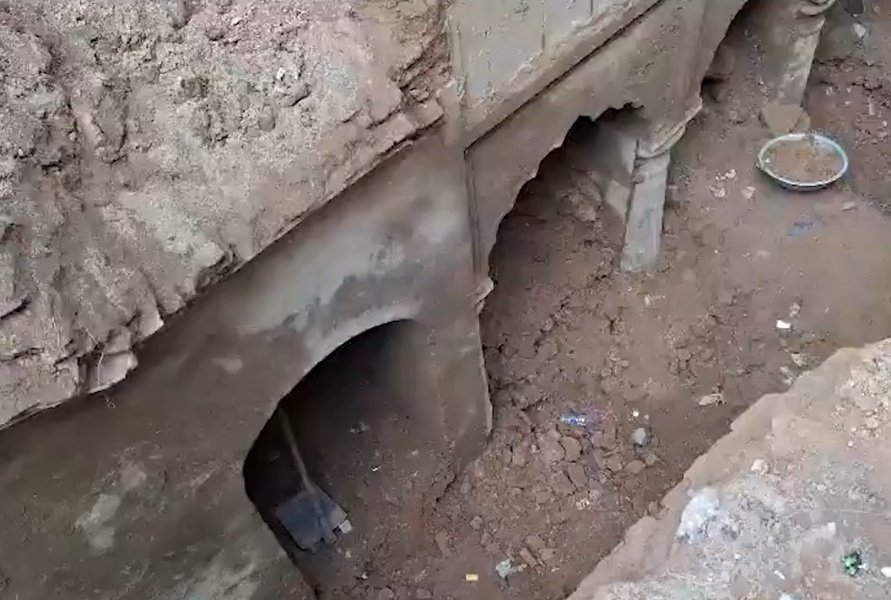
One of the most significant discoveries in this ongoing campaign came on January 26 when a massive ancient well was unearthed in Saraitareen, a locality of great historical significance. Discovered beneath layers of concrete during a municipal excavation, this well is believed to be the largest of its kind in the district.
Dr. Pensiya, accompanied by SDM Vandana Mishra and an Archaeological Survey of India (ASI) team, inspected the site. Located in the Darbar area—the former seat of the Tonk rulers—the well is a remarkable example of pre-Mughal civic engineering, featuring a wide, 25-foot circular mouth and a spiral staircase leading down its inner walls. Constructed using traditional stone masonry, it reflects the period’s skillful use of natural materials, providing evidence of both practical and spiritual uses in ancient times.
The well’s historical significance is not lost on the local community. Azim Tareen, the 16th-generation custodian of the nearby mosque, highlighted the dual spiritual importance of the site for both Hindus and Muslims. The mosque, built by Tareen’s ancestors, sits just 100 meters from the well, reinforcing the site’s historical and cultural relevance for all residents of the region.
The Vanishing of Sacred Sites: A Tale of Migration and Neglect
Historian Suresh Chandra Sharma, author of Sambhal Nagar Ka Pracheen Itihaas, believes that the migration of Hindu families over time has led to the neglect of many of Sambhal’s sacred sites. “Without local custodians, many wells and heritage structures were encroached upon and eventually forgotten,” Sharma explains.
Historically, these wells served as integral parts of Sambhal’s social and religious fabric. Many were located near temples or shrines and functioned as “jal teerths” (holy water sites), where pilgrims would perform sacred rituals. Inscriptions and iconography found on the wells further underscore their spiritual importance, transforming them from mere utilitarian structures into sacred monuments.
The Revival Campaign: From Mohalla Khaggu Sarai to City-Wide Restoration
The heritage revival campaign gained momentum in December 2024 with the discovery of a centuries-old well in Mohalla Khaggu Sarai. Buried under decades of debris and encroachments, this stone-lined well was found to have been a functional water source, with chisel marks on its walls and remnants of an old pulley system.
Senior officials from the Sambhal district administration confirmed that the well’s rediscovery, aligning with descriptions from the Sambhal Mahatmya, sparked a city-wide effort to unearth other lost pilgrimage sites. The well’s unearthing served as the catalyst for the city’s largest heritage restoration drive.
Maha Koops and Pilgrimage Sites: Restoration Underway
Out of the 16 Maha Koops identified so far, 13 have been structurally restored. These ancient dry wells have been reinforced with brickwork and protective iron grills to preserve their historical value. The well inside Shri Kalki Temple, however, remains in disrepair, and plans for further restoration are being finalized.
Additionally, several pilgrimage sites have undergone beautification, with cleaning efforts conducted under the MGNREGA scheme. Proposals for more extensive restoration work have been submitted to the urban development department, tourism department, and religious affairs authorities.
Funds from the 15th Finance Commission’s untied grants, as well as state finance allocations, have already been allocated to the project. “Sambhal is set to become a spiritual and cultural hub, once the necessary funds and efforts come through,” says Dr. Pensiya.
Legal and Logistical Challenges: A Sensitive Task
In Chandausi, another ancient well was recently unearthed near the Mughal-era Shahi Jama Masjid. The site had been covered under a concrete platform for years until locals reported its location. The well’s discovery has sparked a legal dispute, as the site is situated near sensitive religious structures. Security measures have been implemented, and legal action is expected following an investigation.
Despite these challenges, the revival campaign is gaining traction. Local residents, like Sanjay Kumar, have expressed immense pride in seeing the rediscovery of these ancient wells, especially the ones central to their family rituals and festivals. “The rediscovery of these wells has brought back cherished memories and reignited pride in our heritage,” Kumar says.
Conclusion: A Renewed Legacy for Sambhal
Sambhal’s heritage rejuvenation is more than just an excavation of ancient structures—it is a resurrection of the city’s spiritual identity. As more sites are uncovered and restored, Sambhal is poised to become a significant pilgrimage destination once again, drawing visitors and devotees from across the country. With a focus on preservation and cultural pride, Sambhal is reviving its ancient legacy and reaffirming its place in India’s rich historical tapestry.