
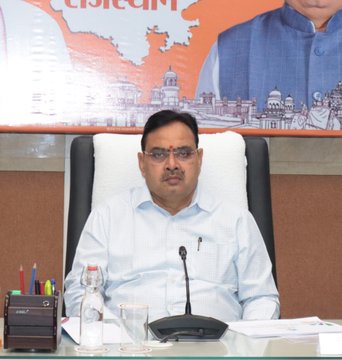
JAIPUR : Rajasthan Chief Minister Bhajan Lal Sharma recently addressed a major gathering at Birla Auditorium in Jaipur. The event celebrated the landmark achievement of the Yamuna Water Agreement. During his speech, the Chief Minister outlined a comprehensive vision for state water security. He emphasized how historic infrastructure initiatives continue to shape regional development today. Additionally, he linked historical water projects to current state welfare policies.
Chief Minister Bhajan Lal Sharma emphasized that water security remains the top priority for state development. The administration allocated substantial funding to complete canal modernization projects without delay. State officials conduct regular site inspections to ensure strict quality standards across all construction zones. Consequently, contractors must meet rigorous engineering benchmarks before project completion.
In 1925, Maharaja Ganga Singh ji inaugurated the famous Gang Canal. That milestone transformed farming across northern Rajasthan nearly a century ago. Later, the state constructed the massive Indira Gandhi Canal to feed desert districts. On the exact same date in 2025, the government laid foundation stones for both canals. These new works focus on strengthening and modernizing canal structures statewide. Furthermore, the administration aims to curb water seepage along major distribution routes.
The historic Yamuna Water Agreement guarantees vital surface water to arid regions. Specifically, the Shekhawati region will receive much-needed drinking and irrigation supplies. Districts like Sikar, Jhunjhunu, and Churu stand to gain massive economic relief. Consequently, local agricultural output will expand significantly over the coming years. Moreover, ground water levels in dry zones will gradually recover over time.
Modernizing Historical Water Assets and Expanding Infrastructure
The state government prioritizes modern engineering standards for all major water channels. Over decades, aging canal linings suffered from severe silt accumulation and physical damage. Therefore, structural repairs will restore maximum flow capacity across the entire delivery network. Engineers will deploy advanced concrete lining technology along key canal segments. As a result, water losses from absorption and seepage will decline sharply.
Furthermore, modern control gates will regulate seasonal water discharge with high precision. Automated sensors will monitor water distribution from primary branches into local feeder lines. Thus, farmers located at the end of distributaries will receive their full allocation reliably. The government is investing heavily to ensure long-term structural integrity. Additionally, regular maintenance schedules will prevent future infrastructure breakdown.
[Rajasthan Major Canal Modernization Framework]
│
├──► Gang Canal Upgrades : Concrete Relining & Silt Removal
├──► Indira Gandhi Canal : Flow Capacity Enhancement & Gate Automation
├──► Yamuna Pipeline Network : 295 km Underground Transfer System
└──► Target Districts : Sikar, Jhunjhunu, Churu, & Hanumangarh
These combined efforts reflect a broader strategy to secure agricultural stability. By combining historical canal renovation with new pipeline construction, Rajasthan builds total water resilience. Moreover, rural communities will gain dependable access to clean drinking water year-round. Consequently, local health outcomes and economic activity will improve steadily across rural areas.
Resolving Inter-State Water Disputes Through Active Dialogue
For nearly three decades, water allocation disputes remained unresolved between neighboring states. However, recent cooperative efforts paved the way for the historic Yamuna Water Agreement. The central government provided strong leadership to align state interests effectively. As a result, officials finalized a practical framework for water sharing without prolonged delays. This collaborative approach demonstrates how constructive dialogue solves complex regional challenges.
Under this agreement, Rajasthan will receive its allocated share of Yamuna floodwaters during monsoon months. A dedicated underground pipeline network will transport water from the Hathnikund Barrage. The pipeline will stretch approximately 295 kilometers across northern transit corridors. This enclosed design minimizes evaporation losses during hot summer months. Furthermore, it prevents land acquisition disputes along the primary transit route.
The government established a specialized agency to manage project execution smoothly. This body oversees engineering designs, environmental clearances, and construction timelines. Moreover, continuous inter-state coordination guarantees transparent water monitoring at all times. Consequently, both Rajasthan and Haryana benefit from a clear, dispute-free operational protocol.
Economic Growth and Environmental Sustainability for Shekhawati
The arrival of Yamuna water brings fresh economic vitality to the Shekhawati region. Historically, severe water scarcity restricted agricultural diversification and industrial expansion in local districts. However, guaranteed water supply allows farmers to cultivate high-value cash crops confidently. Additionally, expanding irrigation reduces financial reliance on expensive diesel pumps. Therefore, net farm incomes will rise significantly across Sikar, Churu, and Jhunjhunu.
Local community leaders praised the state government for addressing long-standing regional grievances. Sustained water availability will prevent youth migration from rural districts to big cities. Instead, young entrepreneurs can explore new opportunities in agribusiness and eco-tourism locally. As a result, rural economies will grow stronger and more self-reliant over the next decade.
The implementation of the Yamuna Water Agreement also supports regional heritage preservation. Shekhawati features hundreds of historic painted havelis that attract domestic and international tourists. By ensuring reliable municipal water supply, the state boosts tourism infrastructure in historic towns. Furthermore, green expressways will connect cultural sites to major commercial centers. Thus, environmental conservation and heritage development proceed side by side.
| Water Project | Primary Goal | Target Region |
| Yamuna Water Agreement | Pipeline Transfer | Shekhawati Districts |
| Gang Canal Project | Structural Modernization | Northern Agriculture |
| Indira Gandhi Canal | Relining & Capacity Boost | Western Desert Zones |
In conclusion, Rajasthan is entering a transformative era of comprehensive water management. The simultaneous execution of canal upgrades and new pipeline networks secures the state’s future. By learning from historical achievements, modern leaders build lasting prosperity for coming generations. Ultimately, the successful rollout of the Yamuna Water Agreement guarantees long-term water security statewide.