
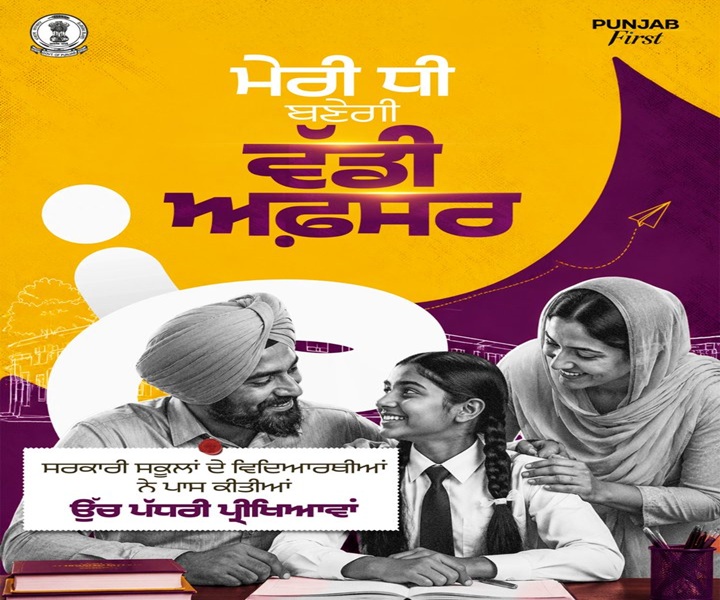
CHANDIGARH : Recently, a massive transformation occurred in the Indian education sector. Punjab government schools secured the top rank in the prestigious NITI Aayog School Education Quality Report 2026. Consequently, the state surpassed traditionally dominant regions like Kerala, Maharashtra, and Delhi. This historic victory marks a complete turnaround for the public education system. For many years, these institutions struggled with poor infrastructure and low enrollment numbers. However, targeted systemic reforms have completely changed the landscape. Today, these classrooms deliver world-class learning experiences to thousands of children across the state. Furthermore, rural students are now leading national merit lists in highly competitive engineering and medical entrance examinations.
Read More : Balbir Singh Inaugurates Rural Health Training Center in Saneta, Boosts Rural Healthcare Push
The Infrastructure Shift Fueling Academic Excellence
Historically, families viewed public institutions as a last resort due to neglected facilities. To fix this, the state administration launched the ambitious “Schools of Eminence” program. Therefore, massive investments flowed directly into local neighborhoods to upgrade infrastructure. Today, an impressive 99.9 percent of Punjab government schools operate with stable electricity connections. Additionally, over 99 percent of these institutions feature fully functional computer labs for digital literacy.
Moreover, modern technology integration has revolutionized daily learning methods. More than 80 percent of classrooms now feature interactive smart boards and high-speed internet. This digital transition helps teachers explain complex science concepts through visual animations. As a result, abstract topics become easily understandable for young minds. This uniform development successfully bridges the deep digital divide between urban centers and remote villages. Consequently, children from ordinary backgrounds study with the exact same tools as expensive private academies.
Smashing National Records in JEE and NEET Exams
The true success of Punjab government schools reflects clearly in recent competitive exam results. Surprisingly, expensive private coaching centers no longer hold a monopoly on top ranks. According to official 2026 data, a staggering 786 public school students successfully cleared the JEE Main exam. Furthermore, 1,284 qualified candidates proudly cracked the NEET medical entrance test.
Most importantly, 59 bright students successfully qualified for the incredibly tough JEE Advanced 2026 examination. This achievement represents a phenomenal 34 percent increase compared to the previous year. To achieve this, the state department rolled out comprehensive, free entrance exam coaching within school premises. Therefore, students receive specialized academic guidance and regular mock tests without any financial burden. Clearly, access to premier institutes like the IITs is no longer limited by a family’s income. Inspiring stories of perseverance are emerging from every single district. For instance, children of daily wage laborers are securing admissions into top engineering branches. Their remarkable academic performance proves that raw talent thrives when given proper resources.
Global Teacher Training and Grassroots Reforms
This classroom revolution did not happen overnight through a simple miracle. Instead, a deliberate focus on human resource development laid the foundation for success. The administration regularly sends batch after batch of school principals for advanced training programs in Finland and Singapore. Consequently, educators return equipped with global best practices in classroom management and empathetic teaching.
Additionally, the state successfully recruited over 13,000 highly qualified teachers and support staff. To improve communication skills, the specialized “English Edge” program now trains nearly three lakh active students. Furthermore, the innovative “Mission Samarth” initiative actively targets and corrects foundational learning gaps in primary classes. Due to these structured interventions, student-teacher ratios have reached an ideal 22:1 benchmark. Consequently, drop-out rates have plummeted drastically across all districts. Over 90 percent of Class 10 students now transition smoothly into higher secondary education. This structural dedication ensures that no child drops out due to lack of academic support.
Celebrating Success at the Grassroots Level
To honor this collective victory, the state recently hosted simultaneous Mega Parent-Teacher Meetings across 19,000 locations. Remarkably, over 20 lakh enthusiastic parents actively participated in these interactive educational workshops. Teachers used this grand platform to felicitate board toppers, language achievers, and competitive exam qualifiers. This massive community engagement rebuilds deep trust between common citizens and public institutions. Parents now proudly see Punjab government schools as their very first choice for a bright career. The NITI Aayog validation confirms that these children are no longer just catching up. Instead, they are confidently leading India’s educational future into a brand new era.