
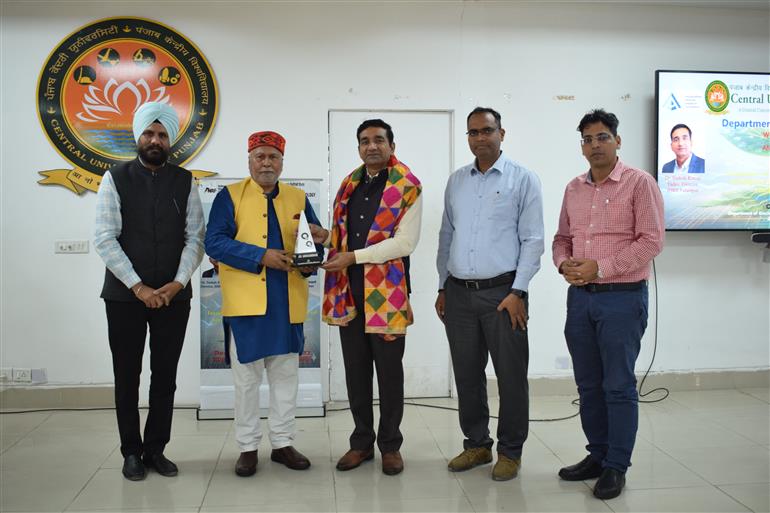
Central University of Punjab hosts a national symposium on AI and Multi-Omics integration in plant biochemistry, advancing precision agriculture and sustainability.
Under the direction of Honorable Vice Chancellor Prof. Raghavendra P. Tiwari, the Department of Biochemistry at Central University of Punjab, Bathinda, successfully held a two-day national symposium on , on the topic of “Integration of Multi-Omics and Artificial Intelligence in Plant Biochemistry for Precision Agriculture.” About 120 Ph.D. scholars and postgraduate students from universities around the nation enthusiastically attended the ANRF-sponsored event.
Chief Guest Dr. Sudesh Kumar Yadav, Director of IHBT, Palampur, gave an energizing opening address to kick off the symposium. Drawing on his research on saffron, quinoa, and picrorhiza, he elaborated on the integration of transcriptomics, metabolomics, and genome editing for crop improvement.
Speaking to the audience, Honorable Vice Chancellor Prof. Raghavendra P. Tiwari emphasized the close ties between agriculture and education. He emphasized the new idea of precision farming and noted that precision food and nutrition will become a more common focus of future research.
Dr. Baljinder Singh Gill, the organizing secretary, welcomed the dignitaries, gave an overview of the symposium’s theme, and thanked the Vice Chancellor and the Chief Guest for their ongoing support and direction.
Also read : CM Bhagwant Singh Mann Oversees Major Flood Relief Distribution in Punjab
Prominent scientists gave state-of-the-art expert presentations over the two-day event, offering profound insights into multi-omics and AI-driven developments in plant sciences. The function of histone demethylases and microRNAs in systemic acquired resistance in plants was explained by Dr. Ashis K. Nandi, a professor at the School of Life Sciences, JNU, New Delhi. Together, Drs. Santosh Upadhyay of Punjab University in Chandigarh and Priyanka Siwach of CDLU in Sirsa talked about cotton virus infections and new AI-based approaches to treating them. Speaking on the use of artificial intelligence to tackle climate change issues was Dr. Kulwinder Kaur Gill, Principal Agrometeorologist from PAU Ludhiana. Dr. Kamaldeep Joshi from UIET, M.D. University, Rohtak, concentrated on the application of machine learning and AI technologies for the early detection of plant diseases, while Dr. Sarvajeet Singh Gill from M.D. University, Rohtak, emphasized the promise of AI-powered precision farming in the future.
Students avidly participated in quiz and poster competitions that were established as part of the academic engagement. The top three winners in each category received cash awards.
The conference effectively brought together plant sciences, artificial intelligence, and multi-omics to advance precision agriculture for sustainable development, and it ended with a ceremonial vote of gratitude.