
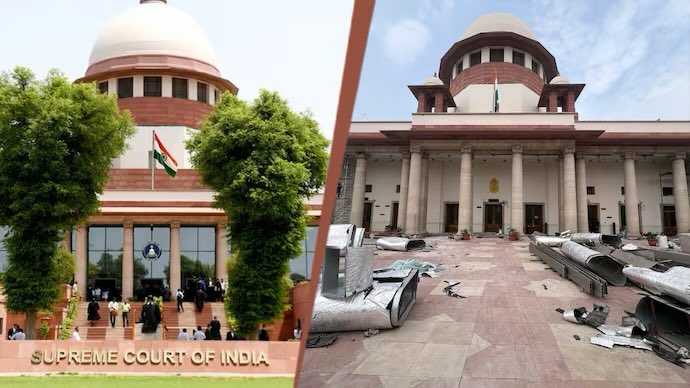
SC’s ₹2.6-Crore Glass Partition Removed, Costing Another ₹8 Lakh
₹2.6 Crore Supreme Court Glass Partition Taken Down in Less Than a Year
In a significant development within India’s judiciary infrastructure, a controversial glass partition installed at the Supreme Court for ₹2.6 crore has now been removed. An RTI response revealed that dismantling the panels cost an additional ₹8 lakh. The decision followed repeated requests by top legal bodies citing inconvenience.
The glass panels were introduced during former Chief Justice DY Chandrachud’s tenure. They aimed to centralise air conditioning in the corridors outside courtrooms 1 to 5. However, the Bar associations flagged major issues soon after the installation.
Bar Associations Push for Dismantling
The Supreme Court Bar Association (SCBA) and the Supreme Court Advocate-On-Record Association (SCAORA) spearheaded the removal request. Their concerns revolved around aesthetics and functionality.
According to sources, the panels reduced corridor space, leading to congestion during busy court hours. Lawyers complained of difficulty moving between courtrooms. Moreover, they alleged lack of consultation before the project was executed, despite being key stakeholders in court operations.
Although the initial request was made shortly after Justice Chandrachud’s tenure ended in November 2024, no action followed during Justice Sanjiv Khanna’s interim term.
It was only when CJI BR Gavai assumed office that the matter was resolved. He immediately ordered the removal, following representations from the legal bodies.
Reform with Repercussions
During his leadership, CJI Chandrachud introduced multiple modernisation initiatives, including digital case filing, online live court feeds, and infrastructural upgrades. Among the most debated was the installation of these transparent glass walls in the Supreme Court’s historic corridors.
Supporters saw it as part of his vision to modernise the judiciary and improve environmental comfort. The panels allowed for better air-conditioning efficiency, reducing energy leakage.
However, the Bar countered that the functional losses outweighed the gains. Movement was severely restricted, especially during peak hours. Legal professionals found it hard to manoeuvre through tight corridor spaces, slowing down proceedings.
Cost and Accountability Under Scrutiny
While the initial installation cost ₹2.6 crore, the removal has now added ₹8 lakh more to the bill. The RTI revelation has sparked public discussion over government spending and judicial accountability.
Critics have pointed out the lack of pre-installation dialogue, arguing that public funds could have been better utilised. On the other hand, supporters claim that such reforms often come with trial-and-error phases.
A senior court official told reporters, “While the intention was genuine, feedback from users must always be incorporated. The new Chief Justice has respected that.”
What’s Next for the Supreme Court’s Infrastructure?
This episode underscores the importance of consultative planning in public projects. With India’s judiciary moving towards digital and physical modernisation, infrastructure reforms must balance comfort, utility, and heritage.
Observers believe that the removal of the panels may now lead to more inclusive approaches in decision-making. As the legal fraternity adapts to change, dialogue between the Bench and the Bar will be critical to shaping the Supreme Court’s future.