
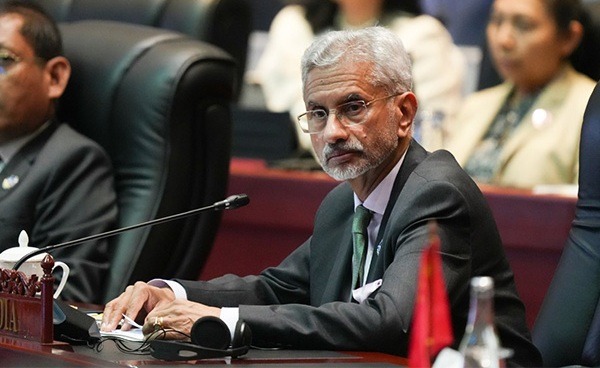
S. Jaishankar Hits Back at Bangladesh’s ‘Ocean Guardian’ Remark, Highlights India’s Key Role in BIMSTEC Connectivity
S Jaishankar Asserts India’s Central Role in BIMSTEC, Responds to Bangladesh’s “Ocean Guardian” Comments
India’s External Affairs Minister, S. Jaishankar, has underscored the country’s pivotal role in regional connectivity, especially within the Bay of Bengal and Southeast Asia, in response to comments made by Bangladesh’s Chief Advisor Mohammad Yunus. In a statement made Thursday during his visit to Bangkok for the 20th BIMSTEC Ministerial Meeting, Jaishankar emphasized India’s 6,500-km coastline and its role as a bridge between the subcontinent and Southeast Asia.
His remarks came after Yunus referred to India’s northeastern states as “landlocked” and positioned Bangladesh as the “only guardian of the ocean” for the region. Jaishankar, however, countered this assertion, highlighting India’s significant contribution to regional connectivity, particularly through initiatives such as the Bay of Bengal Initiative for Multi-Sectoral Technical and Economic Cooperation (BIMSTEC).
India’s Strategic Position in the Bay of Bengal
In his address, Jaishankar emphasized India’s geostrategic advantage, given its extensive coastline along the Bay of Bengal. “India has the longest coastline in the Bay of Bengal, stretching almost 6,500 kilometers,” Jaishankar stated, reinforcing India’s central position in the region. He further clarified that India’s northeastern region is increasingly emerging as a critical hub for connectivity within BIMSTEC, a group of seven nations including Bangladesh, Bhutan, India, Myanmar, Nepal, Sri Lanka, and Thailand.
India’s coastline is not only vital for national maritime security but also plays a crucial role in fostering regional cooperation through shipping routes and trade. This positioning strengthens India’s influence over the economic and strategic dynamics of Southeast Asia, enhancing its role as a key player in BIMSTEC and the broader Indo-Pacific region.
Rebuttal to Bangladesh’s “Ocean Guardian” Remarks
Jaishankar’s remarks came as a direct response to the comments made by Bangladesh’s Chief Advisor, Mohammad Yunus, who recently asserted that India’s northeastern states were landlocked, while Bangladesh serves as the primary guardian of maritime access for the region. Yunus had also highlighted the strategic importance of Bangladesh’s coastline in facilitating regional trade and connectivity.
In his response, Jaishankar stressed that India, with its strategic location, provides essential connectivity between Southeast Asia and the Indian subcontinent. “We are aware of our special responsibility regarding BIMSTEC,” he said, further underscoring India’s leadership role in regional initiatives.
He emphasized the infrastructure investments that India is making in the northeast, positioning the region as a vital connectivity hub. Jaishankar referred specifically to India’s efforts to develop a robust network of roads, railways, waterways, and energy grids that would serve as conduits for cross-border trade and cultural exchange.
The Role of India’s Northeast in Connectivity
Jaishankar pointed out that India’s northeastern states, such as Assam, Tripura, and Meghalaya, are increasingly becoming crucial for regional integration. The completion of projects like the Trilateral Highway—which aims to connect India’s northeastern states to the Pacific Ocean—has been described by Jaishankar as a “game-changer.” This highway, when fully operational, will provide direct land routes connecting India with Myanmar and Thailand, facilitating smoother trade and deeper economic ties with Southeast Asia.
Moreover, Jaishankar emphasized that the region is poised to play a key role in the development of energy grids and pipelines that will not only benefit India but also help meet the energy demands of neighboring countries. These infrastructural advancements are set to provide long-term benefits to the BIMSTEC countries, reinforcing India’s status as a critical regional partner.
BIMSTEC’s Role in Enhancing Regional Connectivity
BIMSTEC has been a critical forum for regional cooperation, and Jaishankar’s remarks highlighted India’s commitment to this initiative. As a key player in BIMSTEC, India’s contributions extend beyond infrastructure projects to fostering economic cooperation, trade liberalization, and regional security. Through initiatives like the Trilateral Highway and other cross-border projects, India is aligning its national interests with regional development goals, aimed at creating a more connected and economically integrated Southeast Asia.
The Bay of Bengal region itself is one of the world’s busiest maritime areas, and its security and prosperity are vital for the nations surrounding it. India’s active involvement in maintaining a stable, open maritime environment has been a cornerstone of its foreign policy in the region, supporting both national and regional security.
The Future of India-Bangladesh Relations
The exchange between Jaishankar and Yunus reflects broader regional dynamics, particularly in the context of India-Bangladesh relations. While both nations share historical and cultural ties, differences over strategic and economic issues continue to surface. The debate over maritime and connectivity issues is part of an ongoing conversation about how India and Bangladesh can collaborate more effectively in an increasingly interconnected South Asia.
As both nations navigate their differences, India’s role in BIMSTEC and its growing influence in the Bay of Bengal will be central to regional stability and economic growth. Jaishankar’s emphasis on India’s responsibility in promoting regional connectivity is a reaffirmation of India’s commitment to strengthening its ties with Southeast Asia, a crucial element for the broader Indo-Pacific strategy.
Conclusion: India’s Growing Influence in the Bay of Bengal
In conclusion, S. Jaishankar’s comments underscore India’s pivotal role in enhancing regional connectivity through projects like BIMSTEC and the Trilateral Highway. The country’s vast coastline, its active engagement in regional cooperation, and its investments in the northeastern states are positioning India as a central player in the Bay of Bengal’s economic and strategic landscape. While responses to remarks like those made by Bangladesh’s Chief Advisor Mohammad Yunus may differ, the underlying message is clear: India’s geographic and infrastructural strength places it at the heart of Southeast Asia’s future development.