
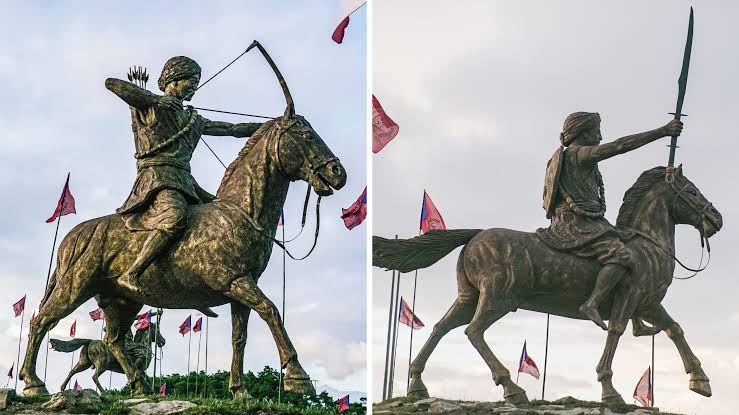
Recently, Meghalaya took a monumental step to celebrate its indigenous freedom fighters. Indeed, the state honored its past by unveiling magnificent new monuments. Specifically, the public welcomed the new initiative as Meghalaya unveils 15-foot statues to honor forgotten Khasi freedom fighters at Laitarted. Therefore, this installation aims to bring lesser-known local history back to life. Consequently, thousands gathered to witness this historic cultural milestone. Meanwhile, the event sparked renewed pride across the northeastern region.
Clearly, the Hynniewtrep Youths’ Council (HYC) successfully organized this major commemoration project. Furthermore, the ceremony marked the council’s grand foundation day. Additionally, the historic event coincided with a deeply revered state anniversary. Specifically, it marked the 191st death anniversary of the iconic U Tirot Sing Syiem. Therefore, the timing added immense emotional value to the gathering. As a result, traditional chiefs and community heads attended from across the state.
Unveiling the Towering 15-Foot Memorials
Today, two majestic fifteen-foot monuments stand tall on the hills of Nongthliew. Indeed, this historic event where Meghalaya unveils 15-foot statues to honor forgotten Khasi freedom fighters displays supreme courage. For instance, the first monument honors the legendary leader Bormanik Syiem of Hima Shyllong. Similarly, the second sculpture immortalizes the brave Sngap Sing Syiem of Hima Maram. Crucially, Habapan Sing Syiem, the Deputy Syiem of Hima Khyrim, unveiled the first monument. Meanwhile, Niandro Syiemiong of Hima Maram unveiled the second figure.
Unquestionably, local organization leaders expressed great pride during their official addresses. For example, HYC President Roy Kupar Synrem highlighted the historical neglect of these patriots. Moreover, general secretary Rhembor Saiborne echoed these strong cultural sentiments. Additionally, vice-president Donbok Kharlyngdoh stressed the absolute need for public awareness. Thus, they stated that mainstream textbooks often overlook these heroic tribal chiefs. Therefore, this new heritage enclave serves as a permanent corrective measure.
The Historical Legacy of Bormanik Syiem
Historically, records show that Bormanik Syiem bravely resisted foreign intervention. In fact, he actively opposed the expansion of the British East India Company in 1828. Specifically, he defended indigenous territory in the vital Dimurua region near Assam. Consequently, the bold chief courageously confiscated all revenues collected by British tax officers. Furthermore, he worked closely with U Tirot Sing Syiem to organize military defense. Thus, he urged neighboring tribal regions to join the anti-colonial struggle.
Soon, this fierce opposition quickly led to a major armed confrontation. In brief, in April 1829, courageous Khasi warriors launched an attack at Nongkhlaw. Consequently, this decisive action officially triggered the First Anglo-Khasi War. Indeed, the bloody conflict lasted from 1829 until 1833. However, superior British military numbers eventually forced a strategic retreat. Ultimately, U Tirot Sing Syiem was captured and exiled to Dacca.
Sngap Sing Syiem and the Second Anglo-Khasi War
Next, following the loss of Tirot Sing, the struggle entered a new phase. Specifically, Sngap Sing Syiem immediately assumed command of the remaining forces. Thus, he masterfully led the region during the Second Anglo-Khasi War. Indeed, this intense conflict spanned from 1835 until 1839. Meanwhile, the brave chief built a famous stronghold at the rugged heights of Nongnah. Consequently, he transformed this difficult terrain into an impregnable natural fortress.
Remarkably, his highly mobile forces repeatedly repulsed armed colonial expeditions. Therefore, they inflicted severe casualties on the invading British military units. Unfortunately, internal betrayal eventually exposed his secret defensive positions. Hence, colonial forces finally captured the heroic chief in 1839. However, the British recognized his extraordinary bravery and popular support. Consequently, they granted him political amnesty after the war ended.
Masterful Craftsmanship by Riti Academy
Clearly, the new heritage enclave highlights incredible local artistic talent. In fact, local artists from the famous Riti Academy developed the entire site. Specifically, they crafted these figures as Meghalaya unveils 15-foot statues to honor forgotten Khasi freedom fighters. Notably, Chief Creative Director Raphael Warjri brilliantly led the artistic team. Furthermore, sculptors Banteilang Hynniewta and Returnwell Sutong worked tirelessly on the project. Additionally, talented sculptor Skhemlang Hynniewta contributed his exceptional skills.
Importantly, the project includes detailed historical documentation alongside the monuments. For instance, the academy’s Documentation Cell prepared all the verified historical texts. Therefore, visitors can read accurate accounts of the colonial resistance while exploring. Thus, this integration of art and history creates an immersive educational experience. Moreover, it offers a deep look into the rich cultural heritage of the state. Indeed, organizers spent months conducting thorough research before starting the physical work.
Preserving Indigenous History for Future Generations
Crucially, the main organizers emphasize that the memorial serves a vital educational purpose. Assuredly, they want to ensure that younger generations understand their ancestral roots. Therefore, this public project where Meghalaya unveils 15-foot statues to honor forgotten Khasi freedom fighters provides constant inspiration. Indeed, the enclave stands as one of the largest regional monuments to freedom fighters. Furthermore, it successfully challenges the standard Eurocentric narratives of colonial history. Meanwhile, it sparks a broader conversation about indigenous rights across India.
Concurrently, community elders believe this project sets a great example for other states. Clearly, it demonstrates how local communities can reclaim their own historical narratives. Additionally, the project highlights the enduring power of unity and cultural pride. Unquestionably, this initiative where Meghalaya unveils 15-foot statues to honor forgotten Khasi freedom fighters will inspire people for decades. Ultimately, the spirits of these brave chiefs live on through these monuments. Truly, their eternal story remains etched forever into the sacred soil of Northeast India.