
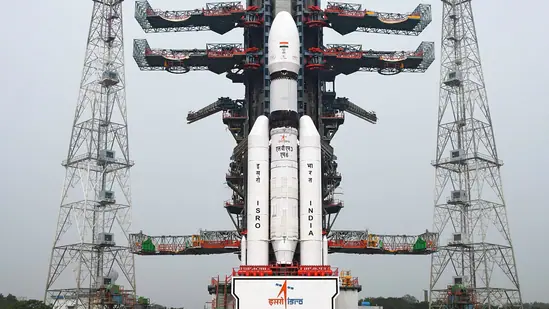
ISRO’s LVM3-M6 launches BlueBird 6, the heaviest satellite from Indian soil, enhancing direct-to-smartphone broadband capabilities.
New Delhi : Launch Vehicle Mark-3 (LVM3)-M6, India’s “Baahubali” rocket, launched BlueBird 6, a cutting-edge communications satellite from US pioneer AST SpaceMobile, this morning from Sriharikota in Andhra Pradesh. This is the largest payload that an Indian rocket has ever carried. The objective is to beam broadband directly from space to regular smartphones without the need for specialized equipment.
The rocket, which was 43.5 meters tall and propelled by two S200 solid boosters, took off magnificently at 8:55 am from the second launch pad at this spaceport, which is located approximately 135 kilometers east of Chennai, as the 24-hour countdown came to an end.
The spacecraft BlueBird Block-2, which was flying on the rocket, detached after a flight of roughly fifteen minutes and arrived at its intended orbit at a height of roughly 520 kilometers.
Dr. V Narayanan, Secretary of the Department of Space and Chairman of ISRO, stated that “LVM3-M6 successfully and precisely” injected the BlueBird Block-2 communication satellite in the desired orbit.
Also read : Kerala SIR 2026 Voter List Released: How to Check Your Name Online
“This is the heaviest satellite that an Indian launcher has ever lifted from Indian territory. “This is one of the best performances of any launch vehicle in the global arena,” Narayanan added. “This is also the third fully commercial mission of LVM-3 and the vehicle has demonstrated its excellent track record.”
The launch was referred to by Prime Minister Narendra Modi as “a significant stride in India’s space sector.”
“A significant milestone in India’s space journey was reached with the successful launch of the LVM3-M6, which sent the heaviest satellite ever launched from Indian soil—the US spacecraft BlueBird Block-2—into its designated orbit. It enhances India’s capacity for heavy-lift launches and solidifies our expanding position in the international commercial launch market,” Prime Minister Modi stated.
The BlueBird 6 satellite is a member of the upcoming BlueBird Block-2 communication satellites, which are intended to give common mobile cellphones direct access to cellular broadband connectivity in space.
The US-based AST SpaceMobile (AST and Science, LLC) and NewSpace India Ltd (NSIL), a commercial division of ISRO, have signed a commercial deal that includes the mission.
To prevent a collision, the launch was postponed by ninety seconds.
In order to exercise caution, ISRO chose to postpone the Launch Vehicle Mark 3 M6 mission by ninety seconds. The original departure time of 8:54 am was changed to 8 hours, 55 minutes, and 30 seconds.
ALSO READ : Yogi Adityanath Criticizes Opposition, Stresses House-to-House SIR Completion in Agra
The Baahuballi rocket’s flight path may have collided with other satellites or debris, according to ISRO, which is why there was a delay. Since thousands of satellites are traveling overhead, the space above Sriharikota is becoming crowded, therefore these delays are not out of the ordinary.
Mark-3 Launch Vehicle
The BlueBird 6s a three-stage launch vehicle that consists of a cryogenic upper stage (C25), a liquid core stage (L110), and two solid strap-on motors (S200). It can carry 4,200 kg of cargo to Geosynchronous Transfer Orbit (GTO) with a lift-off mass of 640 tonnes and a height of 43.5 m.
LVM3 has successfully launched two OneWeb missions with 72 satellites, Chandrayaan-2, and Chandrayaan-3 in its previous missions. The LVM3-M5/CMS-03 mission, which was successfully completed on November 2, was the previous LVM3 launch, according to ISRO.