
NEW DELHI :The Ministry of External Affairs (MEA) addressed ongoing discussions regarding the India Myanmar border land swap proposal on Tuesday.
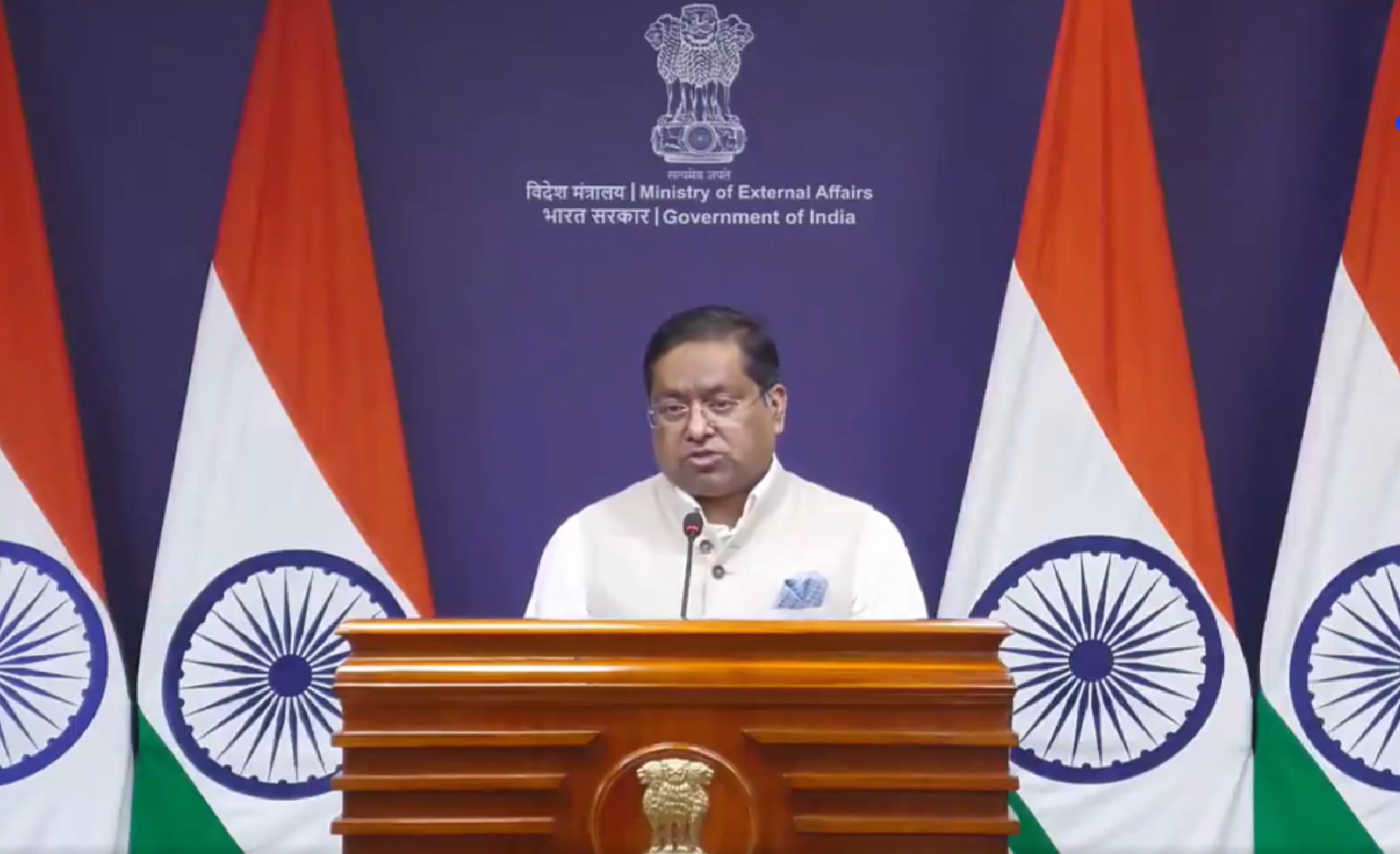
Addressing a press conference in New Delhi, MEA spokesperson Randhir Jaiswal confirmed that discussions on unresolved border sectors remain active.
“There are certain areas on the border which are yet to be settled,” Jaiswal stated during the briefing.
“Discussions on those sectors are ongoing,” he added, responding to questions about potential land exchanges along the Manipur frontier.
His statements follow a report by The Diplomat citing official government documents dated May 26, 2026.
The report indicated that New Delhi is examining a strategic proposal to exchange roughly 1.4 square miles of territory.
Specifically, this land exchange focuses on a 2.8 km stretch between border pillars 65 and 68 in Manipur’s Chandel district.
Consequently, resolving this legacy dispute would allow authorities to erect auxiliary boundary pillars and complete border demarcation smoothly.
However, the proposed territorial adjustments have stirred intense debate among civil society organizations across Manipur.
Therefore, the central government faces the dual task of securing international frontiers while addressing domestic regional concerns effectively.
| Border Sector / Parameter | Existing Status | Proposed Structural Change | Primary Strategic Objective |
| Pillars 65 to 68 (Chandel) | Unsettled 2.8 km border stretch | 1.4 sq mile territorial exchange | Complete physical border demarcation |
| Total International Frontier | 1,643 km total porous boundary | Complete physical security fencing | Stop illegal migration and cross-border crime |
| Free Movement Regime (FMR) | Scrapped by Centre in 2024 | Mandatory passport and visa regime | Control insurgent movements across borders |
| Demarcated Boundary Status | 1,472 km demarcated with pillars | 171 km remaining unresolved | Establish permanent legal boundary lines |
Also Read : Digital Arrest Scam Supreme Court Directions: RBI Ordered to Frame Mule Account SOPs in 4 Weeks
Rationale Behind the Proposed Land Swap Along the Manipur Frontier
India shares a porous 1,643 km international boundary with Myanmar across four northeastern states.
These states include Arunachal Pradesh, Nagaland, Manipur, and Mizoram.
While authorities have demarcated nearly 1,472 km using boundary pillars, around 171 km remains unresolved.
The unresolved stretches lie primarily in Manipur’s Kabaw Valley and Arunachal Pradesh’s Lohit sector.
Historically, ambiguous boundaries prevented security agencies from constructing permanent physical fences along critical border sectors.
However, the central government announced a comprehensive plan to fence the entire 1,643 km border recently.
Additionally, New Delhi scrapped the long-standing Free Movement Regime to enhance national security.
Consequently, executing the India Myanmar border land swap proposal helps fast-track demarcation between pillars 65 and 68.
Once teams erect new boundary pillars, construction crews can erect physical security fencing without territorial disputes.
Moreover, settling these alignment issues helps curb illegal immigration, drug smuggling, and insurgent movements across the border.
Diplomatic Precedents and Bilateral Border Negotiations
Bilateral discussions regarding boundary demarcation have progressed through formal diplomatic channels over recent years.
During high-level talks in New Delhi, Indian officials discussed unresolved sectors directly with Myanmar leadership.
Specifically, negotiators evaluated a 2017 Ministry of External Affairs alignment proposal alongside auxiliary pillar installations.
Furthermore, territorial exchanges with neighboring countries have successful precedent in modern Indian diplomatic history.
For instance, India and Bangladesh successfully ratified the historic Land Boundary Agreement in 2015.
Under that landmark deal, New Delhi transferred 111 enclaves to Dhaka while receiving 51 Bangladeshi enclaves in return.
That agreement successfully resolved a complex 41-year-old border dispute while stabilizing peripheral communities along eastern borders.
Similarly, officials view targeted land adjustments as a legal mechanism to finalize ambiguous international borders permanently.
Key Objectives of Frontier Demarcation
- Accelerated Border Fencing: Enables uninterrupted construction of physical barriers along sensitive mountain sectors.
- Eradication of Safe Havens: Stops cross-border insurgent groups from exploiting porous boundary lines.
- Clear Legal Mapping: Replaces colonial-era ambiguities with mutually agreed geographic coordinates.
Local Opposition and Civil Society Pushback in Manipur
Despite strategic national security benefits, news of the potential exchange triggered swift local pushback in Manipur.
The Coordinating Committee on Manipur Integrity (COCOMI) issued strong warnings against ceding any state territory.
Representing prominent Meitei civil society organizations, COCOMI stated that Manipur’s territorial integrity remains non-negotiable.
“If the proposal is translated into action, COCOMI will not remain a silent spectator,” the organization declared.
Furthermore, leaders emphasized that inherited historical boundaries must be defended without compromise.
They noted that Manipur lost historical areas since merging with the Indian Union in 1949.
Therefore, civil leaders cautioned New Delhi against taking unilateral decisions without consulting local stakeholders directly.
In response, state officials reaffirmed that public consensus and national security interests will guide all final boundary determinations.
Security Outlook and Future Steps for Border Completion
Ultimately, finalizing the border demarcation remains a vital security priority for India’s northeastern frontier.
While diplomatic discussions continue, the Centre remains committed to securing vulnerable border sectors comprehensively.
Furthermore, official surveys and joint inspections will determine exact geographic alignments before any formal agreement takes effect.
Consequently, balancing diplomatic objectives with local regional sensitivities will prove essential for long-term frontier stability.
As bilateral talks proceed, New Delhi aims to establish a peaceful, fully fenced, and clearly demarcated international boundary.