
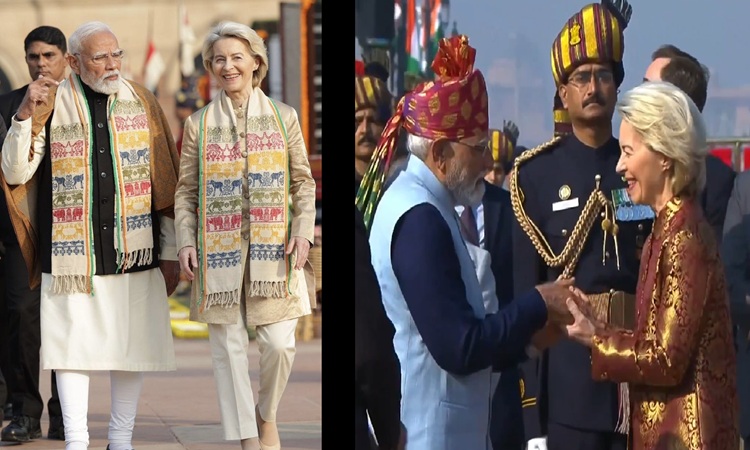
India-EU Trade Deal Finalised Long-Awaited Trade Agreement. Historic Free Trade Agreement Creates 2-Billion-People Market.
India and the European Union have finalised a long-pending free trade agreement, marking a major geopolitical and economic milestone.
The agreement establishes one of the world’s largest free trade zones, covering nearly two billion people.
The announcement came during the high-level India-EU Summit in New Delhi.
The summit brings together leaders from both sides to reset strategic and economic ties.
The European Union delegation is led by Ursula von der Leyen and Antonio Costa.
India is represented by Narendra Modi.
Europe and India are making history today.
We have concluded the mother of all deals.
We have created a free trade zone of two billion people, with both sides set to benefit.
This is only the beginning.
We will grow our strategic relationship to be even stronger. pic.twitter.com/C7L1kQQEtr
— Ursula von der Leyen (@vonderleyen) January 27, 2026
India-EU FTA Creates Major Global Trade Bloc
The India-EU trade deal creates a free trade area accounting for roughly one-quarter of global GDP.
As a result, the agreement significantly reshapes global supply chains.
Trade negotiations between India and the EU resumed in 2022 after a decade-long pause.
Momentum increased last year amid growing global trade uncertainty.
Unlike other trade negotiations, talks between India and the EU progressed with fewer disputes.
Both sides respected core economic sensitivities during discussions.
India protected its agriculture and dairy sectors.
Meanwhile, the EU secured commitments in automobiles, wines, spirits, and industrial machinery.
ALSO READ :Venezuela Accuses US of Testing Advanced Weapons During Maduro Capture Operation
Key Sectors Set to Benefit on Both Sides
Under the agreement, India gains wider access to European markets for key exports.
These include textiles, chemicals, seafood, and value-added manufactured goods.
These sectors faced pressure due to global tariff disruptions.
Therefore, the agreement offers timely relief to Indian exporters.
At the same time, European firms gain easier entry into India’s expanding consumer market.
Priority sectors include aircraft components, high-end machinery, electronics, medical devices, and clean technology.
Moreover, the deal supports supply-chain diversification away from single-market dependence.
This aspect aligns with long-term strategic autonomy goals for both partners.
Strategic and Security Cooperation Expanded
The India-EU trade deal extends beyond commerce.
Both sides have also agreed to deepen cooperation in defence, security, and mobility.
A structured security partnership strengthens maritime security and cyber cooperation.
Additionally, a mobility framework improves talent movement and academic exchanges.
Leaders are also set to adopt a comprehensive strategic roadmap for 2026 to 2030.
This agenda covers climate action, digital innovation, and critical technologies.
Furthermore, the agreement strengthens coordination in multilateral forums.
It enhances joint responses to geopolitical and economic disruptions.
Global Context Behind the Agreement
The deal gains importance amid shifting global trade dynamics.
Rising protectionism has reshaped international economic alignments.
Trade tensions involving the United States accelerated India-EU convergence.
Both sides sought stability amid tariff pressures and supply-chain shocks.
Analysts note that the partnership strengthens economic resilience.
It also positions India and the EU as a counterweight in global trade governance.
The agreement signals renewed confidence in rule-based trade systems.
It reinforces commitment to open markets and fair competition.
Ratification Timeline and Next Steps
Following the announcement, legal vetting and ratification will begin.
The process may take five to six months.
If timelines hold, the agreement could take effect early next year.
Businesses on both sides are already preparing for implementation.
Governments will release sector-specific guidelines after ratification.
Industry consultations are expected during the transition phase.