
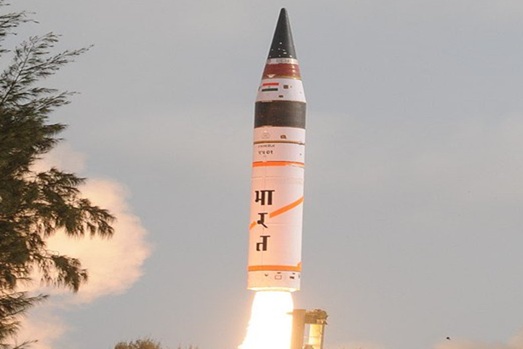
India Develops Advanced Bunker-Buster Variant of Agni-5 Missile Amid Rising Global Security Concerns
India’s Agni-5 Bunker-Buster Missile: A Game-Changer in Modern Warfare and Regional Security
As military tensions evolve across the globe, India is accelerating its own advancements in strategic weaponry, unveiling a groundbreaking development in missile technology. The Defence Research and Development Organisation (DRDO) is working on a conventionally armed variant of the Agni-5 missile, designed specifically as a bunker-buster with unprecedented destructive capability.
The new missile, currently in development, is capable of carrying a 7,500-kilogram conventional warhead, making it one of the largest non-nuclear bunker-buster payloads in the world. Unlike the original Agni-5 — an intercontinental ballistic missile (ICBM) intended for nuclear delivery — this new variant is engineered to neutralize fortified underground military installations, offering India a formidable edge in tactical and strategic scenarios.
What is a Bunker Buster?
A bunker buster missile is a specialized weapon designed to destroy heavily fortified underground targets such as enemy command centers, missile silos, and storage facilities buried under layers of reinforced concrete or rock.
Unlike conventional missiles that explode on impact or above ground, bunker busters are designed to penetrate deep into a target before detonating. They feature:
- Hardened casing to withstand impact and burrow through solid structures.
- Delayed-action fuse to trigger the explosion after reaching the desired depth.
- High mass and kinetic energy to maximize impact force.
How Do Bunker Buster Missiles Work?
These missiles combine aerodynamic engineering, dense warhead design, and precision guidance systems to achieve their target. Upon impact, the missile’s reinforced nose cone allows it to pierce several meters of concrete or earth. Once embedded deep within the target, the internal detonation causes massive shockwaves, collapsing bunkers from the inside.
India’s upgraded Agni-5 version, with its massive 7.5-tonne payload, is reportedly among the most powerful conventional bunker busters being developed globally. It is designed not only for range but for depth-based destruction, allowing India to target deeply buried enemy installations with surgical precision.
Strategic Importance of the Agni-5 Bunker Buster
In an era where adversaries are investing in underground military infrastructure, India’s move to develop a robust bunker-buster capability represents a shift in modern warfare strategy.
Key Combat Applications
- Neutralizing Enemy Command Centers: Many military leadership hubs are buried deep to avoid detection and air strikes. The Agni-5 variant is designed to penetrate these defences.
- Destroying Missile Silos: Underground silos in Pakistan and China could be destroyed before missile launches in a conflict.
- Targeting Ammunition Depots and Weapon Storage: Striking deeply buried stockpiles would disrupt enemy logistics.
- Suppression of Air Defense Infrastructure: Buried radar stations and control rooms supporting surface-to-air missiles could be neutralized preemptively.
Relevance to India’s Security Environment
India faces persistent threats along its borders with China and Pakistan, where underground military fortifications are common. The Agni-5 bunker buster would be particularly effective in mountain warfare, such as in Arunachal Pradesh and Ladakh, where terrain often necessitates tunnelled bunkers and protected logistics bases.
Operation Sindoor: A Catalyst for Indigenous Development
The ongoing global tensions, especially following Operation Sindoor, where the U.S. demonstrated its precision bombing capabilities using advanced bunker busters in the Middle East, have prompted India to fast-track indigenous alternatives. India’s move signals a strategic alignment with evolving warfare doctrines emphasizing non-nuclear deep-strike capabilities.
Tactical and Strategic Benefits for India
- Preemptive Strike Capability: In the event of hostilities, India could target hardened military facilities to reduce enemy response capabilities.
- Strategic Deterrence: The possession of such a high-impact conventional missile can deter adversaries from relying on underground bases.
- Psychological and Diplomatic Leverage: It adds a new layer to India’s power projection, especially in multi-front scenarios.