
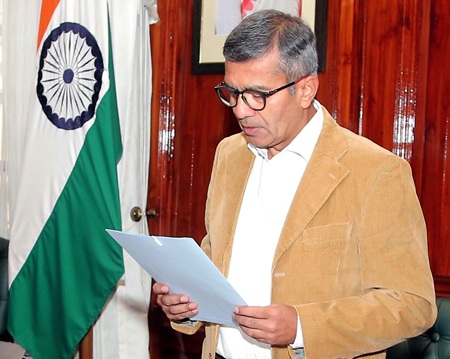
Defence Secretary Urges Private Sector to Boost R&D After Success of Operation Sindoor
Operation Sindoor Spurs Defence Push: Private Sector Asked to Scale R&D
Defence Secretary makes strong pitch for private innovation in defence as India’s indigenous military tech gains global attention
New Delhi, May 31, 2025: In a bold address to India’s industrial leaders, Defence Secretary Rajesh Kumar Singh called for increased private sector investment in research and development (R&D) to complement the government’s defence manufacturing efforts. Speaking at the Confederation of Indian Industry’s (CII) Annual Business Summit 2025, Singh assured that a significant volume of defence orders would follow for companies willing to innovate.
“We’ll bury you, the private sector, in orders — but there is a need for greater investment in R&D from your side,” Singh said, underscoring the urgent need to scale indigenous capability.
The statement came just days after Operation Sindoor, a successful demonstration of India’s homegrown military prowess, boosted both domestic confidence and international interest in Indian defence technology.
Operation Sindoor Marks a Turning Point
Held earlier this month, Operation Sindoor showcased advanced Indian-made systems including:
- Pinaka rocket launchers
- Akash missile defence systems
These technologies were tested in live-combat simulations against hostile targets, with Indian forces intercepting drones and missiles from across the Pakistan border and striking terror camps and airbases. Notably, these systems outperformed Chinese counterparts in battlefield scenarios, positioning India as a serious player in global defence exports.
Suggested Multimedia:
- Infographic: “Key Systems Showcased in Operation Sindoor”
Alt Text: Diagram showing Pinaka and Akash systems in action - Video Clip: “Operation Sindoor: India’s Defence Showcase to the World”
Private Sector’s Role: From Buyer to Builder
Despite defence expenditure declining to 1.9% of GDP, Singh highlighted that the capital allocation is being used more efficiently.
“Last year, for the first time in many years, the capital budget was fully utilised,” he said. “Procurement decisions are happening faster now.”
The Defence Secretary acknowledged legacy issues such as the licence raj, which historically hindered private entry into defence production. However, he affirmed that the government is actively:
- Streamlining licensing and procurement
- Reducing bureaucratic delays
- Creating a dynamic, industry-friendly defence ecosystem
Rajnath Singh Reinforces Vision of Atmanirbhar Defence
Defence Minister Rajnath Singh also addressed the summit, echoing the push for self-reliance and global competitiveness.
“India cannot remain dependent on others for its security. Our goal is not just import substitution — we aim to become a global hub for defence manufacturing,” he said.
He referred to Operation Sindoor as a “battlefield validation” of India’s indigenous defence technologies. With proven operational capabilities, Singh reiterated that India must transition from a buyer to a builder.
A Golden Opportunity for India’s Defence Industry
The success of Operation Sindoor has created momentum in defence diplomacy and arms exports. With global buyers now showing interest in Indian systems, the onus lies on the private sector to build upon this demand through technology and agility.
Both the Defence Secretary and Minister stressed that the future of India’s military power lies in public-private synergy, where policy stability, technological innovation, and industrial capacity must align.
“The time is now. The world is watching, and India has a chance to lead,” said Rajnath Singh in his closing remarks.