
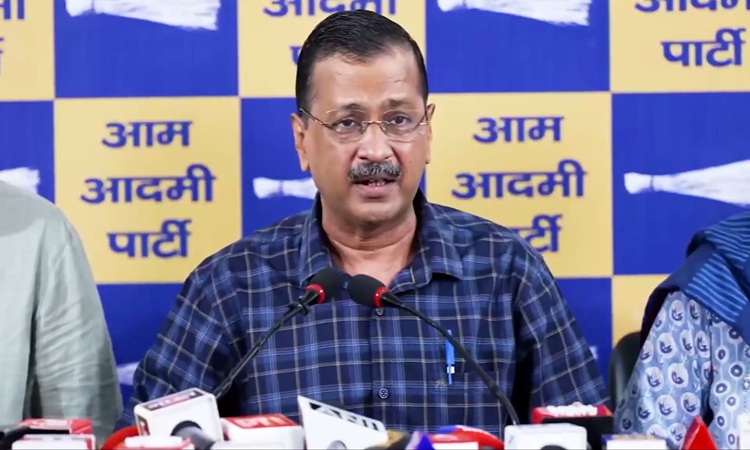
Kejriwal Slams Government Over Trade Decisions
New Delhi, August 29 — Aam Aadmi Party (AAP) national convenor Arvind Kejriwal launched a strong attack on Prime Minister Narendra Modi, urging the Centre to impose a 100% tariff on US goods in retaliation to Washington’s trade measures.
आज हमारा देश दो तरफ़ से मार खा रहा है।
एक तरफ़ ट्रंप ने 50% टैरिफ लगाकर हमारी इंडस्ट्री को खत्म करने की साज़िश की और दूसरी तरफ़ मोदी जी ने अमेरिका के सामने झुकते हुए अमेरिका के माल पर टैरिफ ही हटा दिया।
अब भारत का किसान और व्यापारी दोनों बर्बाद होंगे।
ट्रंप ने 50% लगाया था… pic.twitter.com/8gZ9xaNy75
— Arvind Kejriwal (@ArvindKejriwal) August 28, 2025
Speaking at a press conference in Delhi, Kejriwal said India must respond decisively to the recent 50% tariff imposed by the United States on Indian exports. He accused the government of failing to defend India’s trade and agricultural interests, particularly by lifting import duties on American cotton.
According to Kejriwal, this decision has left millions of Indian farmers vulnerable. He demanded an immediate rollback of the order that temporarily removed the 11% duty on American cotton imports between August 19 and September 30.
Concerns Over Farmers’ Livelihoods
The AAP leader alleged that the removal of import duties on US cotton would result in cheaper foreign produce flooding the Indian market. He claimed this would undercut domestic cotton prices by ₹15–20 per kilogram, making it nearly impossible for local farmers to compete.
Kejriwal stressed that this was not just an economic issue but a threat to farmers’ survival. With Indian agriculture already facing challenges such as rising input costs and unstable markets, the duty waiver could worsen the crisis.
He warned that farmers may be forced into distress sales or even left with no option but to abandon cultivation if the government does not restore protective tariffs.
Call for Tougher Stand Against Washington
During the briefing, Kejriwal also criticised US President Donald Trump, describing him as weak when dealing with global opposition. He accused the Modi government of showing unnecessary restraint in the face of Washington’s trade aggression.
Kejriwal argued that a tougher stance was necessary to protect India’s sovereignty and economic interests. He said India, with a population of 140 crore and a vast consumer market, should not appear weak in negotiations.
According to him, a 100% tariff on American imports would not only send a strong message but also help safeguard domestic industries and agriculture from unfair competition.
Political and Economic Implications
The controversy comes at a time when India’s trade relations with the United States are under strain. The imposition of additional US tariffs on Indian exports has sparked concerns among exporters, traders, and policymakers.
Critics of the government believe the decision to remove cotton duties reflects political pressure from Washington. On the other hand, supporters argue that temporary waivers may ease raw material shortages for certain industries.
For farmers, however, the decision has added uncertainty to an already volatile market. Analysts note that cotton producers, particularly in Maharashtra, Gujarat, and Telangana, may face the harshest impact.
Demands for Policy Reversal
Kejriwal demanded the immediate reinstatement of the 11% import duty on US cotton. He stressed that ignoring farmers’ concerns would lead to widespread discontent and long-term economic damage.
He framed the issue as a betrayal of farmers’ trust, accusing the government of quietly making decisions without transparency. The AAP leader insisted that any trade concessions to foreign powers must not come at the expense of Indian livelihoods.
What Lies Ahead
The demand for stronger retaliation against US tariffs adds pressure on the Modi government to recalibrate its trade strategy. With general elections approaching, the ruling party faces the dual challenge of protecting farmers’ interests while managing international relations.
Whether the government reinstates duties or opts for a negotiated settlement with Washington, the outcome will likely shape the debate on India’s economic sovereignty.