
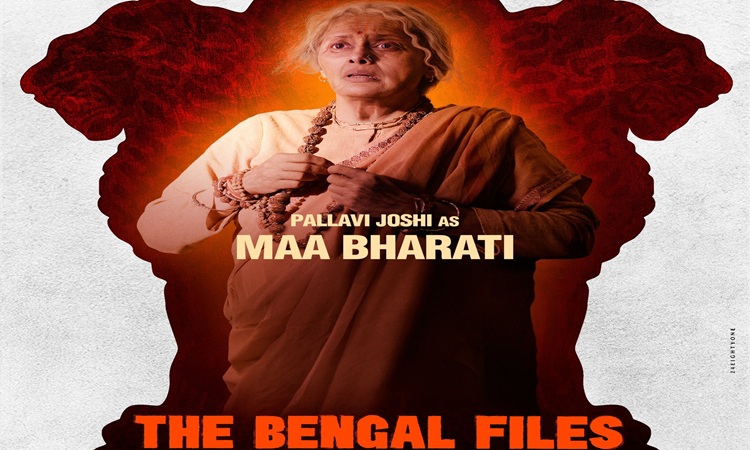
Pallavi Joshi’s Open Letter to the President
A day before its scheduled release, The Bengal Files has sparked a major political storm in West Bengal. The film, directed by Vivek Agnihotri and produced by Pallavi Joshi, is the final chapter in the acclaimed Files Trilogy. However, the movie is facing an unofficial ban in Bengal as multiplex owners back out under alleged political pressure.
On Thursday, Pallavi Joshi issued an urgent appeal to President Droupadi Murmu, urging her intervention to protect her constitutional right to free expression. “With a heavy heart, I reach out to you, not for favours, but for protection,” Joshi wrote in an open letter shared on Instagram.
She alleged that theatre owners were being threatened and intimidated by workers of the ruling Trinamool Congress (TMC) party. As a result, multiplexes across West Bengal have refused to screen the film, despite no official ban from the government.
Allegations of Political Intimidation
In her appeal, Pallavi Joshi accused the Mamata Banerjee-led TMC government of systematically blocking the film. She stated that even before its completion, the Chief Minister had mocked the project. Since then, multiple FIRs were filed, police allegedly blocked the trailer, and newspapers reportedly avoided carrying advertisements.
Joshi further revealed that her family had been facing daily threats, while theatre owners received warnings of possible violence if they allowed screenings. “There is no official ban, yet an unofficial ban silences the film before people can see it,” she wrote.
She also tagged Prime Minister Narendra Modi, the Ministry of Home Affairs, and the Ministry of Information and Broadcasting in her social media appeal, seeking urgent government intervention.
The Bengal Files: What the Film Portrays
The Bengal Files, slated for release on September 5, explores the long-suppressed history of Bengal during the mid-20th century. The narrative highlights the Hindu genocide of Direct Action Day (1946), the Noakhali riots, and the trauma of Partition.
Joshi emphasized that the film aims to shed light on historical events often overlooked in mainstream narratives. “Truth is under siege in Bengal,” she said, insisting that the audience should be allowed to decide the film’s merit rather than political forces dictating its release.
The film follows the legacy of Agnihotri’s previous works, The Tashkent Files (2019) and The Kashmir Files (2022), both of which stirred debates and faced resistance before achieving significant success.
Larger Debate: Free Speech vs Political Sensitivities
The controversy around The Bengal Files has reignited the debate over freedom of expression in cinema. While filmmakers assert their right to tell stories, governments and political groups often push back, citing law and order concerns.
In this case, critics argue that the film could trigger unrest in West Bengal, a state with a history of communal tensions. Supporters, however, view the opposition as a direct attack on democratic rights.
Joshi’s appeal to the President highlights this tension. “I plead for your intervention to uphold my constitutional rights and ensure its release in Bengal,” she wrote, calling the current situation a silencing of truth through fear.
What Lies Ahead for the Film
Despite the hurdles, The Bengal Files will release nationwide on September 5, 2025, except in Bengal where multiplexes have withdrawn. The production team has hinted at exploring legal options if theatres continue refusing under intimidation.
Industry analysts believe the controversy may actually boost the film’s box office performance outside Bengal, as audiences rally around the idea of suppressed voices. Social media campaigns using hashtags like #TheBengalFiles and #RightToFreedom have already gained traction.
For now, all eyes are on whether the President’s Office or central agencies will intervene to ensure the film’s screening in Bengal, or if the standoff will continue.