
India Is Now the World’s 4th Most Equal Country ahead of USA & China. What Does It Mean for Us?
New Delhi, July 6, 2025 — India has officially become the fourth most equal country in the world, according to a World Bank report that examined income distribution across 167 nations. This news comes with profound implications for ordinary citizens, businesses, and policymakers alike.
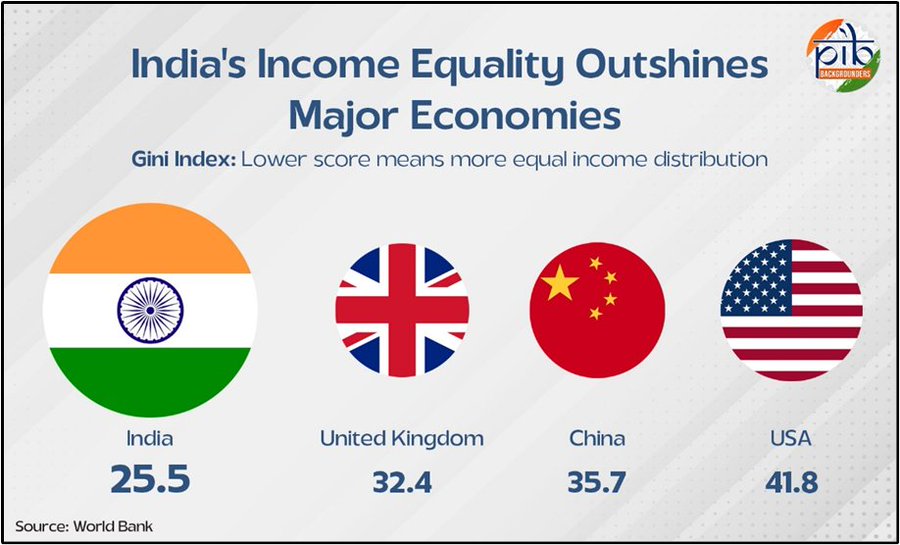
With a Gini Index score of 25.5, India has surpassed major global economies like the United States (41.8) and China (35.7). Only three countries—Slovak Republic, Slovenia, and Belarus—rank higher in income equality.
But beyond the numbers, what does this really mean for the average Indian? Here’s a breakdown.
What Is the Gini Index and Why Should We Care?
The Gini Index is a globally accepted measure of economic inequality. A score of 0 represents perfect equality, while 100 indicates extreme inequality.
India’s score of 25.5 not only places it in the “moderately low inequality” category but also signals that income and wealth are being shared more evenly than ever before in recent history. In 2011–12, India’s score stood at 28.8, and this steady improvement reflects positive structural changes.
For citizens, this means fairer access to income, services, and opportunities, especially in rural and underprivileged areas.
From Extreme Poverty to Inclusion: A Decade of Transformation
One of the most striking revelations from the World Bank report is that 171 million Indians have been lifted out of extreme poverty over the past decade. The percentage of the population living on less than $2.15/day—the global threshold for extreme poverty—has dropped dramatically from 16.2% in 2011–12 to just 2.3% in 2022–23.
What it means for us:
- Improved livelihoods for millions of Indians who were once at the bottom of the economic pyramid.
- Better access to education, healthcare, housing, and basic amenities, especially in rural and semi-urban areas.
- Increased consumer power, which drives local economies and supports job creation.
The Role of Government Schemes: Jan Dhan, DBT, and More
India’s leap in equality rankings didn’t happen overnight. It was driven by a series of government initiatives aimed at financial inclusion and welfare distribution:
- PM Jan Dhan Yojana: Brought over 480 million unbanked citizens into the formal financial system.
- Direct Benefit Transfer (DBT): Reduced leakages in subsidy distribution, ensuring the poor received entitlements directly in their bank accounts.
- Stand-Up India and Mudra Yojana: Helped marginalized communities and small businesses gain credit access.
- Rural electrification, sanitation, and housing programs: Improved quality of life and contributed to better income distribution.
What it means for us:
- Greater financial autonomy for women and low-income households.
- More transparent and efficient governance, reducing corruption and middlemen.
- Improved trust in public systems, creating a stronger social contract between citizens and the state.
Global Comparison: India Outshines US, China, and UK
India’s position as the 4th most equal country is even more significant when viewed globally. The United States, long seen as a land of opportunity, has a Gini Index of 41.8—placing it in the “high inequality” category. China, despite rapid growth, scores 35.7, indicating rising disparities.
India, by contrast, has shown that it’s possible to grow economically while also ensuring a fairer distribution of wealth.
What it means for us:
- Enhanced global reputation as a responsible and inclusive economy.
- Increased investor confidence, as stable and equitable societies are less prone to unrest and economic shocks.
- Potential influence on global development policy, with India serving as a model for other emerging nations.
The Road Ahead: Can We Do Even Better?
India is now on the verge of entering the “low inequality” group, which includes countries with a Gini score below 25. With continued focus on rural development, women’s empowerment, skill-building, and universal healthcare, this milestone is well within reach.
However, challenges remain. Urban-rural divides, informal sector vulnerabilities, and youth unemployment need continued policy attention.
What it means for us:
- A reminder that equality is not just about income, but also about access to quality jobs, education, and opportunity.
- Citizens must stay engaged and informed, demanding accountability and transparency.
- Businesses and civil society must collaborate to ensure inclusive growth reaches every corner of the country.