
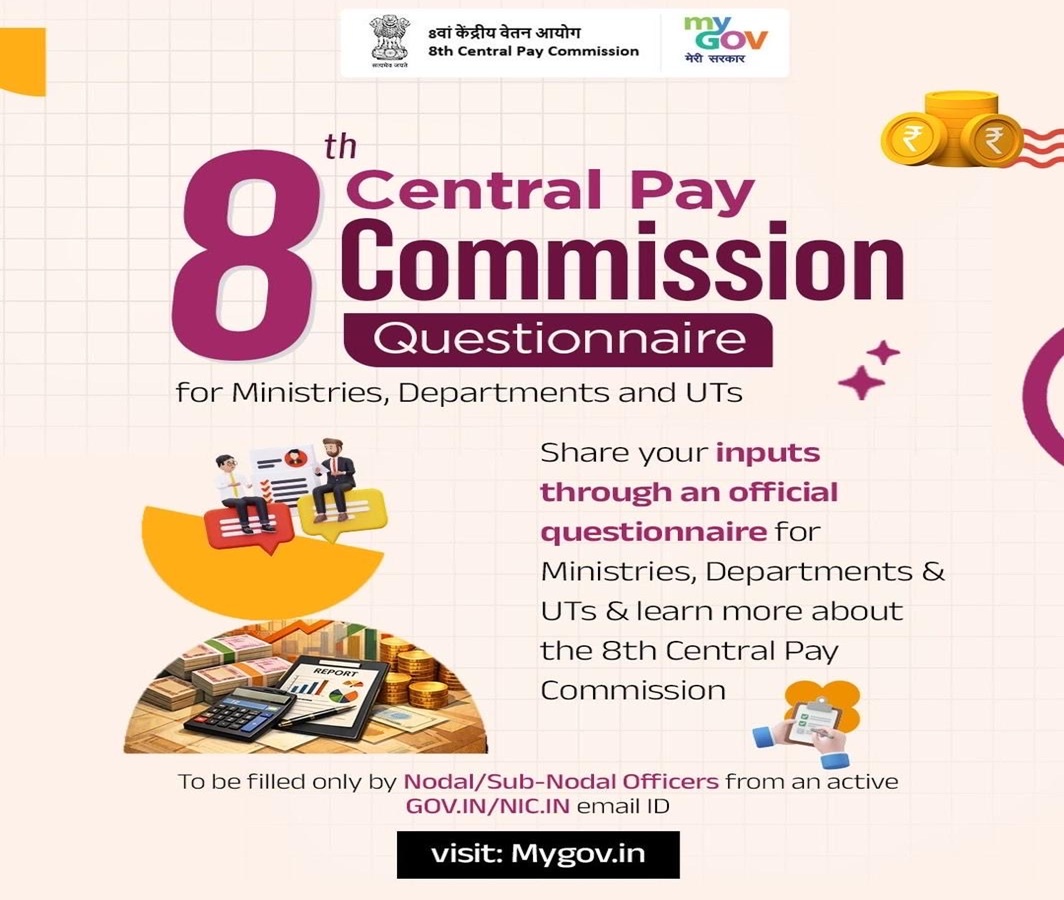
NEW DELHI : Significant financial discussions are actively spreading across the country regarding the next major revision for public sector workers. Specifically, the newly constituted panel is conducting intense regional deliberations to determine the upcoming 8th Pay Commission salary hike. Led by retired Supreme Court Judge Justice Ranjana Prakash Desai, the commission is meeting multiple employee associations directly. Meanwhile, top staff representatives have officially submitted a detailed memorandum demanding a comprehensive restructuring of the existing pay scales. They argue that the current minimum compensation parameters fail to address the heavy economic pressures of modern life. Consequently, the unions are aggressively pushing for a massive 283 percent increase in the baseline monthly salary. This highly anticipated decision will directly affect nearly 50 lakh active workers and about 70 lakh retired pensioners. Therefore, the outcome of these ongoing field visits remains an exceptionally critical issue for the entire national workforce.
Read More : Kuldeep Kumar Raises Concern Over Lal Bahadur Shastri Hospital Corruption Allegations in Delhi
Staff Unions Propose Revolutionary 3.83 Fitment Factor
The core debate centers around a specialized financial multiplier that shapes the baseline structure of public sector earnings. This crucial tool, known officially as the fitment factor, converts existing basic pay into a completely revised salary matrix. During the previous administrative revision a decade ago, the government fixed this specific calculation multiplier at 2.57. However, the Confederation of Central Government Employees and Workers is currently demanding a much higher 3.83 fitment factor. If accepted, this change would instantly elevate the minimum basic pay from 18,000 rupees to 69,000 rupees. Additionally, employee organizations emphasize that this bold proposal relies heavily on rigorous scientific and nutritional calculations. They note that the cost of managing basic household necessities has risen dramatically over the last ten years. Thus, staff side representatives state that a major upward correction is absolutely necessary to restore consumer purchasing power.
Expanded Five Unit Family Model Drives Wage Calculations
To justify the substantial 8th Pay Commission salary hike demands, federations are challenging old structural assumptions. Previously, the administrative bodies calculated basic living costs by using a standard three-unit family framework. That older layout accounted only for the primary employee, a spouse, and a maximum of two young children. In contrast, the current 2026 proposal introduces an expanded five-unit family formula to better reflect social realities. This revised calculation explicitly includes dependent parents and dependent parents-in-law within the core household baseline expenditure. Furthermore, the unions incorporated updated nutritional guidelines from the Indian Council of Medical Research regarding daily calorie needs. They adjusted baseline expenditure norms for essential components like housing, water utilities, electricity, and skill development. Therefore, the resulting data indicates that a fair, need-based minimum wage must sit significantly higher than current levels.
Nationwide Consultations Move into Critical Phase
The central pay panel is moving rapidly to complete its extensive regional evaluation schedule across major states. Specifically, the high-level committee recently finished a productive two-day round of interactive discussions in the capital of Uttar Pradesh. Following those initial sessions in Lucknow, the panel will travel to Bhubaneswar to meet eastern zone representatives. Subsequently, the administrative members will arrive in Kolkata to gather detailed feedback from prominent regional worker associations. The secretariat confirmed it will not grant any further extensions for submitting formal hard-copy or digital memorandums. This strict stance shows that the panel intends to stick firmly to its initial analytical timelines without delays. Analysts suggest these regional meetings are vital because they allow local branches to highlight specific geographic inflation differences. Through these direct field visits, the commission aims to build an incredibly balanced, data-driven report for the treasury.
Cost of Living Concerns Dominate Employee Grievances
While multiple large unions are demanding a 69,000 rupee baseline, other smaller federations are proposing a conservative 55,000 rupees. Despite these minor differences in exact figures, all staff representatives strongly agree on the underlying economic challenges. They consistently highlight the escalating costs of quality healthcare, advanced higher education, and basic food items across urban centers. The current baseline of 18,000 rupees has remained entirely unchanged since the implementation of the last pay panel. Although periodic dearness allowance revisions offer partial relief against inflation, they do not increase real underlying savings. Consequently, workers argue that their real take-home earnings have experienced significant erosion over the past several fiscal years. This shared financial strain explains why the demand for a substantial 8th Pay Commission salary hike enjoys universal support.
Final Report Submission Expected by Mid 2027
Despite the massive momentum behind these union proposals, the final decision remains entirely under government jurisdiction. The pay panel has an official eighteen-month window to complete its comprehensive research and stakeholder mapping. According to initial gazette notifications, the commission expects to submit its final recommendation report around mid-2027. Once received, specialized internal ministries will meticulously examine the fiscal impact of the proposed changes on the budget. It is important to note that the government is not legally bound to accept the highest fitment demands. Historically, the final implemented numbers often balance employee welfare with the overall fiscal capacity of the state treasury. Meanwhile, the commission continues to analyze market data to ensure its eventual proposals remain realistic and sustainable.
Anticipation Builds Across All Administrative Levels
Ultimately, the evolving discussions around the 8th Pay Commission salary hike mark the beginning of a massive fiscal transition. Millions of households are tracking every single regional visit of the commission with immense interest and hope. Furthermore, the outcome will likely reshape consumption patterns, retirement planning, and public sector employment trends for decades. As the panel moves from Bhubaneswar to Kolkata, the technical contours of the new pay matrix will become clearer. For now, central employees must wait patiently as the independent committee compiles its monumental national report.
Note : This above news is based on the facts available and the final notification regarding the salary hike will be announced by government