
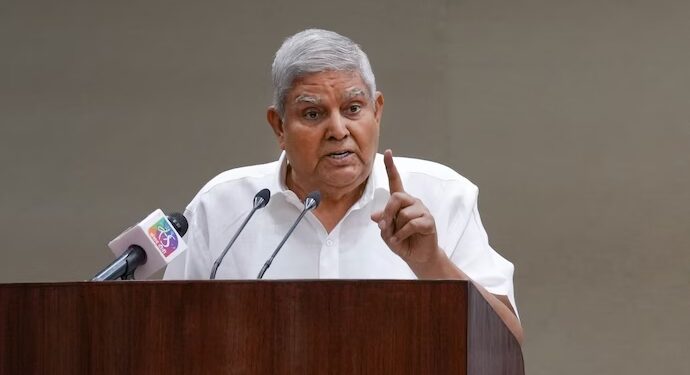
“Cannot have a situation where you direct the President of India” VP Jagdeep Dhankhar on Supreme Court’s Directive
Vice President Jagdeep Dhankhar Criticizes Supreme Court’s Directive on Presidential Assent to Bills
New Delhi : Vice President Jagdeep Dhankhar has strongly criticized a recent Supreme Court order directing the President to act within a specific timeframe on bills sent by governors for consideration. Calling it a worrying development, he expressed concerns over judicial overreach and the erosion of constitutional boundaries.
The Supreme Court’s ruling last week mandated that when a governor reserves a bill for the President under Article 201 of the Constitution, a decision must be taken within three months. The judgment was part of a verdict that criticized the Tamil Nadu Governor’s prolonged inaction and withholding of assent to state bills. The court emphasized that the President does not have a “pocket veto” and must either grant or deny assent in a timely manner.
Vice President Dhankhar termed the development unprecedented, stating, “We never bargained for democracy for this day. President being called upon to decide in a time-bound manner, and if not, becomes law.” He warned against what he saw as judicial overreach and said, “So we have judges who will legislate, who will perform executive functions, who will act as super Parliament, and absolutely have no accountability because law of the land does not apply to them.”
Expressing concern over the erosion of constitutional boundaries, the Vice President reminded the audience of the President’s oath—”to preserve, protect and defend the Constitution.” He emphasized that the President holds a unique and elevated position, unlike others who merely swear to “abide by the Constitution.”
“We cannot have a situation where you direct the President of India and on what basis?” he asked. Referring to constitutional provisions, he said the only authority the judiciary has in such matters is “to interpret the Constitution under Article 145(3)” and even that must be done by a bench of five or more judges.
What the Supreme Court Said
The Supreme Court, while dealing with the Tamil Nadu government’s challenge to the Governor’s delay, stated that constitutional functionaries must act within a reasonable time, even if no specific timeline is mentioned in the law. The bench of Justices JB Pardiwala and R Mahadevan also said that the President’s delay in responding to such bills is open to judicial review. If action is not taken within three months, the court said, valid reasons must be recorded and conveyed to the state concerned.
The judgment further clarified that when questions of a bill’s constitutional validity arise, the executive should not step in to decide. “Only the constitutional courts have the prerogative to study and provide recommendations,” the court said.
Implications and Reactions
The Supreme Court’s directive has sparked a debate on the separation of powers and the role of the judiciary in the legislative process. Supporters of the ruling argue that it ensures timely decision-making and accountability in the legislative process. Critics, however, view it as an encroachment on the executive’s domain and a potential threat to the balance of power among the branches of government.
The Tamil Nadu government’s challenge to the Governor’s delay in granting assent to bills highlights the ongoing tensions between state governments and governors appointed by the central government. The Supreme Court’s intervention underscores the need for clarity and adherence to constitutional procedures in the functioning of state legislatures.
Conclusion
Vice President Jagdeep Dhankhar’s criticism of the Supreme Court’s directive on Presidential assent to bills reflects concerns over judicial overreach and the erosion of constitutional boundaries. As the debate continues, it underscores the importance of maintaining the balance of power among the branches of government and ensuring that constitutional procedures are followed to uphold democratic principles.