
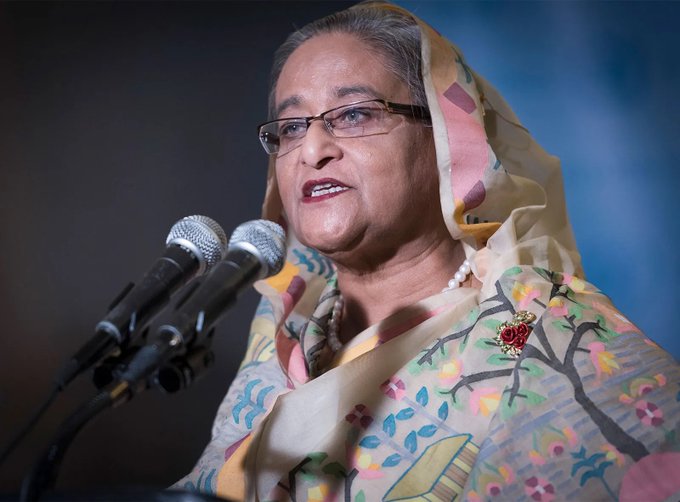
Sheikh Hasina’s Powerful “I’ll Be Back” Message: Bangladesh’s Political Crisis and Terrorism Allegations
Sheikh Hasina’s Powerful “I’ll Be Back” Message Amid Political Crisis in Bangladesh
Former Prime Minister Sheikh Hasina has issued a stark and defiant message to her supporters, promising to return to Bangladesh and pursue justice for members of her political party, the Awami League, who have been targeted by the current government. In a recent social media interaction with family members of Awami League leaders, Hasina expressed strong dissatisfaction with the situation in Bangladesh, alleging political violence, media suppression, and growing terrorism in the country.
Hasina, who was ousted from power during a nationwide movement and subsequently sought refuge in India, has repeatedly criticized the current interim government’s leadership, particularly its chief advisor, Muhammad Yunus. She condemned Yunus for what she described as his personal greed and for betraying the people of Bangladesh by misusing loans for self-enrichment while failing to benefit the public.
Sheikh Hasina’s Condemnation of Political Violence and Terrorism in Bangladesh
In her emotional message, Hasina expressed concern about the escalating political violence in Bangladesh, describing the country as having turned into a “terrorist country.” According to her, leaders and members of the Awami League, along with other opposition figures, are being systematically targeted by violent forces under the current administration. Hasina highlighted how these attacks were not limited to her political party alone, but have extended to journalists, lawyers, artists, and even law enforcement officials.
“Our leaders and workers are being killed in a way that cannot be described,” Hasina remarked, visibly distressed. “Awami League, cops, lawyers, journalists, artists, everyone is being targeted.”
The former Prime Minister also made grave allegations about a media clampdown in Bangladesh. She stated that critical issues, such as rapes, murders, and robberies, are not being reported in the press due to fear of government retaliation. “Nothing can be reported. And if it is reported, the TV channel or newspaper will be targeted,” she claimed, suggesting that the media is under strict censorship.
The Betrayal of Muhammad Yunus and Personal Grievances
A significant portion of Hasina’s remarks focused on Muhammad Yunus, the current chief advisor to Bangladesh’s interim government. She accused Yunus of betraying the people of Bangladesh by exploiting small loans at high-interest rates, which she said were used to fund his luxurious lifestyle abroad. Hasina suggested that Yunus had a “lust for power,” which she believes has been the driving force behind the ongoing crisis in Bangladesh.
Sheikh Hasina revealed how she and her party had once supported Yunus, believing in his vision, but were ultimately disappointed by his actions. “We could not understand his duplicity then, so we helped him a lot. But people did not benefit. He did well for himself,” she said, explaining the deep sense of betrayal she feels.
A Pledge for Justice
Despite the harsh political climate and personal losses she has suffered, Hasina made it clear that she is determined to return to Bangladesh and fight for justice. Reflecting on the personal tragedies she has endured, including the deaths of her father, mother, and brother on the same day, she vowed to bring those responsible for these crimes to justice.
“Allah keeps protecting me, maybe he wants to get some good done through me. Those who have committed these crimes must be punished. This is my pledge,” she stated, emphasizing her unwavering commitment to holding those responsible for the violence accountable.
Hasina’s emotional plea underscores the deep personal and political stakes involved in the ongoing struggle for justice in Bangladesh. Despite being exiled, she remains steadfast in her determination to return to her country and restore what she sees as justice for her party members and the people of Bangladesh.
Political Repression and Growing Divisions in Bangladesh
The escalating political repression in Bangladesh has drawn international concern, with observers noting the increasing restrictions on free speech, media, and political opposition. Hasina’s accusations highlight the tense atmosphere in Bangladesh, where political leaders, activists, and journalists have faced intimidation and violence under the current regime. This environment of fear and suppression is exacerbated by the growing influence of powerful figures like Yunus, whom Hasina believes has aligned himself with forces that threaten the country’s democratic values.
The former Prime Minister’s return to Bangladesh, should it occur, could signal a new chapter in the political drama that has plagued the country for years. As tensions rise, it remains to be seen whether Hasina’s return will result in peaceful political change or further escalation.
Implications for Bangladesh’s Future
Sheikh Hasina’s bold message is not only a personal declaration but also a reflection of the broader political crisis facing Bangladesh. Her call for justice and her criticism of Muhammad Yunus and the current government underscore the deep divides in the country’s political landscape. With a media clampdown and widespread violence against opposition figures, the future of Bangladesh’s democracy remains uncertain.
As political unrest continues to simmer, many are left wondering what the future holds for Bangladesh. Will Hasina’s vow to seek justice resonate with the people, or will the current government’s crackdown on dissent stifle any efforts toward reform?