
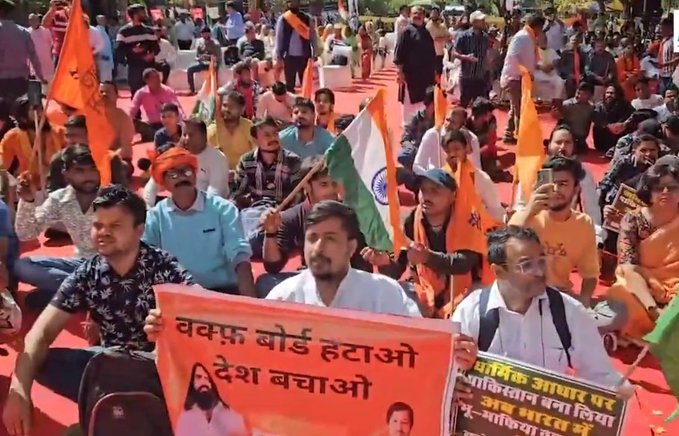
Right-Wing Groups Demand Abolition of Waqf Board in Mahapanchayat
Right-Wing Groups Demand Abolition of Waqf Board, Seek Nationalisation of Properties
In a powerful demonstration of political and social mobilisation, several right-wing organisations held a mahapanchayat on Sunday, extending partial support for the Waqf (Amendment) Bill while calling for the complete abolition of the Waqf Board. The event was organised by the Jansankhya Samadhan Foundation and supported by groups like the Rashtriya Hindu Front, who rallied across the country to voice their opposition to the current functioning of the Waqf Board.
The mahapanchayat, which attracted a significant turnout, sent a memorandum to President Droupadi Murmu, Prime Minister Narendra Modi, and Union Home Minister Amit Shah. The core demand from the participants was the nationalisation of all properties under the Waqf Board, which the organisers claim has caused widespread concern regarding illegal land occupations and religious discrimination.
Key Demands and Political Context
The Waqf Board, a statutory body, oversees the administration of properties belonging to religious communities, primarily Muslims, in India. However, several right-wing factions have raised objections over its functioning, claiming that it has led to the illegal occupation of land belonging to followers of other religions.
According to a statement released by the Jansankhya Samadhan Foundation, the mahapanchayat participants unanimously supported the idea of abolishing the Waqf Board, demanding that the Indian government take over all the properties administered by the body. The petition, which was presented to key political figures, called for a national overhaul of the Waqf system, stating that the properties should be managed by the government under a unified framework.
Anil Chaudhary’s Address: Key Allegations and Criticisms
Anil Chaudhary, President of the Jansankhya Samadhan Foundation, addressed the gathering, articulating the core grievances behind the push to abolish the Waqf Board. He claimed that the Waqf Board had been granted “unlimited rights” through amendments to the Waqf law in 1955, 1995, and 2013, which he believes allowed the board to expand its control over properties beyond its intended jurisdiction.
One of Chaudhary’s primary allegations was that properties belonging to Muslims who migrated to Pakistan during the Partition were handed over to the minority community in 1954. According to the statement, these properties were then claimed by the Waqf Board through a series of legal amendments, enabling it to take control of assets meant for social service activities. He further accused the Waqf Board of “flooding” the country with illegal occupations of land, which he argued violates the property rights of individuals from other religious communities.
Legal and Constitutional Concerns
The mahapanchayat participants found the Waqf Act to be “discriminatory” and argued that it “grossly violates” the constitutional right to equality. This assertion is rooted in the belief that the Waqf system disproportionately benefits one religious group while sidelining others, thus infringing on the principle of secularism guaranteed by the Indian Constitution.
Chaudhary, while addressing these concerns, emphasized that the management of historical properties belonging to Muslims should not be the responsibility of the Waqf Board. Instead, he suggested that a government institution like the Archaeological Survey of India (ASI) could take over the protection and management of such properties. He argued that existing legal structures like the Indian Society Act and Indian Trust Act were sufficient for handling charitable activities such as education and healthcare without the need for a separate religious board.
Support and Opposition to the Movement
While the mahapanchayat gained significant traction among right-wing political groups, it has sparked a wave of opposition from Muslim community leaders and other political factions. Critics argue that the demand for the abolition of the Waqf Board reflects a broader anti-Muslim sentiment rather than a legitimate concern over property rights.
“We must ensure that the Waqf Board remains functional and continues to protect religious and historical properties. The call for its abolition is not based on constitutional values but is part of a broader agenda to create divisions within the country,” said a spokesperson from a leading Muslim organization in India.
However, proponents of the movement maintain that their demands are rooted in the pursuit of equality and fairness for all communities in India. They argue that religious properties should not be managed by a body that is seen as religiously biased, and that nationalisation of these assets could lead to better transparency and accountability.
Political Implications and Future Prospects
The push for the abolition of the Waqf Board and nationalisation of its properties could have significant implications for India’s political landscape, especially as the country heads towards upcoming elections. Right-wing political organisations have been gaining prominence in recent years, and the issue of religious property has emerged as a polarising topic.
While the Waqf (Amendment) Bill has made strides toward reforming the functioning of the Waqf Board, this recent wave of support for its abolition indicates that the issue will continue to be a contentious political debate.
What’s Next for the Waqf Board and Its Future?
In response to these demands, the Indian government has yet to announce any significant policy changes regarding the Waqf Board. However, with the increased political pressure and public discourse, it is expected that the government may revisit the Waqf Act in future legislative sessions. Whether the Waqf Board will be reformed, nationalised, or abolished entirely remains to be seen.
Conclusion
The ongoing demand for the abolition of the Waqf Board has ignited a new political debate about the management of religious properties in India. As right-wing organisations push for nationalisation, the future of the Waqf system and its impact on religious communities remains uncertain. This issue will likely continue to evolve as India’s political landscape faces new challenges and as reform agendas shift in response to public demands.