
September 8, 2026 : The Saudi Pakistan defence pact is facing its first major test after a fresh wave of Houthi attacks struck southern Saudi Arabia.
At least 73 people were injured in the attacks, according to Saudi authorities.
The strikes targeted areas including Abha, Khamis Mushait, Jazan and Najran.
Fires were reported at several sites, including energy facilities and other infrastructure.
The Houthis claimed attacks involving missiles and drones.
Saudi authorities said the attacks represented a serious escalation.
The attacks have raised a crucial question.
If Saudi Arabia, Pakistan and Türkiye agreed that an attack on one would be treated as an attack on all, why has Pakistan not entered the conflict directly?
The answer lies in the wording and structure of the new agreement.
The Saudi Pakistan defence pact creates a framework for collective security.
However, it does not publicly specify that Pakistan must immediately send combat forces whenever Saudi Arabia comes under attack.
That distinction could prove critical as the conflict develops.
Also Read : Sarah Khalifa Sentenced to Death in Major Egyptian Drug Trafficking Trial
What does the Saudi Pakistan defence pact actually say?
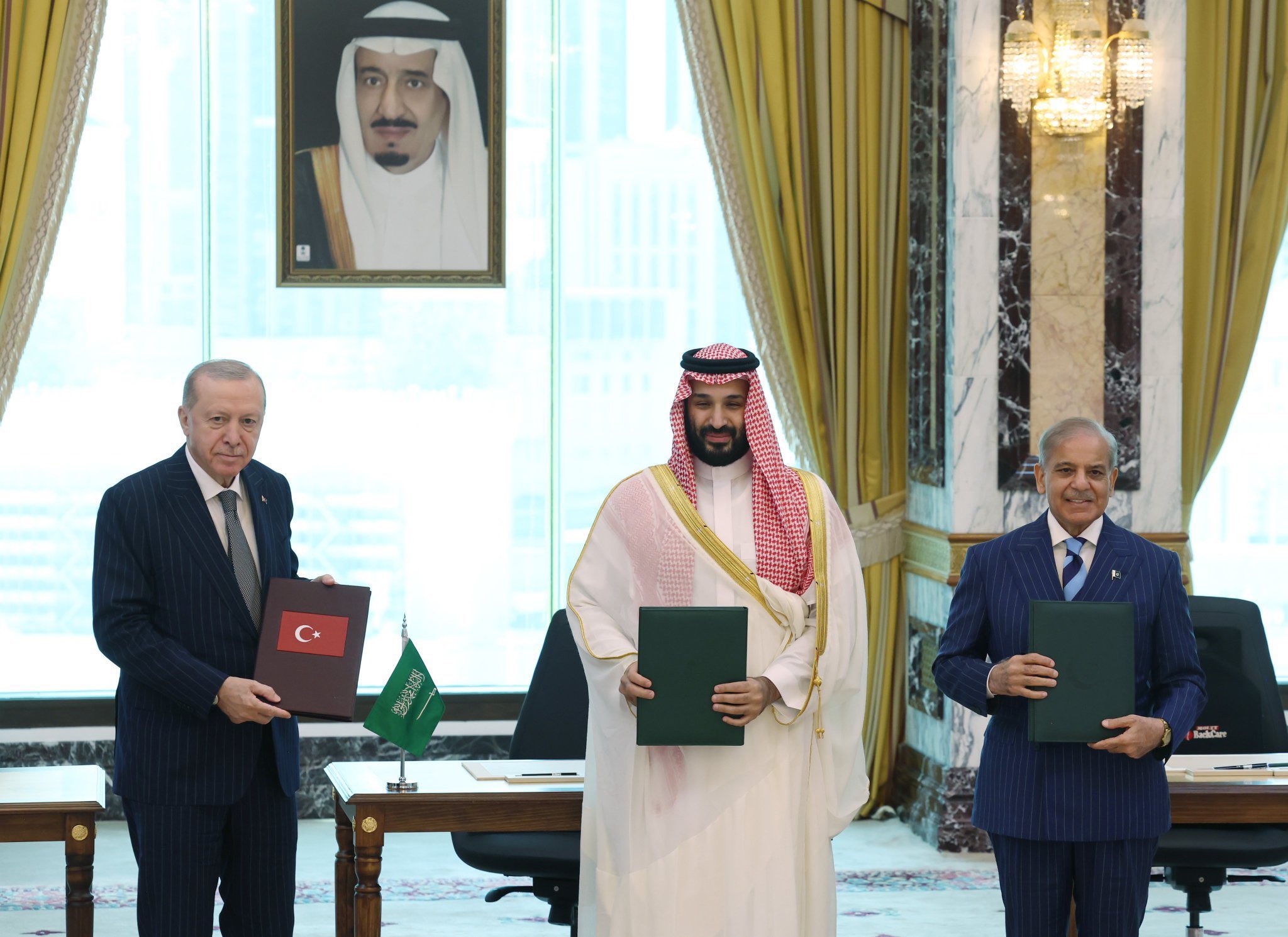
Saudi Arabia, Pakistan and Türkiye signed the Makkah Joint Defence Agreement on August 7.
The agreement was signed in Makkah by Saudi Crown Prince Mohammed bin Salman, Turkish President Recep Tayyip Erdoğan and Pakistani Prime Minister Shehbaz Sharif.
The agreement says an armed attack against any one of the three countries will be regarded as an attack against all three.
It also calls for stronger defence cooperation and collective deterrence.
The Saudi government describes the agreement as part of efforts to strengthen regional security.
However, the publicly available statement does not specify a fixed military response.
It does not create a joint army.
It does not announce a permanent joint command.
It also does not state that Pakistan must immediately launch military operations against an attacker.
That makes the Saudi Pakistan defence pact different from NATO’s Article 5 in practical terms.
NATO members have established structures for collective defence.
The Makkah agreement leaves much more room for individual governments to decide how they respond.
Saudi Pakistan defence pact at a glance
| Key detail | Latest information |
| Agreement | Makkah Joint Defence Agreement |
| Signed | August 7, 2026 |
| Members | Saudi Arabia, Pakistan and Türkiye |
| Location | Makkah, Saudi Arabia |
| Core principle | Attack on one treated as attack on all |
| Joint military command | Not publicly established |
| Automatic combat response | Not publicly specified |
| Current test | Houthi attacks on Saudi Arabia |
Why Pakistan has not sent troops to fight the Houthis
The latest Houthi attacks do not automatically trigger a Pakistani combat deployment.
Pakistan already has a significant defence relationship with Saudi Arabia.
Pakistani personnel have served in Saudi Arabia for training and security cooperation.
Pakistan has also provided military assistance and air-defence support to the kingdom.
Therefore, Islamabad can support Saudi security without directly joining offensive operations in Yemen.
That distinction gives Pakistan several options.
It could increase intelligence sharing.
It could strengthen air-defence cooperation.
It could provide additional training.
It could also increase military deployments for defensive purposes.
Directly attacking Houthi positions would represent a much larger escalation.
Such a decision could pull Pakistan deeper into a regional conflict.
Analysts have therefore described the agreement as a flexible security framework rather than a NATO-style alliance.
Pakistan has another problem: its border with Iran
The Saudi Pakistan defence pact places Islamabad in a delicate position.
Pakistan shares a long border with Iran.
It has also maintained diplomatic and economic links with Tehran.
The Houthis are backed by Iran, although the exact degree of Iranian operational control over Houthi decisions remains contested.
A direct Pakistani military campaign against the Houthis could therefore create serious regional consequences.
Islamabad also has its own security challenges.
Pakistan faces militant threats along its western border.
It must also manage economic pressures at home.
Opening another military front abroad would carry significant financial and strategic costs.
That makes a defensive response more attractive than direct intervention.
Pakistan can demonstrate support for Saudi Arabia without immediately entering Yemen’s conflict.
The Houthis are testing the agreement’s credibility
The latest attacks matter because they came after the new agreement was signed.
The Houthis have repeatedly targeted Saudi territory during periods of heightened regional tension.
On September 8, the latest attacks injured 73 people and affected facilities in southern Saudi Arabia.
The strikes also pushed oil prices higher.
Brent crude moved close to $100 a barrel as markets reacted to concerns about regional energy supplies.
The attacks therefore have implications beyond Saudi Arabia.
Jazan is close to Yemen and contains important energy infrastructure.
Any prolonged disruption could affect regional supply chains.
It could also increase insurance and shipping costs.
September 8 Houthi attack
| Indicator | Latest figure/status |
| People injured | 73 |
| Main affected areas | Abha, Khamis Mushait, Jazan, Najran |
| Weapons claimed by Houthis | Missiles and drones |
| Energy infrastructure affected | Yes |
| Oil market reaction | Brent approached $100 |
| Saudi response | Security and military measures under review |
Why this is not a simple NATO-style obligation
The Saudi Pakistan defence pact uses strong collective-defence language.
Yet the agreement leaves important operational questions unanswered.
There is no publicly defined response ladder.
There is no announced rule requiring air strikes.
There is no publicly confirmed requirement for ground troops.
There is also no publicly announced deadline for a military response.
That ambiguity may have been deliberate.
Each country has different security priorities.
Saudi Arabia wants stronger regional deterrence.
Pakistan wants closer ties with Riyadh without becoming trapped in another regional war.
Türkiye wants a larger role in Middle Eastern security.
The three governments can therefore cooperate while retaining control over their individual military decisions.
The Atlantic Council has similarly assessed that the agreement should not be viewed as a NATO-like alliance.
Saudi Arabia has other defence arrangements
The Saudi Pakistan defence pact is not Riyadh’s only security arrangement.
Saudi Arabia already has extensive defence cooperation with the United States.
It also has collective defence arrangements through the Gulf Cooperation Council.
Pakistan and Saudi Arabia signed a separate mutual defence agreement in September 2025.
Those existing arrangements show that Saudi Arabia has been building several layers of security partnerships.
The Makkah agreement adds another layer.
It does not necessarily replace Saudi Arabia’s existing alliances.
Pakistan can therefore interpret its commitment through several overlapping agreements.
That gives Islamabad greater flexibility during a rapidly changing crisis.
What Pakistan could do next
The Saudi Pakistan defence pact could still produce a stronger Pakistani response.
However, that response does not have to mean Pakistani forces attacking the Houthis.
Islamabad could increase defensive deployments.
It could provide additional air-defence equipment.
It could expand intelligence cooperation with Saudi Arabia.
It could also support Saudi military planning and surveillance.
A direct combat role would be a much bigger decision.
Such a move could damage Pakistan’s relations with Iran.
It could also create domestic political pressure.
Pakistan would therefore have to weigh its commitment to Saudi Arabia against its own national interests.
Türkiye faces a similar calculation
Türkiye is also a key part of the new agreement.
Ankara has significant military capabilities and a growing defence industry.
However, Türkiye has its own regional priorities.
It has been involved in several Middle Eastern conflicts and diplomatic initiatives.
A direct intervention against the Houthis could expand Ankara’s military commitments.
Therefore, Türkiye may also prefer defensive assistance over immediate offensive action.
The three countries can strengthen Saudi air defence without declaring a broader war.
That may be the practical meaning of collective defence under the new pact.
What happens to the Saudi Pakistan defence pact now?
The latest attacks have exposed the difference between political solidarity and automatic military intervention.
The Saudi Pakistan defence pact gives Saudi Arabia an important diplomatic and security signal.
It tells potential adversaries that Riyadh has strong partners.
However, the agreement does not publicly guarantee an immediate Pakistani military response.
That flexibility may become increasingly important if Houthi attacks continue.
For Pakistan, the challenge is to support Saudi Arabia without entering an open-ended conflict.
For Saudi Arabia, the challenge is to turn the new partnership into credible deterrence.
For Türkiye, the agreement offers another route to increase its regional security role.
The next major test will come if attacks intensify.
If Saudi territory faces sustained missile and drone strikes, Islamabad could face stronger pressure to demonstrate what the agreement really means.
For now, the Saudi Pakistan defence pact appears to provide a framework for cooperation rather than an automatic order for war.
The latest Houthi offensive has made that distinction impossible to ignore.