
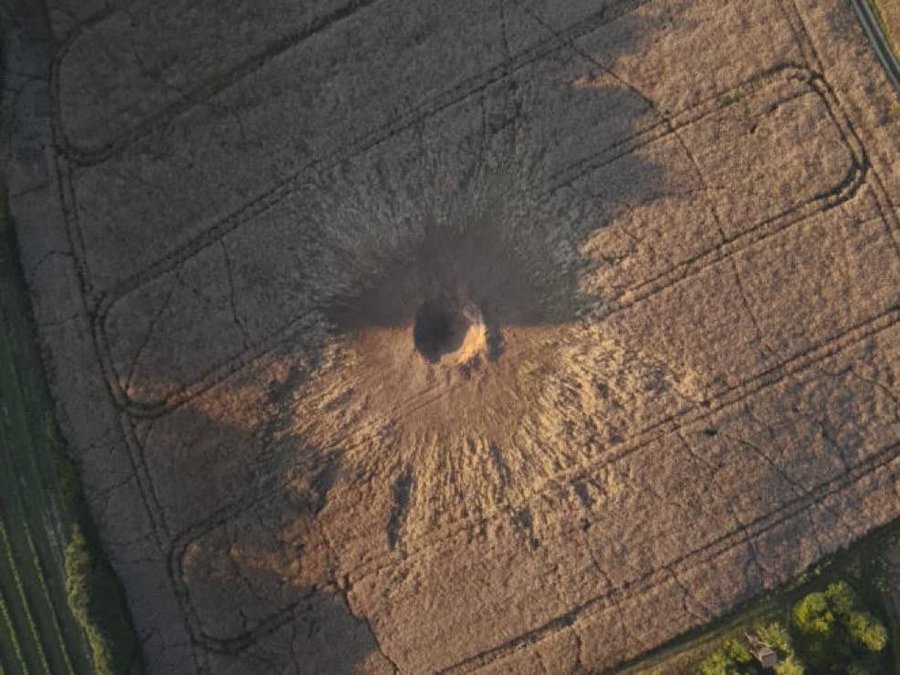
In the early hours of July 30, air raid sirens echoed across the eastern Lublin region. Polish military commanders scrambled F-16 fighter jets after detecting an airborne threat approaching national airspace. Shortly afterward, authorities confirmed a suspected Russian missile impact in Poland near the quiet village of Tarnawa-Kolonia.
Local residents reported hearing a powerful explosion that shook windows across nearby agricultural fields. Military search teams located a ten-meter wide crater situated roughly two kilometers from residential homes. Consequently, Polish Prime Minister Donald Tusk convened emergency security meetings to evaluate the situation immediately.
Initial findings suggest that the projectile was a Russian Kh-101 cruise missile. Moreover, Ukrainian officials confirmed that dozens of long-range missiles targeted neighboring Ukrainian territories overnight. Therefore, this fresh suspected Russian missile impact in Poland has raised severe international concerns regarding European defense.
Timeline of the July 30 Airspace Incursion
├──► 03:40 AM : Radar tracks unidentified object moving westward across border
├──► 03:42 AM : Polish F-16 fighter jets scrambled to intercept airborne target
├──► 03:46 AM : Radar signal vanishes over Lublin Voivodeship rural area
├──► 06:15 AM : Military helicopter locates crater near Tarnawa-Kolonia
└──► 10:00 AM : Prime Minister Donald Tusk addresses emergency defense panel
Also Read : British Kashmiris Stage Shoe Protest Outside Pakistan Consulate
Emergency Response After Missile Landed in Farmland
Fortunately, emergency crews confirmed that no civilian injuries occurred during the crash. Polish bomb disposal experts secured the area quickly to collect remaining metallic debris. However, the presence of military equipment caused widespread anxiety among local residents.
Prime Minister Donald Tusk visited the site personally to inspect ongoing investigation efforts. “All indications point toward a Russian missile,” Tusk stated during a brief press conference. Furthermore, he emphasized that air defense operators were prepared to shoot down the object.
Incident Summary: Tarnawa-Kolonia Impact
- Location : Tarnawa-Kolonia, Lublin Voivodeship
- Distance to Border: ~90 kilometers from Ukrainian border
- Target Type : Suspected Kh-101 Cruise Missile
- Casualty Count : Zero civilian injuries or fatalities
Additionally, military spokespersons clarified that radar operators tracked the intruder for several continuous minutes. Subsequently, a Polish Mi-24 helicopter verified the impact site in the undeveloped field.
Nevertheless, leaders stressed that investigators will confirm technical details before issuing final conclusions. This latest suspected Russian missile impact in Poland demonstrates persistent risks along NATO borderlines.
Depleted Patriot Stockpiles Heighten Air Defense Concerns
Following the event, Polish officials announced plans to consider sending additional Patriot air defense equipment. These surface-to-air defense batteries remain vital for intercepting advanced ballistic threats across eastern Europe. However, global stockpiles of Patriot missiles have grown critically low over recent months.
American defense manufacturers struggle to meet rising demands across multiple international conflict zones. Consequently, Ukrainian President Volodymyr Zelenskyy repeatedly urged Western partners to supply more defensive assets. Moreover, Washington recently granted licenses allowing Ukraine to manufacture selected Patriot components domestically.
Air Defense Supply Chain Challenges
├──► Global Demand : Unprecedented orders from European & Middle Eastern allies
├──► Industry Output : Defense manufacturers scaling assembly line capacities
├──► Local Licensing : Washington authorizes Ukrainian component manufacturing
└──► Border Protection: Poland evaluates deployment of extra battery units
Meanwhile, defense experts warn that interceptor shortages make border surveillance far more difficult. Indeed, protecting vast territorial boundaries requires constant aerial patrols and radar coverage. Therefore, European defense ministers are re-evaluating military supply chains to prevent future airspace breaches.
NATO Vigilance Increases Across Eastern Flank
Unquestionably, this suspected Russian missile impact in Poland renewed urgency within NATO headquarters. Allied commanders stepped up airborne surveillance flights along the entire eastern perimeter. Furthermore, neighboring Baltic nations expressed immediate solidarity with Polish authorities during emergency consultations.
In addition, diplomatic representatives warned that spilling conflict across borders risks broader regional escalation. Consequently, Western governments called for stricter monitoring along sovereign borders. Meanwhile, military analysts emphasize that cruise missiles frequently stray off course due to electronic jamming.
Key Defensive Measures Implemented
- Increased Patrols : Continuous F-16 and AWACS surveillance sorties
- Radar Tracking : Enhanced ground monitoring along eastern borders
- Allied Consultations: Emergency briefings with NATO alliance members
- Civil Protection : Streamlined warning systems for frontier towns
Accordingly, Polish defense forces remain on elevated readiness status across eastern provinces. Local authorities urged residents to report any unusual aerial activity or debris immediately. Overall, NATO partners affirm their total commitment to collective defense guarantees.
Summary of the Incident in Poland
In conclusion, the suspected Russian missile impact in Poland highlights ongoing volatility along European borders. Prime Minister Donald Tusk assured citizens that national security forces remain completely vigilant.
Moving forward, Polish investigators will complete thorough forensic analysis of all recovered debris. Meanwhile, international allies monitor eastern European airspace to maintain stability and prevent further incursions.