
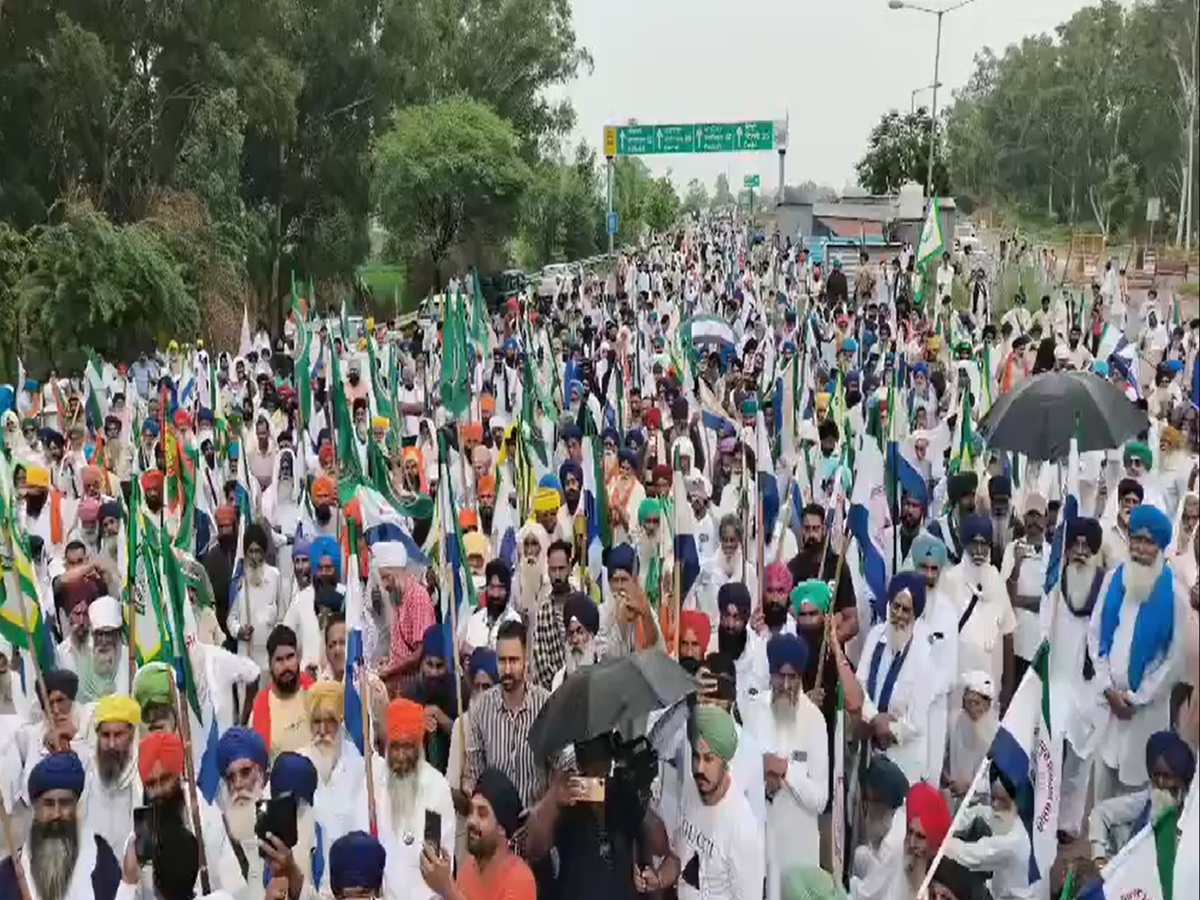
SHAMBHU BORDER : Hundreds of Punjab farmers marched toward the national capital on Tuesday morning. However, security forces halted the massive convoy at the state boundary line. Consequently, the Farmers March to Delhi Stopped at Shambhu Border after heavy police deployment. Multi-layered barricades now block key highway corridors between Punjab and Haryana. Demonstrators immediately converted the blocked transit route into an active protest encampment.
Furthermore, agricultural leaders accused authorities of violating their fundamental right to gather peacefully. Thousands of activists planned to attend a major Kisan Mahapanchayat in Delhi. The Desh Bachao Morcha organized this rally to voice widespread rural economic concerns. Specifically, union leaders strongly oppose proposed bilateral trade agreements between India and Washington.
Meanwhile, local police established rigid checkpoints along all primary boundary roads. Concrete barriers and iron spikes now line the main interstate thoroughfares. Therefore, news that the Farmers March to Delhi Stopped at Shambhu Border sparked immediate regional concern.
Read More : “Hear Our Students”: Diljit Dosanjh, Shabana Azmi, and Top Stars Rally Behind Protesting Students
Heavy Security Fortifications and Regional Disruption
Union representatives expressed strong outrage over the sudden physical highway blockage. They alleged that police erected barriers well inside Punjab territory without authorization. Additionally, activist leaders claimed the local state administration remained entirely silent. Multiple farmer unions participated in the coordinated movement across the region.
Convoys from the Kisan Mazdoor Sangharsh Committee left early Tuesday morning. Similarly, members of the Kisan Mazdoor Morcha joined the highway march. Groups from Azaad Kisan Morcha also moved toward the border barricades. However, security personnel turned back every oncoming vehicle fleet from Punjab.
In contrast, farmer groups from Haryana continued moving toward Delhi. Local activists from Ambala and Kurukshetra managed to bypass early checkpoints. Consequently, tension remains exceptionally high along the entire northern border zone. Demonstrators insist they will remain on the highway until passage opens. Therefore, the Farmers March to Delhi Stopped at Shambhu Border remains a primary focal point.
Security personnel deployed water cannons and heavy equipment along key highways. Moreover, multi-layered wire mesh covers the primary concrete traffic dividers. Commuters faced severe traffic delays as authorities diverted heavy commercial transport. Consequently, daily travel between regional cities suffered significant operational delays today.
Agricultural Opposition to Proposed India-US Trade Agreement
The current protest centers primarily on proposed international trade negotiations. Official joint statements from earlier this year outlined new bilateral trade frameworks. Negotiators aim to finalize the initial trade tranche by autumn 2026. However, Indian agricultural unions strongly oppose opening domestic markets to foreign goods.
Activists argue that the deal extends far beyond standard trade arrangements. The proposed pact encompasses agriculture, dairy, digital trade, and intellectual property. Furthermore, farm leaders point to historical American trade policy objectives. Washington has long sought reduced import tariffs on agricultural commodities.
Specifically, foreign exporters want expanded market access for soybeans, cotton, and maize. Foreign producers also seek lower tariffs on ethanol, apples, and almonds. Indian farmers fear heavily subsidized American imports will crash local crop prices. Consequently, small landholders face severe financial risks from cheap foreign commodities.
Safeguarding Dairy Producers and Rural Livelihoods
India’s domestic dairy sector represents a vital backbone of rural survival. Nearly eighty million rural families depend directly on daily milk production. Therefore, opening dairy markets to foreign competition poses massive economic risks. Foreign dairy products benefit from high international production subsidies. Domestic small-scale farmers simply cannot compete against massive industrial conglomerates.
| Sector Impact | Key Risk Factor | Affected Population |
| Dairy Production | Subsidized foreign imports | 80 Million rural families |
| Grain & Pulses | Lower tariff barriers | Small & marginal landholders |
| Agri-Commerce | Market price volatility | Local traders & micro-enterprises |
Furthermore, any disruption in milk prices affects the entire rural economy. Small traders, feed suppliers, and local processors face direct financial loss. Micro-enterprises across rural towns rely entirely on steady agricultural income. Consequently, union leaders demand total transparency regarding ongoing trade talks.
The Desh Bachao Morcha wants all negotiation documents placed in public. Moreover, leaders insist on comprehensive consultations with all rural stakeholders. They demand the government pause talks until farmers approve the terms. Therefore, the Farmers March to Delhi Stopped at Shambhu Border highlights deep economic anxiety.
Calls for Immediate Government Transparency and Policy Reconsideration
Demonstrators at the border refuse to disperse without formal assurances. They insist that national agricultural interests must take priority over trade deals. Furthermore, union representatives called for emergency meetings with senior central ministers. They demand immediate written guarantees protecting domestic crop and dairy prices.
Meanwhile, local authorities maintain strict perimeter control to prevent forward movement. Emergency medical units and food distribution centers now operate along the highway. Regional civil society groups have expressed strong solidarity with the marching farmers. They urge central authorities to resolve the impasse through constructive dialogue.
Consequently, public pressure builds on policymakers to address these structural grievances. As night falls, thousands of protesters remain camped on the open highway. The ongoing standoff that saw the Farmers March to Delhi Stopped at Shambhu Border continues to draw national attention.