
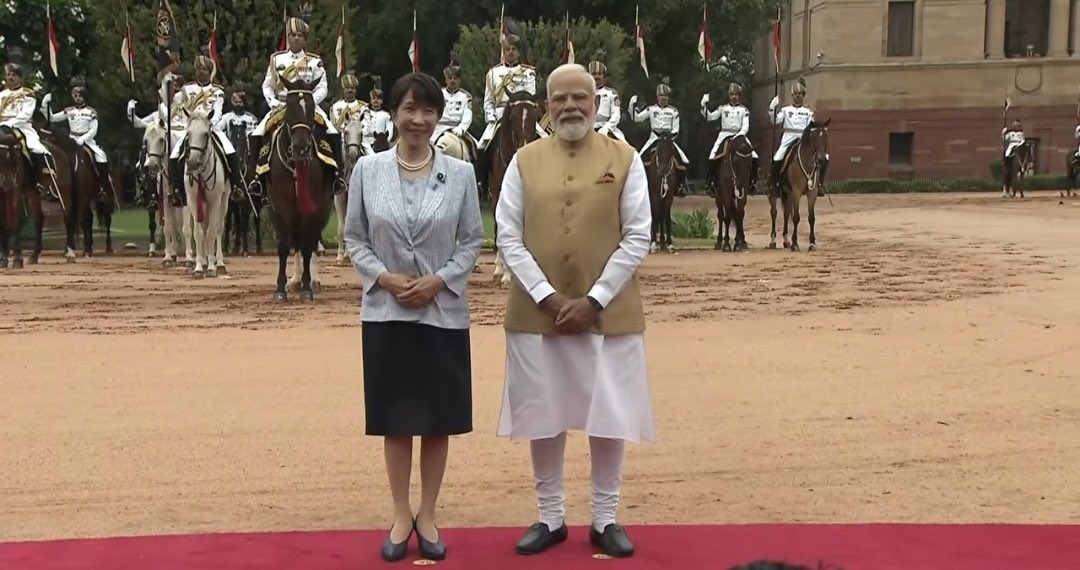
NEW DELHI : Diplomatic ties between New Delhi and Tokyo entered a powerful new era on Thursday morning. Japanese Prime Minister Sanae Takaichi received a magnificent ceremonial Guard of Honour at the historic forecourt of Rashtrapati Bhavan. Prime Minister Narendra Modi personally welcomed his Japanese counterpart, establishing a warm tone for the highly anticipated India-Japan Annual Summit.
📸The ceremonial reception of Japanese PM Sanae Takaichi held at @rashtrapatibhvn. PM @narendramodi attended the ceremonial reception. 🇮🇳 🤝🇯🇵@PMOIndia । @MEAIndia । @IndianEmbTokyo । @MIB_India । @PIB_India pic.twitter.com/ebXByuGj4X
— All India Radio News (@airnewsalerts) July 2, 2026
This high-profile visit marks Takaichi’s first official bilateral state visit to India since taking office. The arrival underscores a mutual determination to fortify the existing Special Strategic and Global Partnership. Furthermore, the extensive three-day diplomatic itinerary aims to address critical geopolitical challenges while creating highly resilient commercial corridors across Asia.
High-Profile Reception Sets Stage for Flagship Bilateral Talks
The formal state reception began with a series of military salutes, demonstrating profound diplomatic respect. Prime Minister Narendra Modi introduced members of the Indian Cabinet to the visiting delegation, emphasizing the deep bilateral goodwill. Following the grand ceremony, the Japanese Cabinet Public Relations Officer released a public statement expressing deep excitement regarding the visit.
Additionally, Union Minister of State for Science and Technology Jitendra Singh had officially received Takaichi on Wednesday evening. Her plane touched down at the Palam Technical Airport, where high-ranking foreign ministry officials immediately established protocol lines.
“We look forward to wide-ranging discussions covering critical bilateral issues and regional stability markers,” Prime Minister Modi shared on social media.
Moreover, the timing of this flagship platform coincides with shifting global alignments, specifically across the Western Pacific region. Therefore, both democratic administrations are prioritizing immediate strategic synchronization to keep international shipping channels open and safe.
Private Investments Surpass Billions in Historic Tech Agreements
The core economic driver of this diplomatic assembly centers on a massive wave of private sector funding. Specifically, Japanese media networks confirm that private corporations are ready to inject $12.5 billion into the expanding Indian market. The capital injection rolls out through approximately 120 targeted cooperation agreements during the active summit timeline.
| Priority Collaboration Sector | Strategic Goals / Joint Initiative | Projected Economic Impact |
| Semiconductor Logistics | Building redundant, secure supply chains outside volatile zones | Reduces regional manufacturing bottlenecks |
| Clean Energy Infrastructure | Developing the Green Ammonia Project located in Odisha | Accelerates carbon-neutral industrial goals |
| Next-Gen Mobility | Advanced lithium-ion battery production and high-speed rail | Modernizes metropolitan transit grids |
Furthermore, over 150 elite business executives from Tokyo traveled to participate directly in the concurrent Japan-India Economic Forum. Japan’s Deputy Chief Cabinet Secretary Masanao Ozaki noted that these commercial ties will strengthen government-to-government relations. Specifically, the framework prioritizes national security alongside economic safety parameters to build independent supply networks.
Prioritizing Economic Security and Indo-Pacific Resilience
Historically, the structural foundation of this partnership relies heavily on frequent, high-level political engagement across global forums. Most recently, the two world leaders conducted brief consultations during the G7 Summit in France. However, this dedicated platform allows both sides to evaluate the entire spectrum of mutual agreements systematically.
Additionally, the diplomatic agendas focus sharply on five priority sectors established during the initial Economic Security Dialogue. These areas include critical minerals, advanced pharmaceuticals, clean energy, artificial intelligence, and communication technology. Consequently, the resulting memoranda of understanding will insulate both economies against unexpected trade disruptions.
Addressing Energy Security Risks and Strategic Alliances
The ongoing talks also focus heavily on regional energy resilience following recent shipping disruptions in international waters. To mitigate future supply shocks, negotiators are finalizing a unique Next-Gen Mobility Partnership framework. This framework explicitly addresses upstream development of oil reserves and alternative fuel storage.
Ultimately, the successful execution of the India-Japan Annual Summit solidifies a vital stabilizing axis in modern Asian geopolitics. By converting shared democratic values into multi-billion-dollar industrial realities, both nations are actively securing their future prosperity. Moving forward, the joint declarations signed at Hyderabad House will undoubtedly guide strategic governance policies for the next decade.