
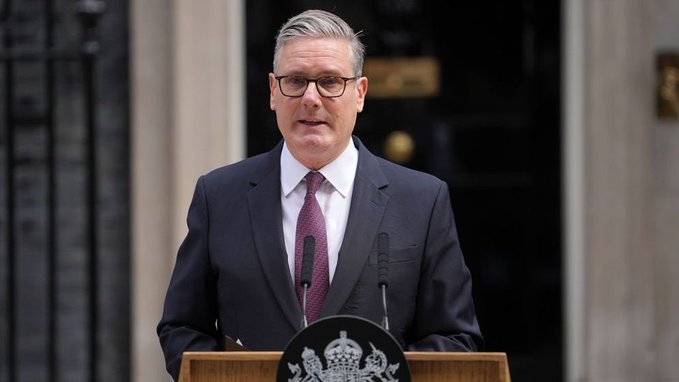
LONDON : In a stunning political development, UK Prime Minister Keir Starmer resigns from his position. Consequently, Britain faces its seventh prime minister in just over a decade. The embattled leader made his emotional announcement outside 10 Downing Street on Monday morning. Furthermore, he revealed that he already spoke to King Charles III about his decision. Therefore, a new leadership contest will officially begin in early July. Meanwhile, Starmer will remain in his post until the party selects a successor.
BREAKING: UK PM Keir Starmer resigns after severe party pressure. Former Manchester Mayor Andy Burnham is tipped to succeed him. Full Keir speech and Read the full analysis here: https://t.co/VqVtlmSQvO#KeirStarmer #UKParlament #AndyBurnham #RishiSunak #10downingstreet #TheUK… pic.twitter.com/nB4KfdkMIc
— India This Week (@indiathisweekk) June 22, 2026
The news follows weeks of intense speculation regarding his unstable political future. Specifically, the pressure peaked after local elections where Labour suffered massive losses. Additionally, the recent by-election victory of a key rival sealed his fate. As a result, Keir Starmer resigns after serving less than two years in office. He entered Downing Street with a historic landslide victory in July 2024. However, deep public unpopularity quickly eroded his initial political momentum.
Read More : US-Iran Talks Yield Major Breakthrough as Both Sides…
What Went Wrong for Keir Starmer?
Several critical political factors caused this sudden collapse of authority. First, the economic stagnation in Britain severely frustrated everyday voters. Moreover, the prime minister struggled to define a clear legislative agenda. Consequently, public trust dwindled as the administration faced multiple policy U-turns. Additionally, continuous ousters of senior advisers created a sense of internal chaos. Indeed, many citizens felt the government failed to deliver on major campaign promises.
External pressures also complicated his brief tenure at Downing Street. For instance, turbulent relations with international leaders strained the traditional special relationship. Furthermore, public criticism grew over his handling of global conflicts. Meanwhile, domestic challenges mounted as insurgent parties gained substantial ground. Particularly, Reform UK and the Green Party capitalized on growing voter anger. Therefore, Labour lawmakers feared a total wipeout in the next general election.
The ultimate breaking point occurred during the nationwide local elections in May. During this vote, the Labour Party hemorrhaged over one thousand local council seats. Moreover, they lost control of the semi-autonomous Welsh legislature after 27 years. This historic defeat triggered a widespread mutiny among rank-and-file members of parliament. Subsequently, dozens of lawmakers openly demanded a timeline for his departure. Thus, the announcement that Keir Starmer resigns became completely unavoidable.
The Internal Mutiny and Andy Burnham’s Rise
Initially, Starmer vowed to fight on and prove his doubters wrong. However, several cabinet ministers privately told him that his time was up. Additionally, high-profile resignations from his government over military spending weakened his position. Then, the political crisis escalated sharply over the weekend. Former Manchester Mayor Andy Burnham won a crucial parliamentary by-election in Makerfield. Consequently, this victory provided Burnham a direct route back into Westminster.
British prime ministers are traditionally chosen from sitting members of parliament. Therefore, Burnham’s return to the House of Commons immediately threatened Starmer. Furthermore, former Health Secretary Wes Streeting threw his support behind Burnham. Streeting stated that a divisive leadership contest could prove highly costly for unity. Instead, he urged the party to roll up their sleeves and back Burnham. As a result, Starmer realized he lacked the parliamentary numbers to survive.
During his speech, Starmer accepted the party’s decision with good grace. He noted that every decision was about putting the country first. Choking back tears, he thanked his wife Victoria for being his rock. He stated that he will now focus on being a good father. With that said, the sudden news that Keir Starmer resigns leaves a massive political vacuum.
Who Will Be the Next UK Prime Minister?
The process to find a successor will move very quickly now. According to official reports, nominations will officially open on July 9. Subsequently, the nomination window will close tightly on July 16. If a full contest occurs, the party will elect a leader by September. However, if the party unites around one candidate, it could happen sooner. In that scenario, Britain could have a new prime minister by mid-July.
Currently, Andy Burnham stands as the absolute frontrunner for the top job. Burnham has already confirmed that he will put himself forward as a candidate. He welcomed the opportunity for party renewal in an orderly way. Moreover, he promised to build an inclusive party that draws on best traditions. Observers believe he can effectively combat the rising forces of nationalism.
Other potential contenders have surprisingly stepped aside to maintain stability. Therefore, Burnham may face an unopposed path to 10 Downing Street. Regardless of the timeline, the next leader faces monumental challenges. They must repair a fractured party and revive a stagnant economy. Additionally, they must win back swing voters who recently defected. Clearly, the chapter after Keir Starmer resigns will define Britain’s future.