
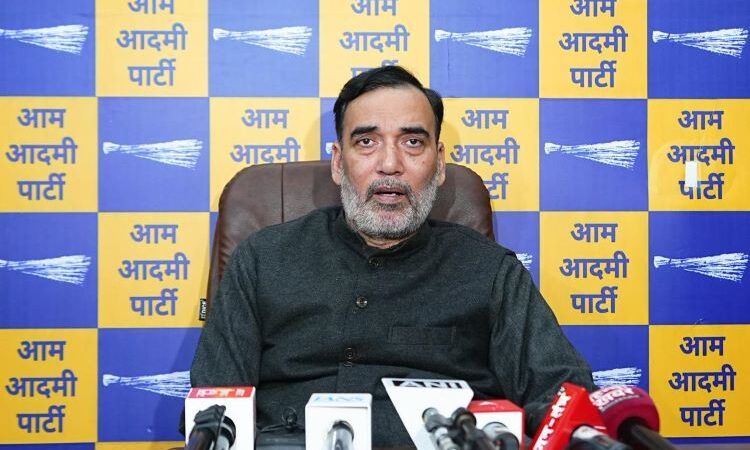
Ahmedabad, Gujarat Senior Aam Aadmi Party (AAP) leader and Gujarat in-charge Gopal Rai on Monday raised sharp questions over the Centre’s proposed trade agreement with the United States, saying the deal has triggered widespread concern across the country and lacks transparency.
Addressing the issue, the former Delhi Cabinet Minister said that discussions are taking place from the national capital to villages across India on why the Union government has suddenly entered into a trade deal with the US. While the Centre claims the agreement will benefit India, Rai alleged that the government is presenting it as an unprecedented and historic deal, urging citizens to celebrate, even as people remain unconvinced and uneasy.
Gopal Rai questioned whether the agreement truly serves India’s interests or disproportionately benefits the United States. “Why is America so happy with this deal?” he asked, adding that citizens are questioning whether the agreement is based on equality or imposed under pressure. He said there is growing suspicion that India has been compelled to accept the deal, while being asked to publicly celebrate it.
The AAP leader Gopal Rai further pointed out what he termed as glaring contradictions in tariff policies. He questioned why the US is reportedly increasing tariffs on Indian goods from 3 per cent to 18 per cent, while India is allegedly reducing tariffs on American imports to zero. He also raised concerns over energy policy, asking why India is willing to purchase costlier crude oil from the US and Venezuela when cheaper oil is available from Russia.
Trade Deal Lacks Transparency on Import Commitments : Gopal Rai
Gopal Rai claimed that the framework of the trade agreement mentions an import commitment of ₹45 lakh crore over the next five years, but does not clearly specify how much the US will import from India. “This lack of clarity is deepening public confusion. There are many questions, but no clear answers,” he said.
He also criticised the government for its inconsistent responses, stating that when journalists ask the Commerce Minister about the future of Russian oil imports, they are referred to the External Affairs Ministry, and vice versa. “If the Commerce Minister is leading this agreement, why can’t he answer direct questions?” Rai asked.
Expressing serious concern, Gopal Rai alleged that the publicly available framework of the deal includes threatening language from the US, warning India of a 25 per cent punitive tariff if it continues to buy Russian oil directly or indirectly, with the US monitoring compliance. “Will America now monitor India? Are we becoming subservient?” he asked, drawing parallels with the East India Company’s entry into India under the pretext of trade, which later led to colonial rule.
Gopal Rai said such developments are alarming for a sovereign, democratic nation with a rich cultural heritage and a massive population. “If a foreign country openly dictates terms and talks about monitoring India, and our rulers accept it without resistance, what does that mean for our future?” he asked.
Highlighting agriculture as the most sensitive issue, Rai said the biggest concern is that India’s agricultural sector—on which crores of livelihoods depend—is being opened up to American products. He claimed that the framework states India will impose zero tariffs on US industrial and agricultural products. “This is extremely dangerous for Indian farmers,” he said.
Also read : MLA Chhatar Vasava Leads “Parivartan Sabha” in Jhagadia, Thousands Join AAP
Gopal Rai argued that American farmers receive massive subsidies, while Indian farmers struggle for survival, often forced into debt for basic needs like education and marriage. With rural unemployment rising and migration increasing, he warned that opening the market to heavily subsidised US agricultural products could devastate Indian farmers.
“The government may claim that some sectors are protected, but in reality, it is trying to mislead the public,” he alleged.
He reiterated that the deal raises fundamental questions about India’s autonomy and decision-making power. “If cheaper options exist, why accept expensive ones under pressure? This is not just about oil or trade; it is about national sovereignty,” Rai said.
Recalling history, Rai warned that trade agreements can have long-term consequences. He cited the East India Company’s arrival in 1757 and how trade gradually turned into colonial rule, leading to centuries of exploitation before India finally gained independence in 1947 after immense sacrifice.
“A single wrong agreement, a single wrong decision, can push a nation towards decades of suffering,” Rai cautioned. He said the proposed trade deal could mark the beginning of a new form of economic subjugation.
Also read : AAP Exposes Drinking Water Crisis in Odhav: Residents Face Health Risks from Sewage
Appealing to citizens, Rai urged people to think calmly and critically. “If we make a mistake today, future generations will not forgive us. This moment could be recorded in history as one of the biggest mistakes of our time,” he said.
He called upon the central government, the Bharatiya Janata Party, and all patriotic citizens to introspect. “Ask your conscience—are we ready to put the country at risk for narrow interests?” Rai concluded.