
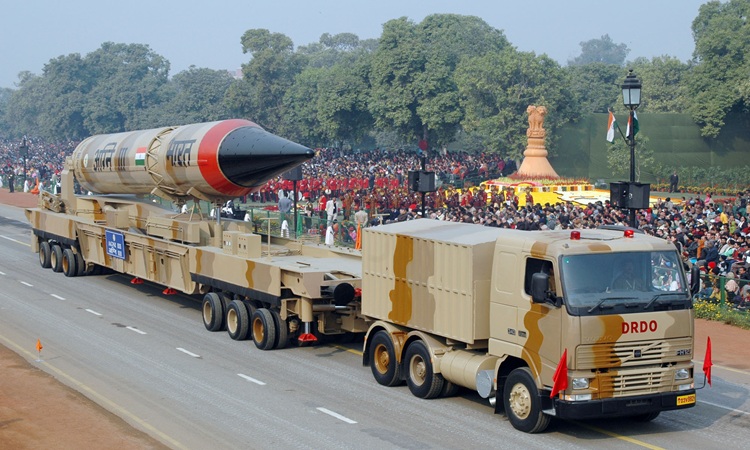
India Successfully Test-Fires Agni-3 Missile from Odisha
India has successfully conducted a user trial of the Agni-3 missile from the eastern coast of Odisha, reinforcing the credibility of its strategic deterrence framework. The test took place at the Integrated Test Range in Chandipur under the supervision of the Strategic Forces Command. According to official confirmation, the missile met all operational and technical parameters.
This Agni-3 missile test forms part of routine validation exercises. Such trials ensure that India’s strategic systems remain reliable, accurate, and ready. Moreover, the launch highlights steady progress in India’s self-reliant defence manufacturing ecosystem.
The Agni-3 is a road-mobile, solid-fuelled intermediate-range ballistic missile. It was developed by the Defence Research and Development Organisation as part of India’s long-term strategic missile programme. The missile is capable of carrying a nuclear payload and forms a key pillar of India’s land-based deterrence.
Also Read: PM Modi Begins Malaysia Visit to Strengthen India-Malaysia Ties
Agni-3 Missile Capabilities and Strategic Reach
The Agni-3 missile has a strike range of approximately 3,000 to 3,500 kilometres. This range allows it to cover critical strategic targets across much of the Asian region. Additionally, the missile can carry a payload of up to 1.5 tonnes, making it one of India’s most potent land-based systems.
The missile uses a solid propulsion system, which reduces launch preparation time. As a result, it improves survivability and response readiness. The road-mobile configuration further enhances operational flexibility. These features together ensure credible deterrence in a rapidly evolving regional security environment.
The successful Agni-3 missile test also validates recent system upgrades. These upgrades focus on navigation accuracy, flight stability, and reliability under operational conditions. Consequently, the test strengthens confidence in India’s nuclear delivery platforms.
Role in India’s Nuclear Triad
India follows a policy of credible minimum deterrence. The Agni-3 plays a vital role in maintaining balance within the nuclear triad. The triad consists of land-based missiles, air-delivered weapons, and sea-based platforms.
While newer missiles have entered service, the Agni-3 continues to remain operationally relevant. It bridges the gap between shorter-range systems and longer-range intercontinental platforms. Therefore, its continued testing remains essential.
Moreover, routine trials send a clear signal of preparedness without escalating tensions. India consistently describes such launches as training and validation exercises rather than weapon demonstrations. This approach aligns with its stated doctrine of restraint and responsibility.
Boost to Atmanirbhar Bharat in Defence
The Agni-3 missile test also reflects progress under the Atmanirbhar Bharat initiative. Most components of the missile are now produced domestically. This reduces dependence on foreign suppliers and strengthens national security.
Additionally, defence scientists and engineers continue to refine missile technologies through incremental testing. Each successful trial feeds data into future system improvements. This process ensures that India’s strategic forces remain technologically current.
The launch from Odisha further confirms the reliability of India’s eastern test infrastructure. Chandipur remains a critical hub for missile development and validation. It supports testing for a wide range of strategic and tactical systems.
Why the Agni-3 Test Matters Now
The regional security landscape continues to evolve. Missile tests like this ensure readiness without altering India’s defensive posture. They also reaffirm command-and-control mechanisms under real-world conditions.
Importantly, the Agni-3 missile test demonstrates continuity rather than escalation. It reflects a mature approach to strategic stability. India continues to balance deterrence with transparency through regular announcements of such tests.
As newer platforms emerge, legacy systems like Agni-3 remain vital. Their proven reliability ensures depth and redundancy in India’s deterrence architecture.