
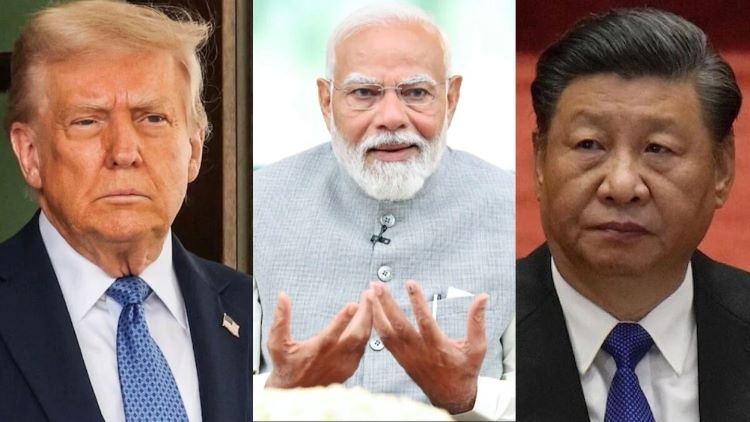
Pentagon warns India: China eases LAC tensions while strengthening Pakistan militarily, signaling a two-front strategy in South Asia.
A recent Pentagon analysis has warned India about Beijing’s two-pronged approach, which involves strengthening military ties with Pakistan while also reducing tensions along the Line of Actual Control (LAC).
The US Department of Defense provides a thorough assessment of China’s changing national strategy, quickening military modernization, and growing international influence in its 2025 Annual Report to Congress on Military and Security Developments Involving the People’s Republic of China.
The People’s Liberation Army’s expanding capabilities in the land, air, naval, space, cyber, and nuclear domains are examined in this paper along with their implications for regional stability and the rules-based international order.
China calls LAC to maintain India’s distance from the US
The report claims that following years of tension, India and China reached a tactical de-escalation in October 2024 by agreeing to withdraw from the last standoff spots along the Line of Actual Control. The Pentagon’s analysis, however, indicates that Beijing’s main goal in de-escalating the LAC is to stabilize relations with New Delhi and avoid a closer strategic alliance between India and the US.
Also read: Trump Administration Offers $3,000 to Undocumented Immigrants Who Self-Deport
Based on previous border disputes and China’s actions in the region, the research emphasizes a lingering lack of trust between India and China that restricts the possibility of a true relationship reset. The fact that Beijing still refers to the Indian state as a “core interest” highlights the fact that Arunachal Pradesh is still a major flashpoint. The research points out that China directly confronts India’s sovereignty by classifying Arunachal Pradesh in the same non-negotiable category as Taiwan and the South China Sea.
US Flags the Military Push by Beijing in Pak
The Pentagon draws attention to Beijing’s robust military backing for Pakistan while China contacts India diplomatically along the LAC. According to the report, China has contributed 36 J-10C fighter jets to Pakistan since 2020, greatly increasing the frontline combat capability of the Pakistan Air Force. Additionally, it mentions that Pakistan and China are still producing JF-17 fighter planes together, and Islamabad continues to be a major beneficiary of Chinese naval platforms and armed drones.
Prepairing For Mountain Warfare
Regarding military readiness, the Pentagon report notes that intense high-altitude, low-oxygen drills were conducted in 2024 by China’s Western Theatre Command, which is in charge of India-related scenarios. Even though disengagement negotiations with India are still continuing, these exercises show continued readiness for mountain combat scenarios.
Although China has chosen to maintain tactical calm along the LAC, it nevertheless contests India’s territorial claims, especially in Arunachal Pradesh, and continues to be Pakistan’s biggest arms supplier, according to the report’s 100-page major findings. New Delhi needs to exercise caution as Beijing strikes a balance between de-escalation and strategic pressure in the vicinity of India, according to the Pentagon’s view.