
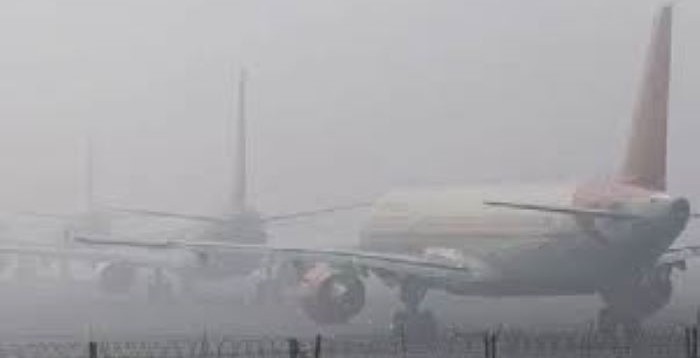
Delhi records AQI 457+, dense haze disrupts visibility and flights; authorities warn residents amid severe pollution and traffic delays.
Delhi also experienced a dense layer of pollution on Monday, with air quality consistently classified within the ‘severe’ category throughout the national capital. The overall Air Quality Index (AQI) was recorded at 457 at 6 am, as reported by the Air Quality Early Warning System for Delhi, with visibility significantly decreasing in multiple regions.
Flights departing from Delhi were also expected to be impacted, as both the airport and airlines issued official advisories.
Images from throughout the city depicted a thick haze enveloping the atmosphere, impairing visibility even over short distances.
During the early hours, visibility at Indira Gandhi International (IGI) Airport decreased to approximately 50 metres around 7 am, as reported by the India Meteorological Department.
The IMD issued a dense fog warning for the morning and forenoon hours, based on conditions reported by the Safdarjung observatory. The highest temperature in Delhi was recorded at 23°C, while the lowest was recorded at 8°C.
Limited visibility throughout the metropolis
Videos circulated by ANI depicted a dense blanket of pollution enveloping various areas of Delhi, including Barakhamba Road, which recorded an AQI of 474 within the ‘severe’ category. Vehicles are visible struggling through the haze.
In the Akshardham vicinity, the AQI was measured at 493, classified as ‘severe’ by the Central Pollution Control Board (CPCB). Comparable conditions were observed in Dwarka Sector-14, where the AQI registered at 469.
The pollution commission categorizes air quality as “moderate” when the AQI ranges from 101 to 200, “poor” between 201 and 300, and “very poor” from 301 to 400. Beyond 400, the air quality is classified as “severe.” For the purpose of mitigation measures, values of 450 and above are classified as “severe plus,” with CPCB levels not exceeding 500 — a threshold already regarded as critically hazardous by the agency.
Delhi Airport and IndiGo Announce Advisory
Flight operations at Indira Gandhi International Airport were affected on Monday due to dense cloud and reduced visibility conditions. Authorities and airlines issued notices, cautioning passengers regarding potential delays and disruptions.
Also read ; Mizoram Rail Link Transports First Automobiles to Aizawl
The Delhi Airport, in an advisory issued on X, stated, “Due to dense fog, flight operations may encounter disruptions.” We are collaborating closely with all stakeholders to minimize inconvenience to passengers. For the most recent flight updates, passengers are encouraged to reach out to their respective airlines. We sincerely apologize for any inconvenience this may have caused.
IndiGo also notified passengers of delays, citing limited visibility over Delhi. Low visibility and fog conditions over #Delhi are expected to affect flight schedules. We are monitoring the weather closely and making every effort to ensure you reach your destination safely and seamlessly. We kindly request that you remain informed of your flight status through our website or mobile application. Be assured, our teams are committed to assisting you at every stage and providing support, the airline stated in a post.
In a separate statement, IndiGo advised travelers to allocate extra time for their journey to the airport, as road traffic was experiencing delays due to the hazardous pollution. Our teams are diligently monitoring the situation and will provide you with ongoing updates. As conditions advance, we will proceed with departures prioritizing safety above all, it added.
Multiple stations in Delhi reached the maximum AQI threshold
The situation deteriorated further over the weekend, with air quality significantly declining on Sunday. At a minimum, three monitoring stations—Wazirpur, Rohini, and Ashok Vihar—recorded a 24-hour average AQI of 500, representing the highest level documented by the CPCB.
Since the AQI scale is capped at 500, actual exposure levels, especially hourly measurements, were probably significantly higher. Data indicated that 38 of the 39 active monitoring stations in Delhi were classified as either ‘severe’ or ‘severe-plus’ at different intervals on Sunday. A minimum of 13 stations recorded AQI levels exceeding 490 for several hours.
Among the most severely impacted areas were Jahangirpuri and Mundka, both reporting an AQI of 499. This was followed by Bawana (498), Delhi Technical University (497), Vivek Vihar (497), Narela (493), Anand Vihar (492), IHBAS in Dilshad Garden (491), and Okhla Phase-2 (490). The highest air quality on Sunday was observed at Shadipur, which still fell within the ‘very poor’ category with an AQI of 375.