
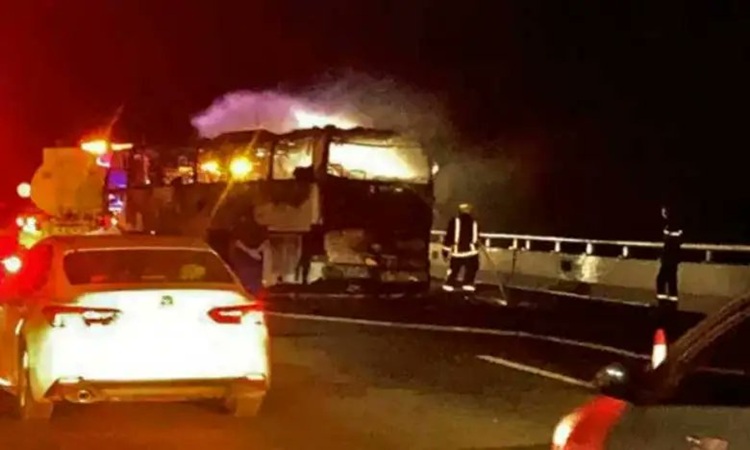
The Tragedy and its Immediate Impact
In the early hours of Monday, a bus carrying approximately 45 Indian Umrah pilgrims from Hyderabad crashed into a diesel tanker on the Mecca-Medina highway near Madinah, Saudi Arabia. Reports indicate that 42 people are feared dead, including 20 women and 11 children, with only one survivor, 24-year-old Mohammed Abdul Shoeb, currently under hospital treatment.
Indian authorities confirmed the accident and have launched emergency coordination. The Ministry of External Affairs (MEA) and the Indian Embassy in Riyadh are working jointly to identify the victims, repatriate the bodies and offer support to the families. Meanwhile, the Telangana Government has set up a control room and established helplines to assist relatives of the pilgrims.
What Happened on the Mecca-Medina Route
The accident occurred around 1:30 a.m. Indian Standard Time (IST), when the bus—transporting Indian Umrah pilgrims from Mecca to Medina—collided with a diesel tanker near Mufrihat in the Madinah region. After the impact, the bus burst into flames and the intensity of the blaze reportedly hampered rescue efforts.
Initial reports suggest the victims were asleep at the time of the crash. Many of the deceased are from Hyderabad’s Bazaar Ghat locality, and include multiple families with children. The lone survivor is hospitalised in Saudi Arabia, and efforts are ongoing to bring in more detailed information about the passengers and their travel itinerary.
Indian Government Response & Support for Families
Prime Minister Narendra Modi expressed deep sorrow over the accident, stating that his thoughts are with the bereaved families and that the government is extending all possible support. External Affairs Minister S. Jaishankar, along with other senior officials, is coordinating with Saudi counterparts to speed up victim identification and repatriation.
A 24×7 control room in Jeddah has been activated with multiple helpline numbers for families to contact. The Telangana CM, A. Revanth Reddy, directed the state machinery to engage with agencies and ensure assistance for the kin of pilgrims.
What This Means for Umrah Pilgrims & Travel Agencies
The tragedy raises deep concerns around safety, transport arrangements and oversight for foreign pilgrims travelling in Saudi Arabia. Many of the victims appear to have been part of organised Umrah packages from Hyderabad. The families are now demanding transparency regarding travel agency responsibilities and service standards.
In particular, the crash underscores the risks facing pilgrims during transit between holy cities like Mecca and Medina, especially in overnight hours, and highlights the need for robust safety standards for buses, tankers and shared pilgrimage transport.
What Families in Hyderabad and India Are Facing
For families of the deceased in Hyderabad, the wait for official confirmation and repatriation is agonising. MPs and local leaders such as Asaduddin Owaisi are in touch, urging swift action on body retrieval and travel support. Some families have reported multiple members aboard the bus. One resident said: “Seven members of my family went for Umrah … we are told the bus caught fire. We request the government to bring back the bodies.”
Telangana police and travel agencies are compiling passenger lists, verifying identities and liaising with Indian and Saudi authorities to expedite formal processes.
Next Steps and Challenges Ahead
Several key tasks lie ahead:
- Accurate identification of all victims and coordination of DNA or forensic verification, given the scale of fire damage.
- Fast repatriation of bodies to India following Saudi protocols and bilateral cooperation.
- Medical treatment and evacuation of the lone survivor and any other injured persons.
- Investigation into travel agency logistics, vehicle safety compliance and oversight of pilgrim transport within Saudi Arabia.
- Psychological and financial support for bereaved families, ensuring full transparency and responsiveness.
Final Word
This tragic accident involving Indian pilgrims on the Mecca-Medina route is a stark reminder of how quickly a sacred journey can turn into unspeakable sorrow. For the families here in India, the pain of loss is compounded by the distance and the complexity of cross-border coordination. As authorities work to bring the victims home, the incident grips the nation and calls for a serious look at how pilgrimage travel is managed, especially overseas.
The government’s response in terms of helplines, coordination and repatriation is critical. Yet, the human toll – mothers, children, families returning from Umrah with hopes of blessing – cannot be undone. The country joins them in mourning and demands accountability, safety and compassion in the days ahead.