
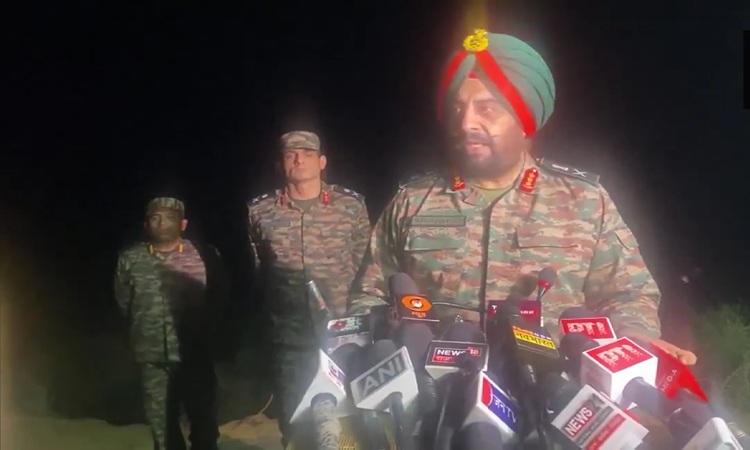
India has entered a new era in its security posture. The Indian Army now declares: any terrorist act will be treated as an act of war. With this shift, the doctrine codenamed “New Normal” signals a decisive move away from traditional restraint.
The change, articulated during a field interaction by Lt Gen Manjinder Singh—Commander of the South Western Command—at Bikaner, underlines India’s readiness to treat terror attacks not merely as criminal acts but as direct aggression.
A doctrine rewrite for the ‘New Normal’
During the address, Lt Gen Singh said the Army has been formally directed to prepare for scenarios where terror strikes are viewed as acts of war. He said: “Any terrorist act against India will be treated as an act of war.”
This shift is more than semantics—moreover, it reflects a broader recalibration. The Army’s approach now emphasises speed, precision and deterrence. He said that modern technologies and night-capable operations are central to the doctrine.
Indeed, in recent months the government announced that any future terror attack would be treated as an act of war. That marks a clear red-line message.
Night-time dominance and technological edge
Another major element of this doctrine is operational change. According to Lt Gen Singh, about 70 percent of training is now conducted at night, while 30 percent takes place during daylight. This shift reflects the understanding that most terror and infiltration activity occurs under cover of darkness.
Additionally, the Ministry of Defence has signed a contract worth around Rs 659 crore for night-vision image intensifier devices for 7.62×51 mm SIG 716 rifles—part of the drive for indigenous defence capability and enhanced soldier lethality at night.
According to official release, these devices will allow soldiers to identify targets up to 500 metres under starlight, a significant upgrade from older passive systems.
Strategic and legal ramifications
The doctrine shift carries strategic significance. By equating terror acts with war-level aggression, India signals it may invoke its right of self-defence under international law (notably United Nations Charter Article 51). This means state-sponsored or proxy terror could draw direct military response, rather than only law-enforcement or diplomatic reactions.
Critically, the change blurs the line between counter-terror operations and conventional warfare—particularly in the context of Pakistan-based terrorist groups. Analysts note the doctrine signals a departure from strategic restraint.
Implications for deterrence and regional security
The doctrine also enhances deterrence. By adopting night-fighting capacity, rapid response readiness and a no-distinction rule between terrorists and their state sponsors, India raises the cost of aggression. Domestic observers note this is an overdue adjustment given past terror episodes and cross-border threats.
However, such posture carries risks: escalation potential remains, especially in a nuclearised region. The shift may invite counter-measures or provoke further tit-for-tat actions. Still, India’s message is clear—terror will no longer be treated as a mere crime.
What lies ahead
As the Army rolls out this doctrine across commands, training, procurement and operational planning will align accordingly. The emphasis on night operations and indigenous tech will intensify. Meanwhile, neighbouring states and militant groups are on notice.
For policymakers and analysts, the key will be how this doctrine is applied in practice: Will India lock into full-scale war or maintain calibrated responses? The articulation of “terror acts as war” offers flexibility—but also demands caution.
In intercepting future threats and projecting deterrence, the Indian Army’s “New Normal” doctrine may redefine the region’s security dynamics.