
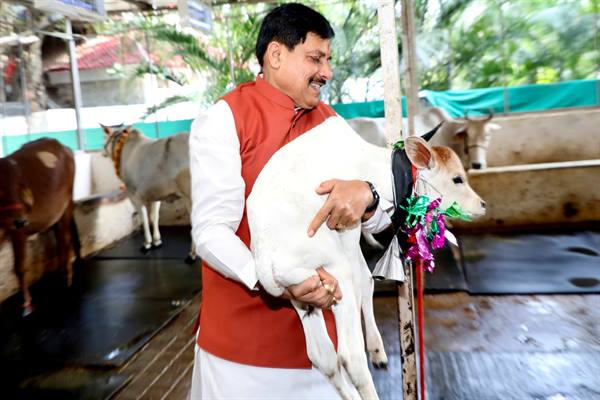
CM Dr. Mohan Yadav launches major initiatives to boost dairy farming and cow protection in Madhya Pradesh. Dugdh Samriddhi Campaign and Govardhan Festival announced across districts.
Dr. Mohan Yadav, the Chief Minister, said that raising cows and other animals is a sacred part of India’s old Sanatan culture. He stated, “People who raise cows are real ‘Gopals,’ and every home with cows is a ‘Gokul.'” The government has made cow protection and promotion a top priority, and it is working toward this goal with the help of the public. The goal is to quadruple the revenue of dairy farmers by making more milk in Madhya Pradesh. The state has a lot of natural resources and a lot of cows, which is why it makes almost 9% of India’s total milk. The government wants to raise this number to 20%.
The “Dugdh Samriddhi Sampark” campaign is going on in villages to help with this. Veterinary doctors are going to farmers’ homes to teach them about better ways to raise cows, improve their breeds, and keep their animals healthy and well-fed. The state has declared 2024–25 to be the Year of Cow Protection and Promotion.
Every district will celebrate the Govardhan Festival.
Dr. Yadav said that the Govardhan Festival will be held throughout all of Madhya Pradesh on October 21, following local customs and traditions. We will make sure that cowsheds and dairy farmers are involved in a special way. During the ceremonies, people who have made important contributions to animal husbandry and milk production will be honored.
Also read: CM Mohan Yadav to Host Kisan Sammelan, Promote Bhavantar Scheme Benefits
Govardhan Puja, Parikrama, and Annakoot Bhog are few of the rites that will take place at the major event at Ravindra Bhavan in Bhopal. There will be traditional performances including the Bareli and Thatya dances by villages that herd cattle. There will be stalls selling organic goods, dairy products, and crafts made from cow dung. There will also be booths where people can learn about different government programs that help with animal husbandry, farming, and cooperatives.
There will also be activities to help people in rural areas make a living by producing dairy and the Vrindavan Gram Yojana. On this day, Anganwadi centers in all districts would give out food manufactured with panchagavya products including ghee, milk, paneer, and curd.
Campaign for “Dugdh Samriddhi Sampark” Across Madhya Pradesh
The Dugdh Samriddhi Sampark Campaign started on October 2, which is Gandhi Jayanti. As part of the program, veterinary teams went to villages and talked to farmers about how to enhance their animals’ health, nutrition, and feed, as well as how to use artificial insemination and vaccinations.
Farmers learned how to make more money by using cost-effective ways to enhance milk production. In the first phase, field officials directly talked to more than 3.7 lakh dairy farmers who owned 10 or more cows or buffaloes and helped them with their difficulties on the spot.
The main goal of the program was to increase milk production and income. Ministers, MPs, MLAs, divisional commissioners, collectors, and senior bureaucrats all took part and talked to dairy producers. The farmers were really excited to be a part of the project and talked about their experiences.
More Money for Cowsheds
The government of Madhya Pradesh is entirely committed to making it easier to care for, preserve, and manage cattle. The amount of money given for cow feed in cowsheds has gone from ₹20 to ₹40 per animal each day.
The amount of money set aside for taking care of cows has gone up from ₹90 crore two years ago to ₹250 crore last year and then to ₹600 crore for FY 2025–26. DBT (Direct Benefit Transfer) sends the grant money straight to cowshed bank accounts, where it is distributed every month in ₹50 crore.
More than 1,000 new cowsheds built
There are currently 2,900 cowsheds in Madhya Pradesh, which take care of about 4.25 lakh cattle. The Mukhyamantri Go-Seva Yojana has built 2,203 cowsheds in rural areas, which can hold 2.11 lakh animals.
In the past year, more than 1,000 new cowsheds have opened, giving homes to more than one lakh animals. In cities like Gwalior, Ujjain, and Indore, big, contemporary cowsheds have been built. A huge cowshed that can hold 10,000 cows is being built in Bhopal on 69.18 acres for ₹45 crore. It should be done in a year.
There are 6,500 cows at the Salariya Cow Sanctuary and Research & Production Center in the Agar-Malwa district right now.
The “Gokul Dham” policy for self-sufficient cowsheds in 2025
The state has come up with a new idea to make cowsheds self-sufficient: the “Swavalambi Cowshed (Gokul Dham) Policy 2025.” The government would give up to 130 acres of land, including 5 acres for business, to anybody who can take care of at least 5,000 cattle. This is the first time that a state in India has used this model.
also read: Disaster-Resilient Madhya Pradesh: Vision 2047
So far, 4,235 acres have been set aside in 18 districts. Bids have been made in 13 districts, including Mandsaur, Jabalpur, Raisen, Damoh, Sagar, Panna, Vidisha, Satna, Ashoknagar, Chhatarpur, Ratlam, Shajapur, and Bhind.
Madhya Pradesh is the first state in India to completely ban cow slaughter.
Madhya Pradesh is the first Indian state to make it illegal to kill cows. The Madhya Pradesh Cow Slaughter Prohibition Act, 2004 (amended in 2010) says that killing a cow is punishable by 7 years in prison, and having or moving meat is punishable by 3 years in prison.
The 2024 Amendment made the law even stronger by adding rules that let the government take (confiscate) cars used to transport cattle illegally.