
The Haryana Jan Vishwas Ordinance 2025 aims to decriminalize 164 provisions in 42 state Acts managed by 17 departments, promoting ease of governance and legal reforms.
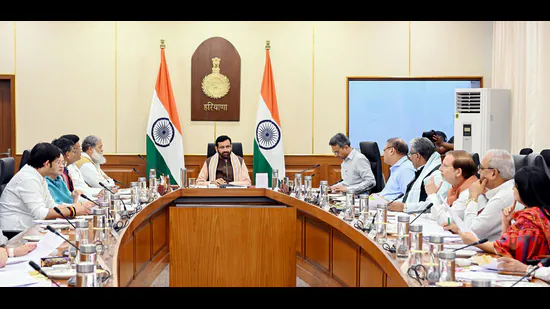
The Haryana Jan Vishwas (Amendment of Provisions) Ordinance, 2025, was ratified by the Haryana Council of Ministers, which convened under the chairmanship of chief minister Nayab Singh Saini on Sunday. This initiative is consistent with the Union government’s objective of reducing compliance burdens and decriminalizing minor offenses in a variety of sectors.
The Haryana Jan Vishwas Ordinance, 2025, aims to decriminalize 164 provisions that are contained in 42 state Acts and are administered by 17 departments. The ordinance substitutes criminal penalties for trivial technical and procedural errors with administrative actions and civil penalties. Additionally, it eliminates obsolete and redundant clauses, thereby enhancing the legal framework’s transparency, efficiency, and facilitation.
This reform initiative is a direct result of the central government’s enactment of the Jan Vishwas (Amendment of Provisions) Act, 2023, which decriminalized 183 provisions across 42 central Acts.
A government spokesperson stated that Haryana has conducted a thorough evaluation of its laws to implement a similar approach at the state level in accordance with the advisory issued by the Union government.
The cabinet secretariat is currently coordinating the ongoing Compliance Reduction and Deregulation (CRD) exercise, which includes the introduction of the Haryana Jan Vishwas Ordinance, 2025, which was designated as a critical action item during the 4th chief secretaries’ conference.
The spokesperson stated that this ordinance represents the most comprehensive decriminalization effort undertaken by any state government to date, with the highest number of criminal provisions proposed for removal, and that it marked a significant transition from enforcement-based to trust-based governance.
Also read: Pensioners to Receive Monthly Increases in Pension Under New Government Scheme
Ordinance Amending the Panchayati Raj
The Haryana Panchayati Raj (Amendment) Ordinance, 2025, was issued with the cabinet’s approval to amend the Haryana Panchayati Raj Act, 1994. Under it, the quorum of a gram sabha meeting is 40% of the members for the purpose of considering and approving eligible beneficiaries of any government scheme. Nevertheless, the quorum for the first and second adjourned meetings will be 30% and 20% of the gram sabha members, respectively. The spokesperson stated that this decision will not only enhance the functioning of the Panchayati Raj system but also bring transparency to it.
The merger of the Housing Board and the Housing and Social Services Vice President (HSVP
The proposal to introduce the Haryana Housing Board (Amendment) Bill, 2025, during the upcoming assembly session was approved. The objective of the action is to facilitate the merger of the Haryana Shehri Vikas Pradhikaran (HSVP) and the Housing Board Haryana (HBH).
The amendment aims to improve the efficacy of service delivery to citizens by eliminating administrative overlap and streamlining urban development and housing functions. The spokesperson stated that the operational aspects of the merger will be managed through existing administrative mechanisms, and the amendment does not have any direct financial implications.
Modification to the regulations governing common land
The cabinet approved the amendment of Rule 6(2) of the Punjab Village Common Lands Rules, 1964 to ensure that 4% of the land proposed for leasing for cultivation is reserved for individuals with a benchmark disability of 60% or higher.
The cabinet also approved an amendment to Rule 6(2A) that allows the animal husbandry department or Haryana Gau Sewa Aayog to lease land for the purpose of establishing a “gau abhyaran” for a period of 20 years at a rate of ₹5,100 per acre per year, subject to certain terms and conditions.
In addition, gram panchayats were authorized to develop the utilization plan for land up to 250 acres on their own. This limit was previously set at 100 acres. If a panchayat samiti or zila parishad fails to agree or approve the plan within a particular timeframe, the gram panchayat may submit an application to the state government for a suitable decision.
The employment of women in industries
An amendment to the Punjab Factories Rules, 1952, was approved by the cabinet, which allows women to work in specific factory processes. The proposed amendment will enable the online submission of fees that are required by the regulations and the employment of women in all categories of work, provided that they meet the specified safety requirements. “The amendment will eliminate gender disparity, expand employment opportunities for women, and promote inclusivity in industrial sectors such as engineering, chemicals, and manufacturing, where women’s participation was previously restricted,” the spokesperson stated.
Exclusion of expectant women and lactating mothers from hazardous employment categories is guaranteed by the amendment.
Defined as a habitual offender
The Haryana Prison Rules, 2022, were amended by the cabinet to include the definition of a habitual offender. By the amended Haryana Prison (Amendment) Rules, 2025, a habitual offender is defined as an individual who has been convicted and sentenced to imprisonment on more than two separate occasions over a five-year period for any one or more of the offenses committed on separate occasions, which are not part of the same transaction, and whose sentence has not been reversed in appeal or review.
“The amendment provides that any period spent in jail, whether under sentence of imprisonment or detention, shall not be considered in the computation of the continuous period of five years referred to above.”