
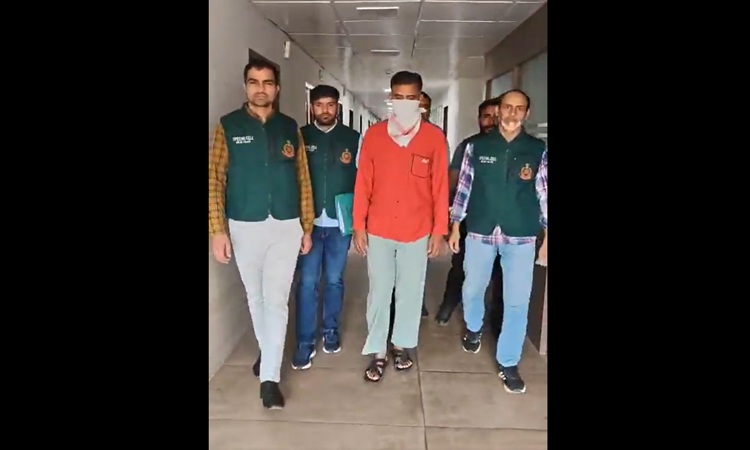
Nepali Man Arrested in Delhi for Espionage
The Delhi Police’s Special Cell has uncovered a cross-border espionage racket linked to Pakistan’s Inter-Services Intelligence (ISI). A 43-year-old Nepali national, Prabhat Kumar Chaurasia, was arrested in Delhi’s Laxmi Nagar on August 28 after intelligence inputs flagged his involvement in supplying Indian SIM cards to ISI operatives.
Chaurasia, a resident of Birgunj in Nepal, is accused of smuggling Indian SIM cards across the border and enabling their use by ISI handlers in Pakistan. Police believe his network played a crucial role in helping operatives establish secure digital communication channels for anti-India activities.
SIM Cards Traced to Pakistan
According to investigators, Chaurasia purchased 16 SIM cards in India using an Aadhaar card from Maharashtra’s Latur district. He smuggled the cards to Nepal, from where they were routed to Pakistan.
Of these, 11 SIM cards were traced to Pakistan, where they were allegedly used by ISI operatives in Lahore and Bahawalpur. Bahawalpur is a known base of the terror outfit Jaish-e-Mohammed (JeM), whose training camps and headquarters were recently targeted during India’s Operation Sindoor.
Police said these SIM cards were used to operate WhatsApp accounts, allowing handlers in Pakistan to coordinate with contacts for anti-India activities. The recovered devices and empty SIM packets provide strong evidence of Chaurasia’s involvement.
Link to ISI and Motive
During interrogation, Chaurasia reportedly confessed to coming into contact with ISI operatives in 2024. He was allegedly introduced by a Nepalese intermediary, who promised assistance in securing a US visa under the cover of journalism.
In exchange, Chaurasia was tasked with supplying Indian SIM cards and attempting to gather sensitive defence-related information. Officials suspect he may have been motivated by financial gain and the promise of foreign travel opportunities.
Police said his arrest highlights ISI’s increasing use of cyber-enabled espionage networks in India’s neighbourhood. By exploiting loopholes in mobile verification systems, the agency aims to set up proxy accounts that are harder to trace.
Background of the Accused
Born in Nepal in 1982, Chaurasia studied in Bihar’s Motihari and earned a degree in information technology. He worked as a pharmaceutical representative before starting a logistics business in Kathmandu in 2017.
However, after his company collapsed, Chaurasia reportedly began searching for ways to travel abroad. Investigators believe this desperation made him vulnerable to ISI’s approach. His background in IT and his mobility across Nepal and India may have further made him an attractive recruit.
Police added that Chaurasia’s case highlights how ISI operatives often target individuals facing financial instability, promising them opportunities abroad while using them for espionage.
Ongoing Investigation
The Special Cell has filed a case under charges of criminal conspiracy for acts endangering the sovereignty, unity, and integrity of India. Officials are now working to identify Chaurasia’s network, his contacts in Nepal, and any Indian associates who may have helped procure documents or SIM cards.
Intelligence agencies are also investigating whether the SIM cards were linked to any past terror plots or digital propaganda campaigns. The possibility of a wider cross-border module cannot be ruled out.
For now, Chaurasia remains in custody, while the hunt continues for his ISI handlers and other collaborators.
Conclusion
The arrest of Prabhat Kumar Chaurasia underscores the constant threat of espionage networks operating from India’s neighbourhood. By supplying Indian SIM cards to Pakistan’s ISI, the accused allegedly enabled communication networks that could have been used for anti-India activities.
With further investigation underway, authorities hope to dismantle the wider module and prevent future misuse of Indian digital infrastructure by foreign intelligence agencies.