
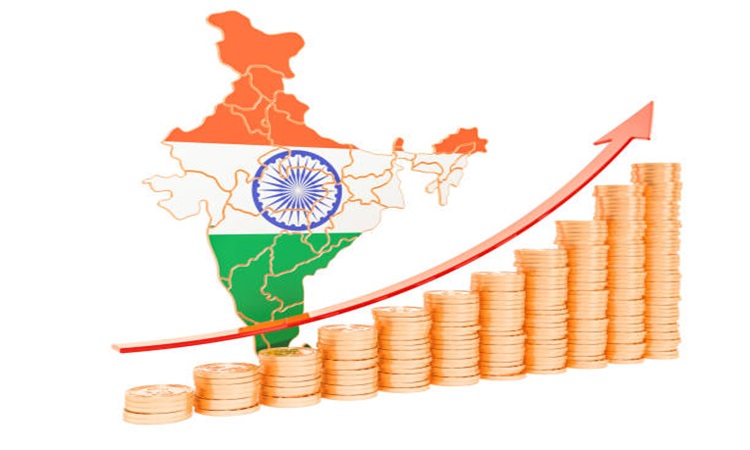
India on Track to Overtake US Economy
India is set to become the world’s second-largest economy by 2038, overtaking the United States in purchasing power parity (PPP) terms, according to the latest EY Economy Watch report. Despite the recent imposition of 50% tariffs on Indian goods by US President Donald Trump, the study suggests that India’s long-term growth trajectory remains intact.
The report, based on IMF forecasts, highlights that India’s GDP could reach $20.7 trillion by 2030 and further expand to $34.2 trillion by 2038 in constant PPP dollars. This growth, driven by strong consumption, investment, and stable macroeconomic fundamentals, places India ahead of most major economies over the next decade.
Strong Growth Forecasts Strengthen Outlook
India’s economy is expected to grow at an average of 6.5% annually between 2028 and 2030, compared to just 2.1% for the United States. This divergence suggests that India will continue to widen its growth lead over advanced economies.
In 2024, India’s growth was already more than twice that of the US. By the end of the decade, the report projects India’s growth rate to be 3.1 to 3.6 times higher. The analysis underlines that India’s growth is not only consistent but also resilient to external shocks, including trade disputes and tariffs.
The country is also expected to achieve significant milestones earlier than 2038. India could overtake Japan in 2025 (FY26) to become the world’s fourth-largest economy in market exchange terms. By 2028 (FY29), it may surpass Germany to claim the third spot, trailing only China and the US.
Consumption and Investment Driving Expansion
One of the key drivers of India’s rise is its strong domestic consumption. The report shows that final consumption expenditure accounted for 71.4% to 72.7% of GDP between FY20 and FY23. This robust demand base ensures a steady growth foundation even when global markets slow.
India also maintains one of the highest investment ratios among major economies, with gross capital formation consistently above 30% of GDP except during the pandemic year FY21. High levels of infrastructure investment and private capital inflows are expected to sustain economic momentum.
Additionally, India’s incremental capital-output ratio remains lower than that of most peers, signaling that investments translate efficiently into growth.
Debt Levels Support Long-Term Stability
The EY study highlights India’s relative strength in managing public finances. India’s general government debt-to-GDP ratio is projected to fall from 81.3% in 2024 to 75.8% in 2030. This contrasts with rising debt ratios in the US, Germany, and China.
For context, Japan’s debt stands at 236.7% of GDP, while the US ratio has already crossed 120% in 2024. China’s government debt is estimated at 88.3%. India’s ability to reduce its debt burden enhances investor confidence and supports long-term macroeconomic stability.
This fiscal discipline also helps India withstand global headwinds such as inflationary pressures, refinancing risks, and higher interest costs that challenge advanced economies.
Impact of US Tariffs Remains Limited
While the imposition of additional 25% tariffs by the US has unsettled markets, the EY report suggests the impact on India’s growth will be limited. The effect is estimated to be no more than 10 basis points (0.1%) of GDP.
India’s low export-to-GDP ratio shields it from sharp tariff shocks compared to economies heavily dependent on global trade. Moreover, its high investment ratio and strong domestic demand provide a buffer against short-term external pressures.
In contrast, the US could face more significant challenges. With its high government debt levels, much of which requires refinancing in the coming years, the US economy may experience greater strain. Rising borrowing costs could further increase its interest payment obligations.
India’s Road to Becoming the World’s No. 2 Economy
If growth continues at the forecasted pace, India will not only surpass the US in PPP terms by 2038 but also consolidate its position as a global growth leader.
The economy’s strengths—high consumption, robust investment, efficient capital use, and improving debt profile—offer strong fundamentals. Combined with demographic advantages and policy reforms, these factors make India the most dynamic among major economies.
By 2038, India’s projected $34.2 trillion GDP in PPP terms would mark a historic shift in the global economic order, placing it ahead of the US and second only to China.