
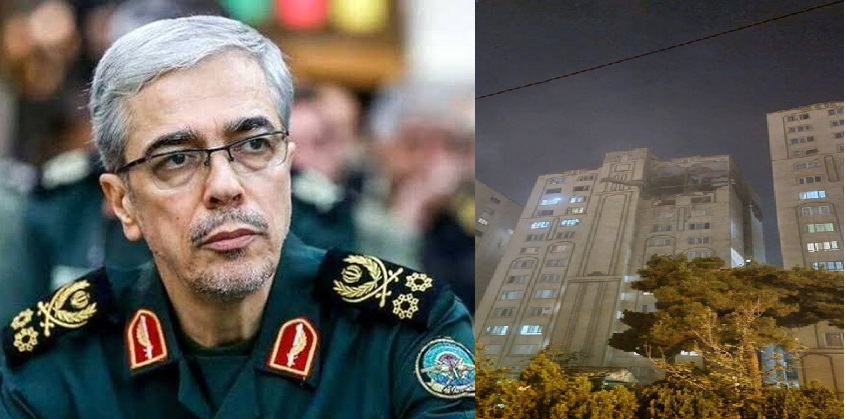
Iran’s Top Military Leader Killed in Israeli Airstrike Targeting Tehran Defense Leadership
Iran’s Military Chief Mohammad Bagheri Killed in Israeli Airstrike: What We Know So Far
Tehran/Jerusalem: In a significant escalation of regional tensions, Major General Mohammad Bagheri, the Chief of Staff of Iran’s Armed Forces, was reportedly killed in an overnight Israeli airstrike targeting Iran’s nuclear and military installations, according to Iran’s state-run TV IRINN.
We can now confirm that the Chief of staff of the Iranian Armed Forces, Commander of the IRGC and the Commander of Iran’s Emergency Command were all eliminated in the Israeli strikes across Iran by more than 200 fighter jets.
These are three ruthless mass murderers with…
— Israel Defense Forces (@IDF) June 13, 2025
Bagheri, Iran’s highest-ranking military official, was the second senior figure confirmed dead in the strike, following the reported death of General Hossein Salami, commander-in-chief of the Islamic Revolutionary Guard Corps (IRGC).
The news marks a turning point in Iran-Israel hostilities and may trigger significant geopolitical consequences across the Middle East.
Who Was Major General Mohammad Bagheri?
Mohammad Bagheri held the top position in Iran’s military hierarchy, serving as the Chief of Staff of the Armed Forces, a role in which he oversaw both the Islamic Republic’s conventional army (Artesh) and the IRGC.
Bagheri was considered one of the most powerful and strategic military minds in the Iranian defense establishment. His responsibilities included:
- Coordinating strategic defense policy
- Overseeing domestic and foreign military operations
- Supporting Iran’s proxy engagements in Lebanon, Syria, and Iraq
According to the United Against Nuclear Iran (UANI) group, Bagheri played a crucial role in aligning military doctrine with Iran’s ideological goals.
His Background: Academic and Military Ranks
There are conflicting accounts of Bagheri’s early life. The U.S. Treasury Department lists his birth year as 1960 in Tehran, while some Iranian sources cite 1958.
Bagheri came from a dual background of military and academic experience. His notable qualifications include:
- Engineering degree
- Doctorate in political geography from Tarbiyat-e Modares University
He was deeply embedded in the roots of the Islamic Revolution of 1979. Reports suggest that he was among the students who stormed the U.S. Embassy in Tehran, marking the beginning of the decades-long U.S.-Iran standoff.
The Israeli Airstrike: A Precision Blow to Iran’s Military Nerve Center
The airstrike that killed Bagheri is believed to be part of a coordinated Israeli operation targeting multiple strategic Iranian sites. This includes:
- Nuclear research facilities
- Missile development centers
- Key military command posts in and around Tehran
The strike, conducted in the early hours of the morning, reportedly involved long-range drones and missile systems, sources from Western intelligence communities indicated.
Iranian authorities confirmed the deaths of both Bagheri and Salami, although they have yet to provide full details on the extent of the damage.
Implications for Iran and the Region
Bagheri’s death could trigger major ramifications:
- Iran’s military leadership vacuum: Losing both Bagheri and Salami in a single strike is a massive blow to Iran’s command-and-control structure.
- Potential retaliation: The IRGC may respond with cyberattacks or military engagements in regional proxy zones.
- Escalation risk: Tensions between Iran and Israel, already high due to ongoing skirmishes in Syria and threats against Israeli interests, are now at a breaking point.
Analysts believe this incident may provoke direct confrontation or asymmetric responses, including attacks via Hezbollah in Lebanon or Houthi rebels in Yemen.
International Reactions
While Israel has neither confirmed nor denied the strike, its leadership has previously warned about targeting individuals and infrastructure critical to Iran’s nuclear and regional military ambitions.
The U.S. and EU have not issued official statements, though intelligence cooperation between Israel and Western allies is widely acknowledged.