
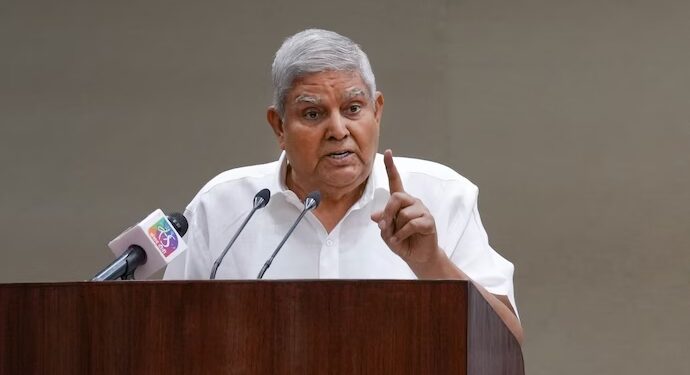
“Parliament is Supreme”: Vice President Dhankhar Asserts Legislative Authority Amid Constitutional Debate
In a significant address at the University of Delhi on April 22, 2025, Vice President Jagdeep Dhankhar underscored the paramountcy of Parliament in India’s constitutional structure. His remarks come at a time when the judiciary’s role in legislative matters has been a subject of intense debate.
Parliament’s Sovereignty: A Cornerstone of Democracy
Vice President Dhankhar began his speech by quoting the Preamble of the Indian Constitution:
“We, the people of India…”
He emphasized that sovereignty resides with the people, who express their will through their elected representatives in Parliament. According to Dhankhar, these representatives are the “ultimate masters” of constitutional content, and there is no authority above Parliament.
He further stated that the Constitution does not envision any authority above Parliament, asserting its supremacy in the Indian democratic framework.
Recent Supreme Court Ruling: A Point of Contention
Dhankhar’s comments also touched upon a recent Supreme Court ruling concerning the powers of Governors in withholding assent to state bills. The Court had stated that Governors cannot keep bills pending indefinitely and must act “as soon as possible” .
The Vice President expressed concern over the Court’s invocation of Article 142, which grants the judiciary the power to pass any order necessary for “complete justice.” He described this as a “nuclear missile against democratic forces,” suggesting that such broad powers could undermine the legislative process.
The Role of the Judiciary: Interpretation vs. Intervention
While Dhankhar acknowledged the judiciary’s role in interpreting the Constitution, he cautioned against overreach. He emphasized that the legislature is the primary body for lawmaking and that judicial interpretations should not encroach upon this domain.
This perspective aligns with earlier statements where Dhankhar referred to Parliament as the “soul of democracy,” asserting that its supremacy should not be amenable to intervention from the executive or judiciary .
Call for Collaborative Governance
In his address, Dhankhar called for a collaborative approach among the executive, judiciary, and legislature. He advocated for resolving differences through dialogue and mutual respect, rather than through public confrontations.
He also highlighted the importance of maintaining the balance of power among the three branches of government to ensure the effective functioning of India’s democracy.
Conclusion
Vice President Jagdeep Dhankhar’s address at the University of Delhi serves as a timely reminder of the foundational principles of India’s democratic system. By reaffirming the supremacy of Parliament and advocating for collaborative governance, Dhankhar emphasizes the need to uphold constitutional values and ensure that all branches of government function within their prescribed limits.