
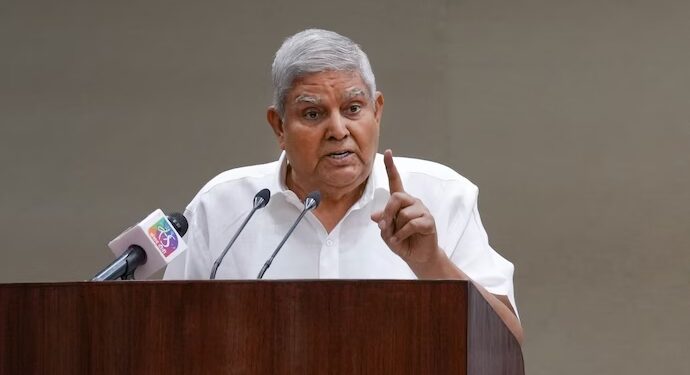
VP Jagdeep Dhankhar Questions Delay in FIR Against Justice Yashwant Varma, Stresses Rule of Law
New Delhi : Vice President Jagdeep Dhankhar has sharply criticized the delay in registering a First Information Report (FIR) against Delhi High Court Judge Justice Yashwant Varma, after bundles of semi-burnt Indian currency notes were discovered at his Lutyens’ residence following a fire on March 14.
Speaking at an event with Rajya Sabha interns at the Vice-President’s Enclave, Dhankhar raised concerns over what he described as inconsistent application of the rule of law, especially when it involves members of the judiciary.
Piles of Cash Discovered, But No FIR Filed
The case began when “four to five semi-burnt sacks of Indian currency notes” were found at Justice Varma’s official residence in one of the most secure areas of New Delhi. Despite the high-profile nature of the case and the apparent cognizable offence, no FIR has yet been registered—a delay that Dhankhar questioned publicly.
“You all will be wondering why there has been no FIR. The answer is simple,” said Dhankhar. “In our country, an FIR can be registered against anyone. But if it is a judge, the process suddenly becomes conditional and opaque.”
VP Challenges Judicial Immunity Interpretations
In his address, the Vice President emphasized that no section of the Constitution provides immunity from legal action to judges, unlike the President or State Governors, who are explicitly protected.
“The Constitution of India has accorded immunity from prosecution only to the Honourable President and the Honourable Governors,” Dhankhar stressed. “Judicial independence must not be mistaken as judicial impunity.”
He pointed out a critical contradiction in the current legal system: while the law mandates that every cognizable offence must be reported, an additional layer of judicial approval is reportedly required when the accused is a member of the judiciary. This, Dhankhar noted, is not grounded in the Constitution.
Independence of Judiciary: Not an Impenetrable Shield
Addressing a broader concern, Dhankhar argued that judicial independence must not be construed as a “blanket shield against accountability.” The Vice President expressed alarm over a recurring pattern where investigations into judges accused of corruption are often stayed or stalled under the pretext of preserving judicial independence.
“In a democratic nation, the purity of its criminal justice system defines its direction. Rule of law cannot be selective,” he said.
His remarks come amid growing public scrutiny over judicial conduct and calls for greater transparency and accountability within the higher judiciary.
Dhankhar’s Remarks Spark Political and Legal Debate
The Vice President’s candid remarks have rekindled national debate over judicial accountability. Legal experts, political analysts, and constitutional scholars are now discussing the ambiguities and loopholes in the current system, particularly when it comes to the accountability of sitting judges.
Some legal experts have noted that the Veeraswami judgment (1991), passed by the Supreme Court, effectively mandates prior approval from the Chief Justice before initiating criminal investigations against sitting judges. However, critics argue this interpretation lacks constitutional backing and compromises public trust in judicial impartiality.
A Call for Systemic Reform
VP Dhankhar’s comments are being viewed as part of a larger push for judicial reforms, including greater transparency in appointments and enhanced mechanisms to deal with corruption allegations in the higher judiciary.
Civil society organizations and legal advocacy groups have echoed the Vice President’s views, stating that “justice must not only be done, but must be seen to be done.”
Conclusion
Vice President Dhankhar’s public remarks on the absence of an FIR against Justice Yashwant Varma have reignited concerns over transparency and accountability in India’s judiciary. As calls for reform grow louder, the incident underscores the urgent need to balance judicial independence with constitutional responsibility—ensuring that no individual is above the rule of law.