
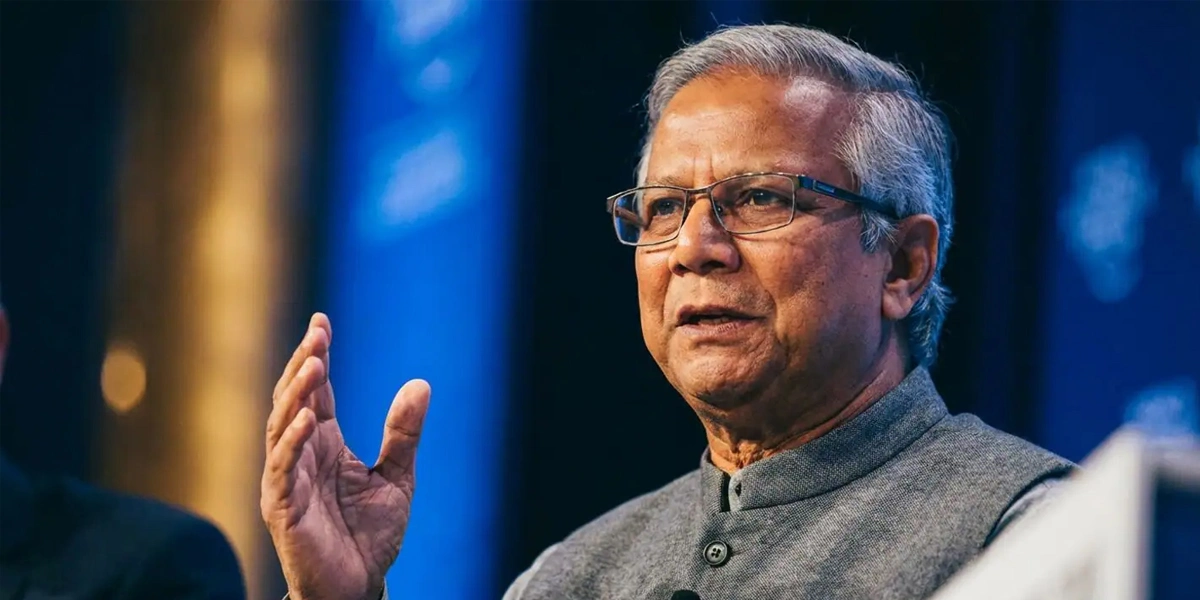
Bangladesh’s outgoing Chief Adviser, Muhammad Yunus, used his farewell address to project a bold and defiant stance abroad, even as his tenure faced domestic criticism for failing to fully restore democratic norms and protect vulnerable minorities. His remarks, delivered amid heightened political sensitivity, included indirect but provocative references to India’s northeastern region.
Yunus, who led the interim government after years of former Prime Minister Sheikh Hasina’s authoritarian rule and institutional challenges, came under scrutiny for inadequate protection of the Hindu minority following the July 2024 unrest.
Anti-India Rhetoric and Regional Assertions
In his address, Muhammad Yunus emphasised Bangladesh’s regained “sovereignty, dignity, and independence” in foreign policy, signalling that the nation would no longer follow external directives. While framed broadly, observers interpreted the remarks as a message to New Delhi, particularly his references to economic integration with Nepal, Bhutan, and India’s “Seven Sisters” northeastern states.
By grouping India’s northeastern states alongside sovereign nations in a single economic vision, Yunus appeared to blur established borders, implying that Bangladesh’s ports and maritime access could play a central role in regional trade. The statement challenged India’s longstanding connectivity initiatives aimed at integrating its northeast, suggesting Dhaka could shape access and economic opportunities for the region.
Strategic Partnerships and China Factor : Muhammad Yunus
Muhammad Yunus highlighted Bangladesh’s strengthening ties with China, Japan, the United States, and Europe, citing progress on Chinese-supported projects, including the Teesta River initiative near India’s Siliguri corridor and a 1,000-bed hospital in Nilphamari. The emphasis on foreign partnerships suggested a shift in Dhaka’s priorities, potentially at odds with Indian security sensitivities.
Military Modernisation and Assertive Tone
The outgoing adviser also mentioned efforts to modernise Bangladesh’s armed forces “to counter any aggression,” underscoring a hardline posture that reinforced the sovereignty-focused narrative of his speech.
Domestic Criticism and Minority Protection
Notably, Muhammad Yunus ’ address did not acknowledge his administration’s failures in addressing communal violence or protecting minority communities. Human rights groups have criticised his tenure for the slow response to attacks on Hindu citizens, vandalism of temples, and selective enforcement of law against extremist elements. The speech instead focused outward, highlighting regional ambitions while avoiding introspection on unresolved domestic challenges.
Legacy and Political Messaging
Yunus’ farewell read as a defensive statement shaped by domestic pressures rather than a unifying conclusion. While asserting Bangladesh’s independence and strategic vision, the Nobel laureate leaves behind lingering questions regarding democratic restoration, minority safety, and the prudence of introducing geopolitical provocations amid internal fragility.